Neural Networks Power Modern AI But Still Baffle Experts
Introduction
Computers used to need exact instructions.
A programmer had to define the rules, write the logic, and tell the machine what to do step by step. That worked for structured tasks, but it struggled with the messy parts of the real world: recognizing faces, understanding speech, translating language, detecting disease, or making sense of patterns too complex for humans to manually describe.
Neural networks changed that.
Instead of following only hand-written rules, neural networks learn from data. They look for patterns, adjust through training, and improve their predictions over time. That shift helped turn artificial intelligence from a narrow rule-following system into a technology that now powers chatbots, image recognition, recommendation engines, medical research, fraud detection, and generative AI tools.
But there is a catch.
The same complexity that makes neural networks powerful also makes them difficult to explain. A model can produce an impressive result while leaving even its creators unsure exactly how it reached that answer.
This guide explains what neural networks are, how they learn, why they became so important, where they show up in real life, and why their inner logic still creates one of the biggest trust problems in modern AI.
Key Takeaways
- Neural networks are machine learning systems that use connected layers to process data and recognize patterns.
- They do not rely only on hand-written rules. They improve by adjusting internal weights during training.
- Their layered structure helps them learn complex patterns in images, language, audio, code, and scientific data.
- Neural network architectures such as convolutional neural networks and transformers helped make modern AI systems more powerful and flexible.
- Their biggest weakness is interpretability. Neural networks can produce useful results while making it difficult to trace exactly how they reached them.
Affiliate Disclosure: Some links on our site are affiliate links. This means that if you click one of these links and make a purchase, we may earn a small commission at no additional cost to you.
What Neural Networks Actually Are
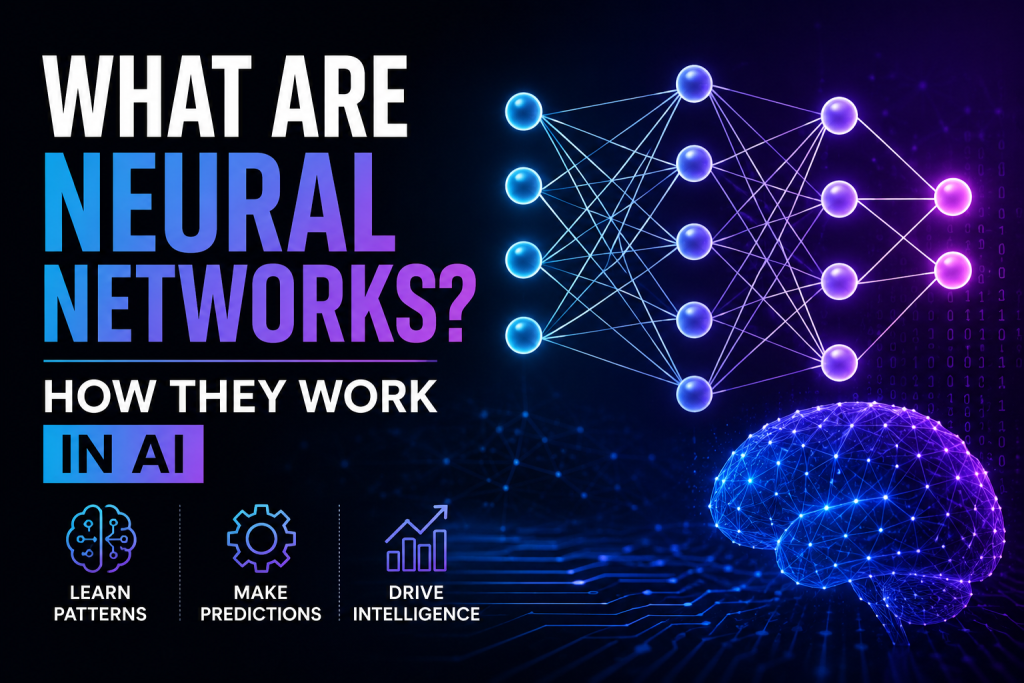
A neural network is a machine learning system that learns patterns from data.
It is made of connected processing units, often called nodes or artificial neurons. These nodes are arranged in layers. Each layer receives information, transforms it, and passes it to the next layer.
The structure is loosely inspired by the human brain, but that comparison has limits. A neural network is not conscious. It does not think, feel, understand, or reason the way a person does. It is a mathematical system designed to find relationships in data.
That is what makes it useful.
A neural network can study thousands, millions, or billions of examples and learn patterns that would be difficult for humans to write as rules. In an image system, it might learn visual patterns. In a language system, it might learn word relationships. In a fraud detection system, it might learn unusual behavior patterns.
The important idea is simple.
A traditional program follows instructions written by people.
A neural network learns from examples.

How Neural Networks Moved AI Beyond Hand-Written Rules
Early software depended on explicit instructions.
If developers wanted a computer to complete a task, they had to write the rules for that task. The system followed those rules exactly. This worked well when the task was predictable, structured, and easy to define.
It worked less well when the task involved messy real-world patterns.
A programmer can write rules for calculating sales tax or sorting a spreadsheet. It is much harder to write every rule that defines a face, a spoken sentence, a suspicious transaction, or an early sign of disease in a medical scan.
Neural networks changed the approach.
Instead of telling the system every rule, developers give it examples. The network studies those examples, makes predictions, measures its errors, and adjusts its internal connections to improve.
That shift is why neural networks became so important.
They made it possible for AI systems to handle problems where the answer depends on patterns that are difficult to describe by hand.
How A Neural Network Learns
A neural network learns by making predictions and correcting itself.
First, the model receives training data. That data might be images, text, audio, numbers, transactions, medical scans, or code. The network processes the input and produces an output, such as a label, prediction, score, or generated response.
At the beginning, the model is usually wrong.
Its internal connections have not been adjusted yet. Those connections are controlled by values called weights. A weight helps determine how strongly one node influences another.
During training, the network compares its output with the correct answer or desired result. If the prediction is wrong, the system calculates the error and adjusts the weights. Over many examples, those small adjustments help the network improve.
This process does not mean the model suddenly understands the world.
It means the model has found patterns that help it perform better on the task it was trained for.
That is why training matters so much. A neural network is only as useful as the data, design, testing, and feedback behind it.
Why Layers Make Neural Networks Powerful
The power of a neural network comes from how its layers build understanding step by step.
The first layers usually detect simple patterns. In an image system, that might mean edges, colors, lines, or basic shapes. Those early patterns are not very meaningful on their own, but they create the foundation for deeper learning.
As the data moves through more layers, the network combines simple patterns into more complex ones.
Edges can become shapes.
Shapes can become objects.
Objects can become faces, road signs, tumors, products, or handwritten numbers.
The same idea applies beyond images. In language, smaller patterns can become grammar, meaning, tone, and context. In fraud detection, small behavior signals can combine into a larger risk pattern.
This layered structure is why neural networks can handle complex data.
They do not need every pattern to be defined manually. They can learn useful representations from the data itself, then use those representations to make predictions or generate outputs.
The Architectures Behind Modern AI
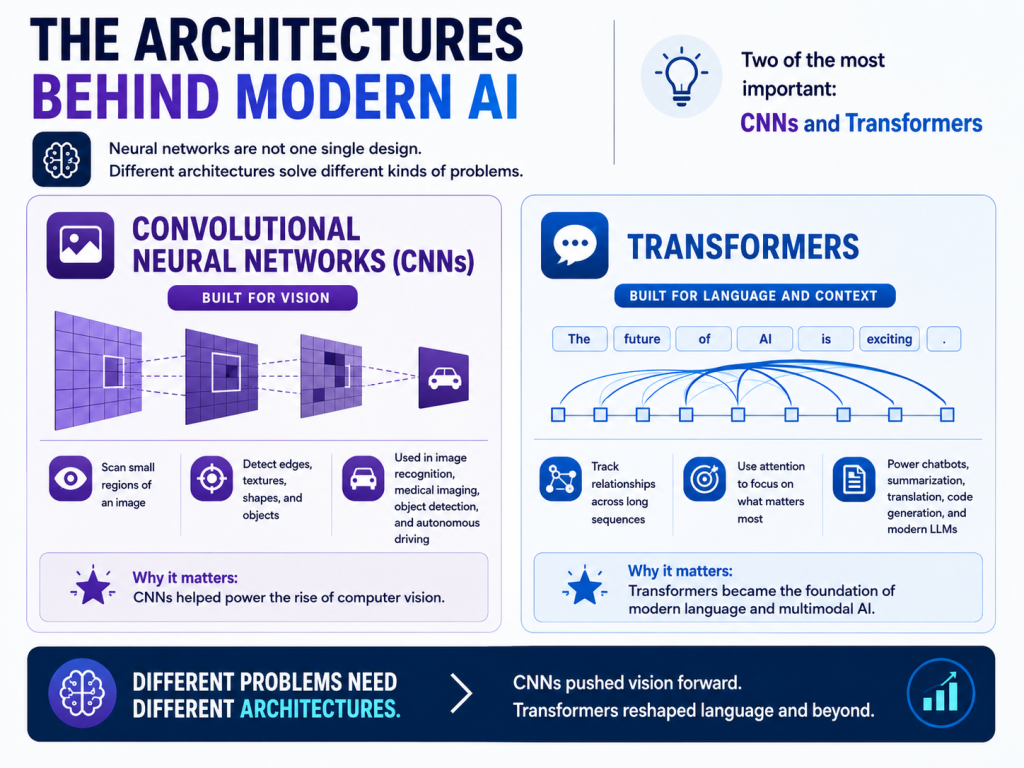
Neural networks are not one single design.
Different architectures are built for different kinds of problems. Some are better at images. Some are better at language. Some are better at sequences, signals, recommendations, or large-scale pattern recognition.
Two of the most important architectures are convolutional neural networks and transformers.
Convolutional Neural Networks
Convolutional Neural Networks, or CNNs, became especially important in computer vision.
They are designed to process visual data by looking for patterns across small regions of an image. This makes them useful for detecting edges, shapes, textures, objects, and more complex visual features.
CNNs helped drive progress in image recognition, facial recognition, medical imaging, object detection, and autonomous vehicle perception.
Their strength is that they can learn visual patterns without requiring humans to write every rule for what an object looks like.
Transformers
Transformers became one of the most important architectures behind modern AI.
They are especially powerful for language because they can track relationships across long sequences of text. Instead of treating every word in isolation, a transformer can weigh how different words or tokens relate to one another across the full context.
That ability comes from attention.
Attention helps the model focus on the parts of the input that matter most. This is why transformer-based systems can write coherent paragraphs, summarize long documents, translate languages, generate code, and power many modern Large Language Models.
The transformer architecture was introduced in the 2017 paper “Attention Is All You Need”, which described the attention-based approach that became central to many of today’s most capable AI systems.
Where Neural Networks Show Up In Real Life
Neural networks are not just research concepts.
They already sit behind many tools people use every day.
They help voice assistants recognize speech. They help translation tools convert one language into another. They help recommendation systems decide which videos, products, songs, or articles to show next.
They also power many generative AI tools, including systems that write text, create images, generate code, summarize documents, and answer questions.
In business, neural networks can support fraud detection, demand forecasting, customer service, document processing, and risk analysis.
In healthcare, they can help analyze medical images, identify patterns in patient data, and support research into diseases and treatments.
In transportation, they help autonomous and driver-assistance systems interpret cameras, sensors, lanes, signs, and surrounding objects.
The common thread is pattern recognition.
Neural networks are useful when the data is complex, the patterns are hard to write by hand, and the system has enough examples to learn from.
Why Neural Networks Are So Hard To Explain
Neural networks can produce impressive results without giving clear reasons for how they reached them.
That is the black box problem.
The issue is not that engineers know nothing about the system. They understand the architecture, the training process, the data pipeline, and the math behind the model. The problem is that the final decision often comes from complex interactions across many layers, weights, and learned patterns.
A neural network does not usually make a decision through one clean rule.
It may rely on thousands or millions of tiny signals working together. Some of those signals may be meaningful. Others may be difficult to interpret. In large models, the reasoning path can become so distributed that no single person can easily point to one cause and say, “This is exactly why the model gave that answer.”
That opacity matters most when the stakes are high.
If a neural network recommends a movie, a mistake may not matter much. If it helps evaluate a medical scan, flag a financial transaction, screen a job application, or guide a safety system, people need more than a prediction. They need a way to question, audit, and understand the result.
This is why interpretability is one of the central challenges in modern AI.
A model can be accurate and still be hard to trust if no one can explain its decision clearly. Computer scientist Cynthia Rudin has argued that black box models are especially risky in high-stakes decisions because accuracy alone is not enough when people also need transparency and accountability.

The Risks Behind Powerful But Opaque Systems
The problem with neural networks is not simply that they can make mistakes.
Every system can make mistakes.
The problem is that neural networks can make mistakes in ways that are hard to see, explain, or challenge.
One risk is bias. Neural networks learn from data, and data often reflects the world as it is, not the world as it should be. If the training data contains unequal representation, historical bias, or flawed labels, the model can learn those patterns and repeat them.
Another risk is overtrust. A neural network can produce an output that looks precise, even when the reasoning behind it is unclear. That can make people treat a prediction as more reliable than it deserves.
There is also the risk of weak accountability. If a model affects a hiring decision, credit decision, diagnosis, insurance review, or safety process, people need to know who is responsible when the system gets it wrong.
This is why neural networks require more than technical performance.
They need testing, monitoring, human review, and clear limits. The more important the decision, the more important those safeguards become.
NIST identifies harmful bias, privacy risk, information integrity, and accountability concerns as major issues for AI systems, especially when they are used in settings where errors can affect people’s rights, safety, or opportunities.
How To Think About Neural Networks Going Forward
Neural networks should not be treated as magic.
They should also not be dismissed as hype.
They are pattern-learning systems that can be extremely useful when the task, data, and safeguards are well matched. They can help people find signals in complex information, automate repetitive analysis, improve recommendations, support research, and make software more adaptive.
But their power has limits.
A neural network does not automatically know whether its output is fair, safe, accurate, or appropriate. It does not understand responsibility. It does not know the human consequences of a wrong prediction unless people design systems around that risk.
That means the future of neural networks depends on more than larger models.
It depends on better data, stronger evaluation, clearer oversight, and more interpretable systems. It also depends on people knowing when to trust a model, when to question it, and when a human decision should remain in control.
The goal is not to make neural networks seem less impressive.
The goal is to use them with enough clarity to make their strengths useful and their limits visible.
Conclusion
Neural networks changed artificial intelligence by changing how machines learn.
Instead of depending only on hand-written rules, they can study examples, detect patterns, adjust through training, and improve their predictions over time. That shift helped make modern AI possible, from image recognition and translation to chatbots, medical research, fraud detection, and generative tools.
But the same structure that makes neural networks powerful also makes them difficult to fully explain.
Their decisions can emerge from complex interactions across layers, weights, and training patterns. That can make a system useful and accurate in one setting, while still raising serious questions about trust, bias, accountability, and oversight.
The real lesson is not that neural networks are mysterious machines we should blindly trust.
It is that they are powerful pattern-learning systems that work best when people understand both sides of the technology: what it can reveal, and what it can hide.
Frequently Asked Questions
What Is A Neural Network?
A neural network is a machine learning system that uses connected layers to process data and recognize patterns.
It is loosely inspired by the structure of the brain, but it is not conscious or human-like. It is a mathematical model that learns from examples.
How Does A Neural Network Learn?
A neural network learns by making predictions, measuring its errors, and adjusting internal values called weights.
Over many training examples, those adjustments help the network improve its performance on a specific task.
Are Neural Networks The Same As The Human Brain?
No. Neural networks are loosely inspired by biological brains, but they do not think, feel, understand, or experience the world. They use math and data to detect patterns and produce outputs.
What Are Neural Networks Used For?
Neural networks are used in image recognition, speech recognition, translation, recommendation systems, fraud detection, medical imaging, autonomous vehicle perception, chatbots, and generative AI tools.
They are especially useful when the data is complex and the patterns are difficult to define by hand.
What Is The Difference Between A Neural Network And Deep Learning?
A neural network is the model structure.
Deep learning is a type of machine learning that uses neural networks with multiple layers. The “deep” refers to the number of layers the data passes through.
Why Are Neural Networks Hard To Explain?
Neural networks are hard to explain because their outputs often come from complex interactions across many layers, weights, and learned patterns.
A model may produce a useful result, but it can be difficult to trace exactly which signals caused that result.
Are Neural Networks Safe?
Neural networks can be safe when they are used in well-tested, well-monitored systems with clear limits.
They become riskier in high-stakes settings where errors affect people’s health, rights, finances, safety, or opportunities. In those cases, human oversight, auditing, and accountability are essential.

Leave a Reply