What Is Retrieval-Augmented Generation (RAG)?
Introduction
Large Language Models can answer questions in seconds.
The problem is that a fluent answer is not always a reliable one. A model may be working from outdated training data, missing context, or broad patterns that do not match the exact information the user needs.
Retrieval-Augmented Generation, or RAG, helps solve that problem.
Instead of asking the model to rely only on what it learned during training, RAG gives it a way to retrieve relevant information before it responds. That information might come from documents, websites, research papers, manuals, databases, notes, or other approved sources.
The model then uses that material as context when generating its answer.
This can make the response more current, more specific, and easier to verify. It can also help AI answer questions about information that was never part of its original training data.
But RAG does not turn AI into a truth machine.
The system can still retrieve the wrong passage, misunderstand the evidence, or generate a conclusion the source does not support.
This guide explains what RAG is, how it works, where it is used, what it improves, and why better retrieval still does not remove the need for judgment.
Key Takeaways
- Retrieval-Augmented Generation, or RAG, gives an AI model access to external information before it generates an answer.
- RAG is useful when the answer depends on current, private, specialized, or source-specific information.
- A RAG system retrieves relevant passages, adds them to the model’s context, and then asks the model to answer using that material.
- RAG can make answers more grounded and easier to verify, but it does not eliminate hallucinations or poor reasoning.
- Reliable RAG depends on accurate sources, strong retrieval, visible references, and careful testing.
Affiliate Disclosure: Some links on our site are affiliate links. This means that if you click one of these links and make a purchase, we may earn a small commission at no additional cost to you.
What RAG Actually Is
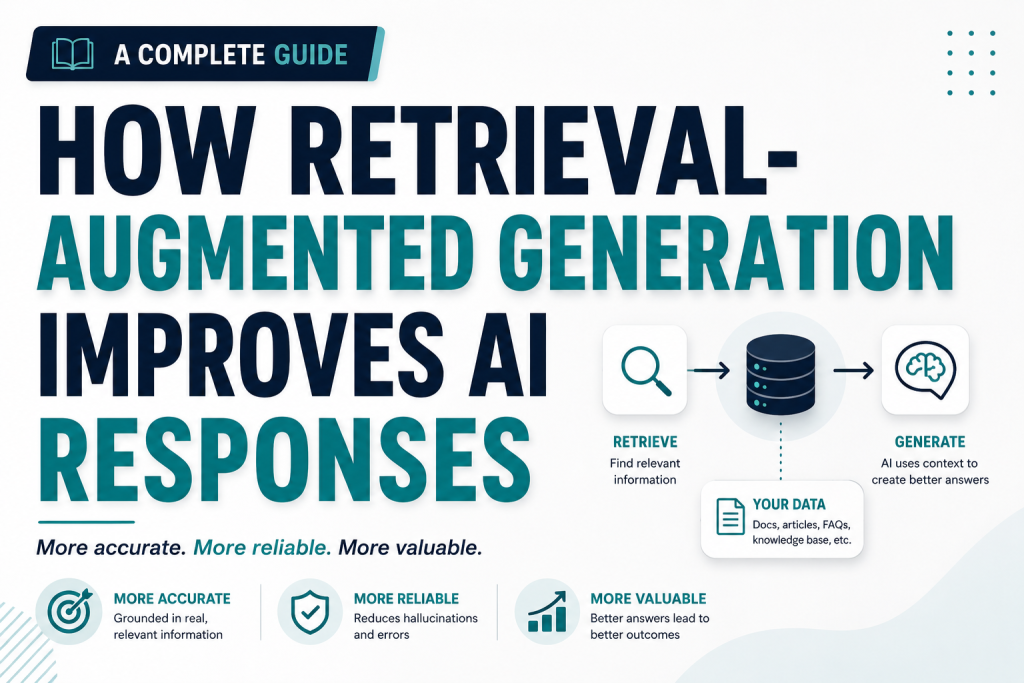
RAG stands for Retrieval-Augmented Generation.
The name describes the process.
Retrieval means the system searches for information related to the user’s question.
Augmented means that information is added to the context given to the AI model.
Generation means the model uses that context to produce an answer.
A standard Large Language Model responds using patterns learned during training and whatever information appears in the prompt. A RAG system adds another step by retrieving relevant material before the model answers.
That material may come from documents, websites, databases, research papers, manuals, notes, or another defined source collection.
The model is usually not retrained when new information is added.
Instead, the system searches for the most relevant passages at the moment a question is asked. Those passages are placed into the model’s working context, giving it evidence it can use while generating the response.
The simplest distinction is this:
A standard LLM answers from its training and prompt.
A RAG system retrieves relevant evidence before answering.
Why Language Models Need Retrieval
Large Language Models are trained on broad collections of text.
That gives them wide general knowledge, but it also creates clear limits. A model may understand a topic without having access to the exact source needed to answer one specific question.
The missing information might be recent.
It might be private.
It might belong to a specialized field.
It might exist in a document the model has never seen.
That is why a language model can give a polished answer and still miss the detail that matters most.
A model may understand how a return policy usually works, but not the policy published on one website. It may understand a scientific topic, but not the findings in a newly released paper. It may know general legal language, but not the contents of a specific contract.
Training data also becomes outdated.
When information changes after training, the model does not automatically update itself. New laws, revised policies, product changes, research findings, and current events may fall outside what it learned.
Retrieval gives the model a way to reach beyond those limits.
Instead of relying only on stored patterns, the system can search for the information that applies to the question and use it as evidence while generating the answer.
How RAG Works Step By Step
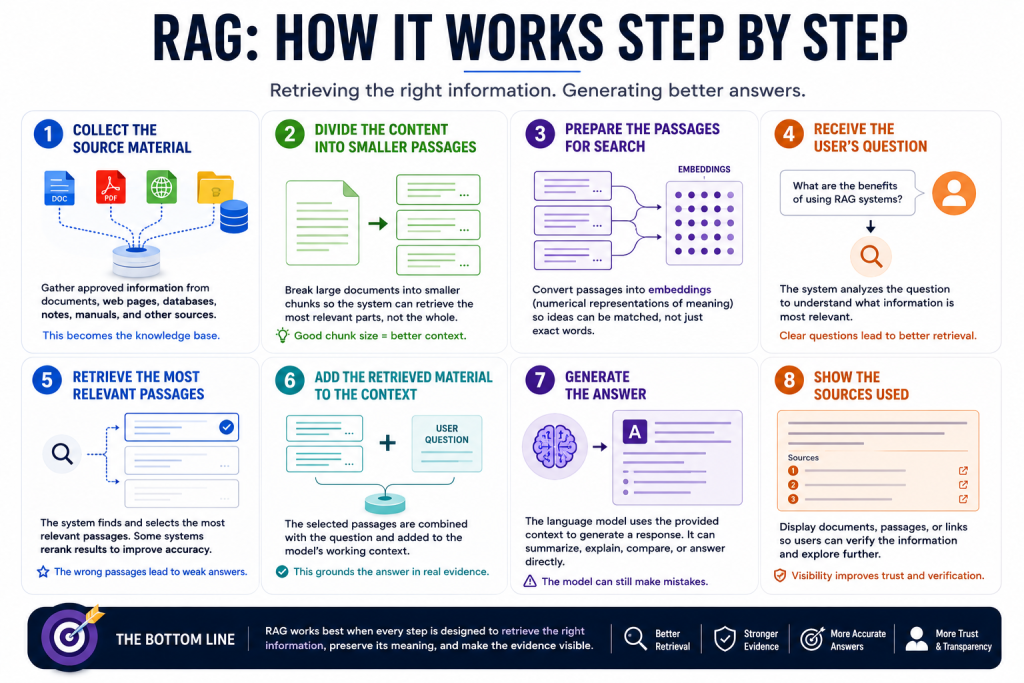
RAG works by adding a retrieval process before the language model generates an answer.
Each stage has a specific role. The quality of the final response depends on how well the system handles every step.
Step 1: Collect The Source Material
The process begins with a defined set of information.
This might include documents, webpages, research papers, manuals, notes, databases, or other approved sources.
These sources become the knowledge base the system can search.
Step 2: Divide The Content Into Smaller Passages
Large documents are usually broken into smaller sections, often called chunks.
This helps the system retrieve the most relevant part of a source instead of sending an entire document to the model.
The size and structure of these passages matter. If they are too large, they may include irrelevant information. If they are too small, important context may be lost.
Step 3: Prepare The Passages For Search
The passages are converted into a format the retrieval system can search.
Many RAG systems use embeddings.
An embedding is a numerical representation of meaning. It allows the system to compare ideas and concepts, not just exact words.
This means a question can still match a passage even when the wording is different.
Step 4: Receive The User’s Question
The retrieval process begins when the user asks a question.
The system analyzes the question and determines what information is most relevant to the request.
A clear question usually leads to stronger retrieval.
Step 5: Retrieve The Most Relevant Passages
The system compares the question with the stored passages.
It then selects the sections that appear most relevant.
Some systems also rerank the results to improve the order and remove weak matches.
This is one of the most important stages in the process. If the wrong passage is retrieved, the model may produce a polished answer based on weak evidence.
Step 6: Add The Retrieved Material To The Context
The selected passages are placed into the model’s working context.
The original question is included with them.
This gives the model access to information it may not have learned during training and helps ground the response in specific evidence.
Step 7: Generate The Answer
The language model uses the retrieved material to produce a response.
It may summarize the evidence, explain it, compare sources, or answer the question directly.
The model is still generating language, so it can still misunderstand the material or add unsupported claims.
Step 8: Show The Sources Used
A well-designed RAG system may display the documents, passages, or links behind the answer.
This allows the user to check whether the response reflects the source accurately.
Source visibility does not guarantee correctness, but it makes the answer easier to verify.
Each stage matters.
If the source material is poor, the passages are divided badly, or the retrieval system selects weak evidence, the final answer may still be unreliable.
RAG works best when the full process is designed to retrieve the right information, preserve its meaning, and make the supporting evidence visible.
What Happens During Retrieval
Retrieval is the part of RAG that decides which information the model gets to see.
That makes it one of the most important parts of the system.
If retrieval works well, the model receives relevant evidence. If retrieval works poorly, the model may answer from incomplete, weak, or misleading context.
Chunking
Documents are usually divided into smaller sections called chunks.
A chunk might be a paragraph, a page, a group of sentences, or another meaningful unit of text.
The goal is to make each section small enough to search precisely but large enough to preserve context.
Poor chunking can damage the answer.
A chunk that is too short may separate a fact from the explanation that gives it meaning. A chunk that is too long may contain so much information that the useful part becomes difficult to identify.
Embeddings
Many RAG systems convert each chunk into an embedding.
An embedding is a numerical representation of meaning.
It helps the system recognize that two passages are related even when they use different words.
For example, a question about “ending a subscription” may match a document that uses the phrase “account cancellation.” The words are different, but the meaning is similar.
Semantic Search
Semantic search looks for passages with similar meaning to the user’s question.
This is different from traditional keyword search, which focuses mainly on matching exact words.
Semantic search is useful when the source and the question describe the same idea in different language.
But similarity does
How RAG Changes The Answer
RAG changes the answer by changing what the model has access to before it responds.
Without retrieval, a language model relies on patterns learned during training and the information included in the user’s prompt.
With retrieval, the model receives additional context from selected sources.
That can make the answer more specific.
Instead of responding with general knowledge, the model can use the exact policy, research finding, document passage, or record related to the question.
It can also make the answer more current.
If the connected source has been updated, the model can use that newer information even if it was not part of the original training data.
RAG can also make the answer easier to verify.
When the system shows the documents or passages it retrieved, the user can compare the response with the source material.
That changes the role of the model.
The model is no longer answering only from learned patterns. It is generating a response from a combination of its language ability and the evidence placed in its context.
But the answer is still generated.
The model may summarize the source incorrectly, overlook an important detail, combine passages in a misleading way, or add a claim that the evidence does not support.
That is why RAG should not be described as a system that gives guaranteed facts.
A better description is this:
RAG gives the model better evidence.
Whether the final answer is reliable still depends on how well the system retrieves, interprets, and presents that evidence.
Where RAG Is Used
RAG is useful wherever an AI system needs to answer from a specific body of information.
That information might be public, private, current, specialized, or too large to place into a prompt manually.
AI Search Engines
Some AI search tools use retrieval to find relevant webpages before generating a direct answer.
Instead of returning only a list of links, the system combines information from selected sources and may show where the answer came from.
Document Question-And-Answer Tools
RAG can be used to ask questions about reports, manuals, contracts, notes, transcripts, or collections of files.
The system searches the documents for relevant passages, then uses those passages to generate a response.
Research Assistants
Research tools can use RAG to search papers, reports, datasets, or other source collections.
This can help users compare findings, locate evidence, summarize material, or identify where a claim appears.
The sources still need to be reviewed, especially when the topic is technical or high stakes.
Educational Tools
RAG can connect an AI assistant to textbooks, course materials, lecture notes, or approved learning resources.
This allows the system to answer questions using the material being studied rather than relying only on general model knowledge.
Customer Support Systems
Support tools can retrieve product information, troubleshooting guides, policies, and help-center articles before suggesting an answer.
This can make responses more consistent with the available documentation.
Legal And Compliance Tools
RAG can help search contracts, policies, regulations, case files, or legal research.
It can surface relevant passages and prepare summaries, but professional review remains necessary when the answer may affect rights, obligations, or legal decisions.
Healthcare And Scientific Tools
RAG can retrieve approved clinical guidance, medical literature, research papers, or scientific documentation.
Because errors can have serious consequences, these systems require strict source control, testing, and expert oversight.
Personal Knowledge Assistants
A personal RAG system can search notes, saved articles, transcripts, journals, or files.
This can make it easier to retrieve information from a large personal archive without remembering the exact wording or location.
AI Agents
AI agents can use RAG before taking action.
An agent may retrieve instructions, policies, account history, technical documentation, or current records before deciding what step to take next.
This makes retrieval especially important in agentic systems, where weak information can lead to more than a weak answer.
Across these uses, the pattern is the same.
The answer needs to come from a defined source collection, and the user benefits from receiving a direct response without searching every document manually.
RAG Vs. Search, Fine-Tuning, And Long Context
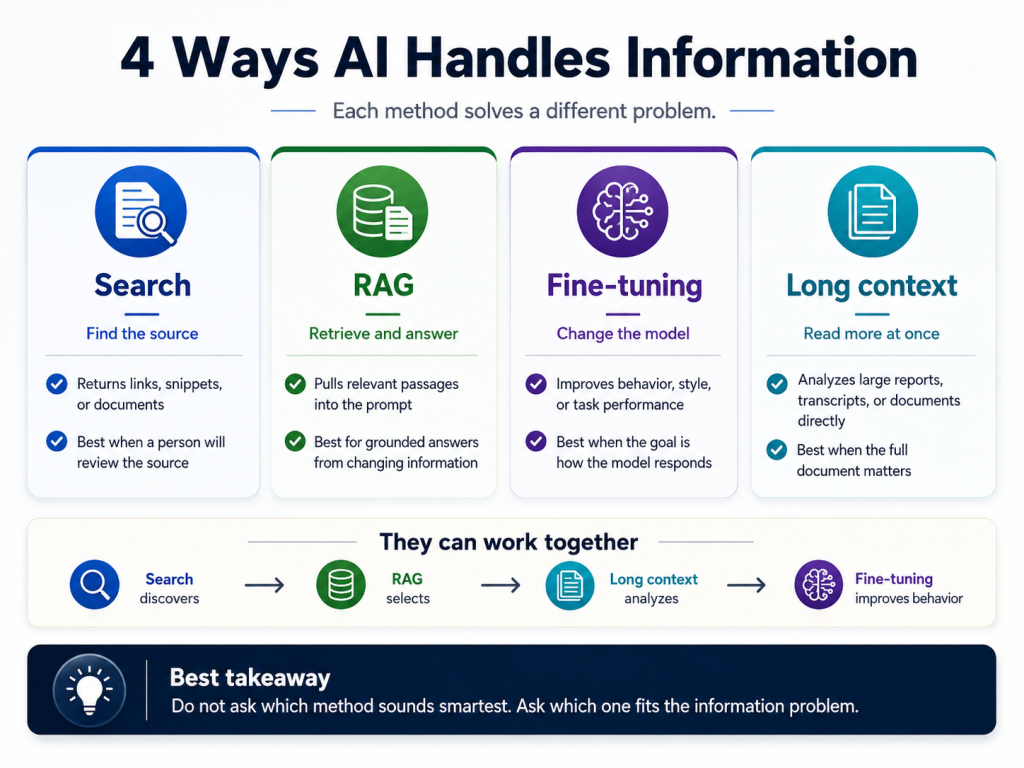
RAG is often compared with search, fine-tuning, and long-context models because all four approaches help AI work with information.
They solve different problems.
RAG Vs. Traditional Search
Traditional search helps users find documents, webpages, or records.
It usually returns links, titles, snippets, or ranked results. The user then opens the source and interprets the information.
RAG adds a generation step.
The system retrieves relevant material, places it into the model’s context, and produces a direct answer based on that evidence.
Search helps you find the information.
RAG helps an AI explain or use the information after finding it.
That convenience creates a tradeoff. A generated answer may be faster to read, but it can also misrepresent the source. The underlying documents still matter.
RAG Vs. Fine-Tuning
Fine-tuning changes the model.
It involves additional training that adjusts the model’s behavior, style, task performance, or response patterns.
RAG usually leaves the model unchanged.
Instead of teaching the model new information permanently, it retrieves relevant information when the user asks a question.
Fine-tuning is useful when the goal is to change how a model behaves.
RAG is useful when the goal is to give the model access to specific or changing information.
The two approaches can also work together. A fine-tuned model may follow a task more effectively, while RAG provides the evidence needed to answer accurately.
RAG Vs. Long-Context Models
Long-context models can process large amounts of information inside one prompt.
A user might provide an entire report, transcript, contract, or collection of documents and ask the model to analyze it directly.
RAG takes a more selective approach.
Instead of sending everything to the model, the retrieval system searches the source collection and adds only the passages that appear most relevant.
Long context can be useful when the full document matters or when important information is spread across many sections.
RAG can be more efficient when the source collection is large and only a small part is needed for each question.
Neither method is automatically better.
The right choice depends on the amount of information, the kind of question, the cost of processing, and whether the system can reliably identify the passages that matter.
These Methods Can Work Together
Search, fine-tuning, long context, and RAG are not always competing options.
A system might use search to discover sources, RAG to retrieve the strongest passages, long context to analyze a larger document, and fine-tuning to improve how the model follows instructions.
The important question is not which method sounds most advanced.
It is which method solves the actual information problem.
What RAG Does Not Fix
RAG can improve the information available to a language model, but it does not solve every weakness in the system.
It does not guarantee that the retrieved source is correct.
If the connected documents are outdated, incomplete, biased, or contradictory, the model may generate an answer based on weak evidence.
RAG also does not guarantee that the right passage will be found.
The system may retrieve information that shares similar wording but does not actually answer the question. It may also miss a relevant section because the document was divided poorly, labeled incorrectly, or stored without useful metadata.
Even when the correct evidence is retrieved, the model can still misunderstand it.
It may summarize the passage inaccurately, overlook an exception, combine unrelated details, or add a conclusion that the source does not support.
RAG does not remove hallucinations either.
It can reduce them by grounding the response in source material, but the model is still generating language. It can still introduce unsupported claims or present uncertainty as confidence.
Privacy and access problems also remain.
A retrieval system connected to restricted information must control who can search, view, or use that content. RAG should not become a way to bypass existing permissions.
The main limit is simple.
RAG improves the model’s evidence.
It does not guarantee that the system will retrieve, interpret, or present that evidence correctly.
Why RAG Systems Still Fail
RAG systems fail when one part of the retrieval pipeline breaks down.
The language model is only the final step. Before it answers, the system has to prepare the sources, search them correctly, choose the right passages, and pass enough context to the model.
A weakness at any stage can damage the final response.
The Right Document Is Never Retrieved
The system may fail to find the source that actually contains the answer.
This can happen when the document was not added to the knowledge base, the file was indexed incorrectly, or the retrieval method does not recognize the connection between the question and the source.
If the right evidence never reaches the model, the model cannot use it.
The Retrieved Passage Is Related But Not Relevant
A passage may share keywords or discuss the same general topic without answering the specific question.
For example, a system may retrieve a general refund policy when the question concerns an exception for damaged products.
The result may look relevant at first, but it lacks the detail needed for an accurate answer.
Important Context Is Split Across Chunks
The answer may depend on information spread across several parts of a document.
One chunk may contain the rule. Another may contain the exception. A third may explain when the exception applies.
If the system retrieves only one section, the model may produce an incomplete or misleading response.
Too Much Irrelevant Context Is Added
More information does not always produce a better answer.
If the system sends too many weak passages to the model, the useful evidence can become buried inside noise.
The model may focus on the wrong detail, combine unrelated passages, or struggle to identify which source matters most.
The Model Ignores The Best Evidence
Even when the retrieval system finds the correct passage, the language model may not use it properly.
It may rely on a weaker source, follow a familiar language pattern, or generate an answer that reflects its general training more than the retrieved evidence.
Retrieval improves the context, but it does not force perfect interpretation.
The Sources Conflict
A knowledge base may contain different versions of the same policy, outdated documents, or sources that disagree.
Without clear metadata or ranking rules, the system may retrieve conflicting evidence and generate an answer that blends incompatible information.
This is why version control and source quality matter.
The Model Adds Unsupported Claims
A model may begin with retrieved evidence and then add details that were never present in the source.
The final answer can sound complete while quietly moving beyond what the evidence supports.
This is one of the most important failure modes because the response may include citations that appear trustworthy even though the cited source does not support every claim.
RAG systems do not fail for one single reason.
They fail when retrieval, source quality, context selection, or generation is weaker than it appears.

What Makes A RAG System Reliable
A reliable RAG system does more than connect a language model to a collection of documents.
It has to retrieve the right information, preserve the meaning of that information, and make it clear when the evidence is weak or incomplete.
Accurate And Current Sources
The source material needs to be trustworthy.
Outdated files, duplicate documents, conflicting versions, and weak content can undermine the system before retrieval even begins.
A reliable RAG system depends on sources that are accurate, current, and clearly maintained.
Clear Document Structure
Documents should be organized in a way that preserves meaning.
Headings, sections, labels, dates, and version information help the retrieval system understand what each passage is about and when it should be used.
Poorly structured content makes accurate retrieval harder.
Effective Chunking
Chunks should be small enough to retrieve precisely but large enough to preserve context.
The right chunk size depends on the source material and the type of questions users ask.
A legal clause, product instruction, research finding, or policy exception may each require a different level of context.
Strong Retrieval
The system needs to find passages that truly answer the question.
That may require a combination of semantic search, keyword search, metadata filters, and reranking.
Retrieval quality should be tested with real questions, not assumed from a few successful examples.
Useful Metadata
Metadata helps the system distinguish between sources.
Dates, authors, document types, topics, versions, and access levels can improve filtering and ranking.
This is especially important when the knowledge base contains similar or conflicting material.
Source Visibility
Users should be able to see which sources support the answer.
That may include links, document names, quoted passages, or references to specific sections.
Visible sources make it easier to verify the response and identify when the evidence does not match the answer.
Clear Permission Controls
A RAG system should only retrieve information the user is allowed to access.
Public documents, private notes, restricted records, and sensitive files should not be treated as one open collection.
Access rules need to remain active throughout the retrieval process.
Real-World Evaluation
The system should be tested with the kinds of questions people will actually ask.
Evaluation should check whether the right source was retrieved, whether the answer reflects the evidence, and whether the system handles uncertainty correctly.
A polished answer is not enough.
Ongoing Monitoring
RAG systems need regular review.
Teams should look for failed searches, unsupported claims, outdated sources, repeated questions, and cases where the system retrieves weak evidence.
That feedback helps improve the knowledge base, retrieval logic, and answer quality over time.
A reliable RAG system is not defined by the model alone.
It is defined by the quality of the sources, the strength of the retrieval process, and the system’s ability to show where the answer came from.
How RAG Supports AI Agents
AI agents need reliable information before they can take useful action.
A language model can help an agent interpret a goal, plan steps, and generate responses. But the model may not know the current facts, instructions, records, or rules needed to complete the task correctly.
RAG gives the agent a way to retrieve that information first.
Retrieving Instructions Before Acting
An agent may need to check a policy, manual, procedure, or set of instructions before deciding what to do.
For example, an agent handling a support request might retrieve the latest return policy before preparing a response. A coding agent might search technical documentation before changing a file.
This helps ground the action in a defined source instead of relying only on general model knowledge.
Using Current And Specific Information
Agents often work with information that changes.
Account records, product details, schedules, policies, and system status may all be updated after the model was trained.
RAG allows the agent to retrieve the information that applies at the moment the task is performed.
That makes the action more relevant, but not automatically correct.
Giving Context To Multi-Step Workflows
An agent may need different information at different stages of a task.
It might retrieve one source to understand the request, another to choose the next step, and a third to confirm whether the action succeeded.
RAG can provide context throughout the workflow instead of only at the beginning.
Supporting Decisions With Evidence
When an agent must choose between actions, retrieved evidence can help guide the decision.
The system may compare instructions, records, or source material before deciding whether to continue, pause, escalate, or ask for approval.
This can make the workflow more transparent when the retrieved sources are visible.
Increasing The Risk Of Bad Retrieval
RAG becomes more important when AI can act because a retrieval error may lead to more than a weak answer.
If a chatbot retrieves the wrong policy, it may give incorrect information.
If an agent retrieves the wrong policy and then processes a request, updates a record, or sends a message, the mistake can move into the real workflow.
That is why agentic systems need strong retrieval, limited permissions, clear approval points, and a way to stop when the evidence is missing or uncertain.
RAG helps AI agents move from general knowledge to context-aware action.
But the more authority an agent has, the more carefully its sources, access, and decisions need to be controlled.
What To Consider Before Using RAG
RAG is most useful when the answer needs to come from a specific body of information.
It is not necessary for every AI task.
Before using RAG, the first question is whether retrieval solves a real problem.
Does The Answer Depend On A Specific Source?
RAG is a strong fit when the response should come from defined material.
That might include documents, research papers, manuals, policies, notes, records, websites, or other approved sources.
If the question can be answered well from general knowledge, retrieval may add unnecessary complexity.
Does The Information Change Often?
RAG is useful when the source material is updated regularly.
New research, revised documents, current records, product changes, and updated guidance may not appear in the model’s training data.
Retrieval gives the system access to newer information without retraining the model.
Is The Source Collection Reliable?
The system cannot retrieve trustworthy evidence from an unreliable collection.
Before connecting documents, check whether they are accurate, current, complete, and free from unnecessary duplication or conflict.
RAG can make information easier to access, but it cannot repair weak source material on its own.
Should Users Be Able To Verify The Answer?
If accuracy matters, the system should show where the answer came from.
Visible sources allow users to compare the response with the supporting evidence.
This is especially important when the question involves research, legal information, healthcare, policy, finance, or another high-stakes subject.
Is Any Information Private Or Restricted?
A RAG system may search sensitive material.
That creates questions about who can access which sources, what information can appear in an answer, and how permissions are enforced.
Private and public content should not be treated as one open collection.
What Should Happen When Evidence Is Missing?
A good RAG system needs a clear response when it cannot find enough information.
It should not automatically fill the gap with a confident guess.
Depending on the use case, the system may need to say that the answer is unavailable, ask for clarification, retrieve more information, or send the question for review.
How Serious Would A Wrong Answer Be?
The level of oversight should match the risk.
A weak answer in a casual knowledge tool may cause little harm. A weak answer involving health, legal rights, financial decisions, safety, or private records may have serious consequences.
The higher the stakes, the stronger the testing, verification, and human review should be.
RAG is valuable when it improves access to evidence that already matters.
It should be used because retrieval makes the answer more useful, not because adding retrieval makes the system sound more advanced.

Conclusion
RAG gives AI systems a way to retrieve relevant information before generating an answer.
That makes language models more useful when the response depends on current, private, specialized, or source-specific knowledge.
But retrieval does not remove uncertainty.
A RAG system can still retrieve the wrong passage, rely on weak sources, miss important context, or generate a conclusion the evidence does not support. The quality of the final answer depends on the entire process, from source preparation and retrieval to generation and verification.
The value of RAG is not that it makes AI infallible.
It makes AI more grounded.
When the sources are reliable, the retrieval is strong, and the evidence is visible, RAG can help move AI away from plausible guessing and closer to answers that users can inspect and verify.
Frequently Asked Questions
What Does RAG Stand For In AI?
RAG stands for Retrieval-Augmented Generation.
It is a method that allows an AI system to retrieve relevant information from external sources before generating an answer.
How Does RAG Work?
RAG works by searching a defined collection of information, retrieving the passages most relevant to the user’s question, and adding those passages to the model’s context.
The language model then uses that material to generate a response.
Does RAG Stop AI Hallucinations?
No. RAG can reduce hallucinations by giving the model stronger evidence, but it cannot eliminate them. The system can still retrieve the wrong passage, misunderstand the source, or add claims the evidence does not support.
What Is RAG Used For?
RAG is used in AI search tools, document question-and-answer systems, research assistants, educational tools, support systems, legal and healthcare applications, personal knowledge assistants, and AI agents.
It is most useful when the answer should come from a specific body of information.
Is RAG The Same As A Search Engine?
No. A search engine usually returns links, documents, or ranked results.
A RAG system retrieves information and then uses a language model to generate a direct answer from the retrieved material.
Is RAG The Same As Fine-Tuning?
No. Fine-tuning changes the model through additional training.
RAG leaves the model largely unchanged and gives it external information at the time a question is asked.
Does RAG Require A Vector Database?
Not always. Vector databases are commonly used because they make it easier to search embeddings by meaning, but RAG can also use keyword search, traditional databases, search indexes, or a combination of retrieval methods.
Can RAG Use Information From The Internet?
Yes. A RAG system can retrieve information from webpages, search results, databases, documents, or other connected sources.
It can also be limited to a private or controlled collection of information.
Can RAG Give A Wrong Answer?
Yes. The source may be inaccurate, the wrong passage may be retrieved, or the model may misinterpret the evidence.
RAG improves access to information, but it does not guarantee a correct response.
How Can You Tell Whether A RAG Answer Is Reliable?
Check whether the answer includes visible sources, whether those sources are relevant, and whether they actually support the claims being made.
A reliable system should also handle missing evidence clearly instead of filling gaps with confident guesses.
Leave a Reply