Large Language Models Explained: Why AI Still Makes Things Up
Introduction
Large Language Models can draft emails, write code, summarize research, answer questions, translate text, and turn a rough idea into something usable in seconds.
They can also invent facts with complete confidence.
That contradiction is what makes Large Language Models so important to understand. They are not simple chatbots, and they are not digital minds. They are powerful AI systems trained to recognize and generate patterns in language.
This is why they can feel so useful and so unreliable at the same time.
To use them well, you need to understand what they actually are, how they generate answers, why they make things up, and where human judgment still matters. This guide breaks down the promise and the limits of LLMs without treating them like magic or dismissing them as hype.
Key Takeaways
- Large Language Models are AI systems trained to process and generate human-like language.
- LLMs do not understand information the way humans do. They predict likely language patterns based on training data, context, and probability.
- Their strength is flexibility. The same model can help with writing, coding, summarizing, translation, research, customer support, and analysis.
- Their biggest weakness is reliability. LLMs can produce answers that sound polished but are false, outdated, biased, or unsupported.
- The safest way to use LLMs is with controlled trust. They are useful for drafts, ideas, summaries, and assistance, but important claims still need human review.
Affiliate Disclosure: Some links on our site are affiliate links. This means that if you click one of these links and make a purchase, we may earn a small commission at no additional cost to you.
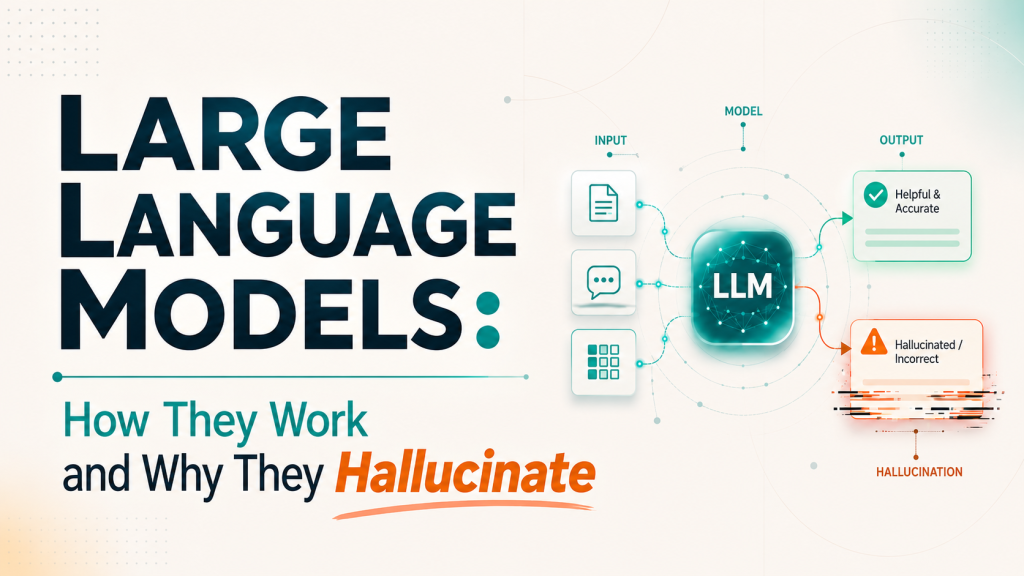
What Large Language Models Actually Are
A Large Language Model is an AI system trained to process and generate language.
It learns from massive amounts of text, then uses those patterns to produce responses that sound natural, useful, and human-like.
The word large refers to the scale of the model. LLMs are trained on enormous datasets and use many internal parameters to recognize patterns across words, phrases, sentences, code, and documents.
The word language matters because these models are built around text. Even when an LLM helps with coding, analysis, translation, or summarization, it is still working through language patterns.
The word model means it is not a database, a search engine, or a human mind. It is a mathematical system that predicts likely outputs based on the input it receives and the patterns it learned during training.
That distinction is important.
An LLM does not “know” something the way a person knows it. It can generate an answer that looks informed because it has learned how information is usually expressed. That makes it powerful, but it also explains why it can sound certain even when it is wrong.
IBM defines large language models as deep learning models trained on massive datasets to understand and generate natural language, which helps explain why they sit at the center of modern generative AI systems.
Why LLMs Feel Different From Older AI Tools
Older software usually works by following instructions.
A developer writes rules. The system executes those rules. If the situation falls outside those instructions, the software usually fails, stops, or produces a predictable error.
Large Language Models work differently.
They are not limited to one narrow command path. They can respond to open-ended prompts, adjust to context, and produce new language for tasks they were not explicitly programmed to handle.
That is why an LLM can summarize a legal document, rewrite a sales email, explain a technical concept, debug a piece of code, and help brainstorm a strategy inside the same conversation.
This flexibility is what makes LLMs feel less like traditional software and more like collaborators.
But that feeling can be misleading.
An LLM may sound conversational, confident, and aware, but it is still generating language from patterns. It is not checking every sentence against reality unless it has been connected to reliable tools, retrieval systems, or verification steps.
That is the first major lesson of LLMs.
They feel intelligent because they are fluent. But fluency is not the same as understanding.
How LLMs Generate Answers
Large Language Models generate answers by predicting language.
They do not pull a finished answer from a storage folder. They do not open a mental file marked “truth.” They process the prompt, break the text into smaller units called tokens, and predict what should come next.
A token can be a word, part of a word, punctuation, or another small piece of text.
When you ask an LLM a question, the model looks at the context you provided and calculates which tokens are most likely to follow. It keeps doing this step by step until it produces a complete response.
That process can create impressive results.
It allows the model to write paragraphs, explain ideas, translate text, summarize documents, and generate code. The answer feels smooth because the model has learned many patterns in how people write, reason, ask questions, and explain information.
But this same process creates a risk.
If the model does not have enough reliable information, it may still generate the most plausible-sounding answer. It is built to continue the pattern, not automatically stop and admit uncertainty.
That is why an LLM can produce an answer that reads well but turns out to be false.
The technology is powerful because it predicts language with extraordinary flexibility. It is risky because a likely answer is not always a true one.
Why Transformers Changed Everything
The modern LLM boom did not happen because computers suddenly became good at language on their own.
A major breakthrough came from the transformer architecture.
Before transformers, many language systems struggled to keep track of long-range context. They could process words in sequence, but longer passages were harder to handle efficiently.
Transformers changed that by using a mechanism called attention.
Attention helps a model weigh the importance of different words or tokens in relation to one another. This allows the model to track meaning across longer pieces of text, not just the words that appear nearby.
That matters because language depends on relationships.
A word at the end of a paragraph may depend on something mentioned at the beginning. A pronoun may refer to a person named several sentences earlier. A technical explanation may only make sense when the model can connect ideas across the full prompt.
Transformers made that kind of context handling more practical at scale.
This is why they became the foundation for many of today’s most capable language models. They made it easier to train systems that could process large amounts of text, learn broader relationships, and generate more coherent responses.
The transformer architecture was introduced in the 2017 paper “Attention Is All You Need”, which described the attention-based approach that became central to modern language models.
What LLMs Can Do In Real Workflows
Large Language Models became popular because they are useful across many kinds of work.
They can help turn a rough idea into a first draft. They can rewrite dense text into clearer language. They can summarize long documents, create outlines, suggest code, explain errors, translate messages, and help teams move faster through routine communication tasks.
That flexibility matters.
Most software is built for a specific workflow. A spreadsheet organizes data. A word processor handles documents. A project management tool tracks tasks.
An LLM can move across those boundaries because language sits inside almost every workflow.
That does not mean LLMs are equally good at everything. They are strongest when the task involves drafting, restructuring, explaining, comparing, summarizing, or generating options.
They are weaker when the task requires perfect accuracy, private knowledge, current facts, legal judgment, medical judgment, or decisions where a wrong answer could cause harm.
This is why LLMs are best understood as work accelerators, not final authorities.
They can reduce the time it takes to start, organize, and refine work. But they still need a person to judge whether the output is accurate, appropriate, and complete.
A study by Erik Brynjolfsson, Danielle Li, and Lindsey Raymond found that access to a generative AI assistant increased customer support productivity by 14% on average, with the largest gains among newer and less experienced workers. NBER
Why LLMs Hallucinate
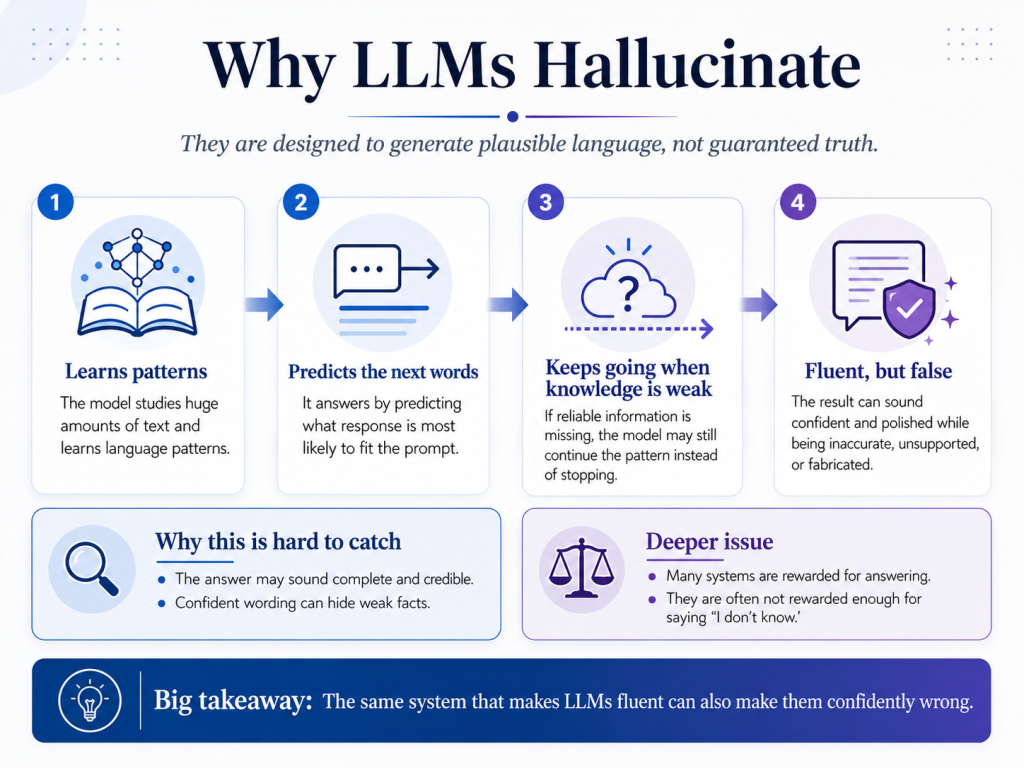
Large Language Models hallucinate because they are built to generate plausible language, not to guarantee truth.
That does not mean they are broken. It means their strength and weakness come from the same place.
An LLM learns patterns from training data. When it receives a prompt, it predicts what response is most likely to fit that prompt. In many cases, that produces a helpful answer. But when the model lacks enough reliable information, it may still continue the pattern instead of stopping.
That is when hallucinations happen.
A hallucination is an output that sounds fluent and confident but is false, unsupported, or fabricated. It might be a made-up statistic, a fake legal case, an incorrect quote, a broken citation, or a confident explanation of something that is not true.
This is why LLM mistakes can be so hard to catch.
A bad search result often looks incomplete. A broken calculator gives an obvious error. An LLM can give the wrong answer in polished language, which makes the error feel more credible than it is.
The deeper issue is incentive.
Many AI systems are trained and evaluated in ways that reward answering. If a model gets credit for correct answers but little credit for saying “I don’t know,” it has a reason to guess. That can make the system look more capable in tests while making it less reliable in real use.
A 2026 Nature paper by Adam Tauman Kalai, Ofir Nachum, Santosh Vempala, and Edwin Zhang argues that next-word prediction and accuracy-based evaluations can reward unwarranted guessing, which helps explain why hallucinations remain persistent even in advanced language models.
The Risks Behind Confident AI Answers
The main danger of an LLM is not that it can be wrong.
The danger is that it can be wrong in a way that looks finished, polished, and authoritative.
That creates several real risks.
The first is false information. An LLM can invent facts, misstate details, summarize a document incorrectly, or give an answer that sounds reasonable but does not match the source material.
The second is fake evidence. Some models can generate citations, case names, quotes, or references that look real but do not exist. This is especially dangerous in research, legal, medical, financial, or compliance work.
The third is bias. LLMs learn from human-created data, which means they can absorb and repeat patterns of bias found in that data. A model may produce outputs that reflect stereotypes, unequal representation, or distorted assumptions.
The fourth is privacy exposure. If users paste sensitive company data, personal information, client records, or confidential documents into an AI tool without proper controls, they may create risks they did not intend.
The fifth is overreliance. People may stop checking the output because the model sounds confident. That is when the tool becomes most dangerous.
LLMs are useful because they make work easier to start. They become risky when people treat that first output as final truth.
NIST identifies confabulation, harmful bias, data privacy, information integrity, and intellectual property concerns as important risk areas for generative AI systems.
Open Models Vs. Proprietary Models
Not every Large Language Model is built, shared, or controlled the same way.
Some LLMs are proprietary. These models are developed by companies that control the model, the infrastructure, the training methods, and the terms of access. Users usually interact with them through a chatbot, app, or API.
Proprietary models can be powerful and convenient because the provider handles hosting, updates, safety layers, and performance improvements. The tradeoff is control. Users may not know exactly what data was used to train the model, how the system was tuned, or what limits exist behind the interface.
Other LLMs are open models. These may allow developers to download model weights, run the model on private infrastructure, modify it, or fine-tune it for a specific use case.
Open models can offer more control, privacy, and customization. They can also help teams avoid sending sensitive data into third-party systems. But they still require technical skill, infrastructure, security planning, and careful attention to licensing terms.
The choice is not simply open versus closed.
The real question is what the user or organization needs most.
A company handling sensitive internal documents may care about privacy and control. A small team may care more about speed, ease of use, and strong hosted performance. A developer may want the freedom to fine-tune a model. A regulated business may need auditability, security, and vendor accountability.
Both approaches can be useful.
The best choice depends on the task, the risk, the data, and how much control the organization needs.
How To Use LLMs Without Overtrusting Them
The best way to use a Large Language Model is not to trust it blindly.
It is also not to avoid it completely.
The right approach is controlled trust.
Use LLMs where they are strong. Let them help with drafts, summaries, outlines, brainstorming, coding support, explanations, comparisons, and first-pass analysis.
But do not treat the output as final just because it sounds confident.
When accuracy matters, verify the answer against reliable sources. When the work involves private information, do not paste sensitive data into a tool unless your organization has approved the system and its data handling rules. When the topic involves legal, medical, financial, compliance, or safety decisions, keep a qualified human in the loop.
A good rule is simple.
Use LLMs to accelerate thinking, not replace judgment.
They are excellent at helping people start, organize, and refine work. They are weaker as final authorities on facts, risk, policy, or high-stakes decisions.
The more important the outcome, the more review the output needs.
That is not a weakness in the workflow. It is how the tool should be used.
What LLMs Mean For The Future Of Work
Large Language Models will not affect every job in the same way.
They are more likely to change tasks before they replace entire roles.
That matters because most knowledge work is not one activity. It is a mix of reading, writing, researching, deciding, communicating, reviewing, and organizing information. LLMs can support many of those steps, especially when the work depends on language.
A marketer may use an LLM to draft campaign ideas.
A lawyer may use one to summarize long documents before reviewing the details.
A developer may use one to explain an error or suggest a first version of a function.
A customer support team may use one to draft responses faster.
In each case, the model helps with part of the work. It does not remove the need for judgment.
The most valuable workers will not be the people who trust LLMs the most. They will be the people who know how to use them carefully, ask better questions, verify important claims, and improve the output.
That is the real shift.
LLMs make language work faster. They also make review, judgment, and source awareness more important.
Conclusion
Large Language Models are powerful because they make language work faster.
They can draft, summarize, explain, translate, code, and organize information in ways that feel almost effortless. That is why they are becoming part of everyday workflows so quickly.
But the same systems can also produce confident falsehoods.
That is the paradox at the center of LLMs. They are useful because they are fluent, flexible, and fast. They are risky because fluency can make weak, false, or unsupported answers look more trustworthy than they are.
The right response is not hype or rejection.
It is disciplined use.
LLMs are most valuable when people understand what they are good at, where they fail, and why human judgment still matters. They can accelerate work, but they should not become the final authority on truth, risk, or important decisions.
Frequently Asked Questions
What Is A Large Language Model?
A Large Language Model is an AI system trained to process and generate human-like language.
It learns patterns from large amounts of text and uses those patterns to produce responses to prompts.
How Do Large Language Models Work?
Large Language Models break text into smaller units called tokens, then predict which tokens are most likely to come next based on the prompt and the model’s training.
This is why they can write fluent answers, but it is also why they can produce false information.
Why Do LLMs Make Things Up?
LLMs make things up because they are designed to generate plausible language, not verify truth by default.
When they lack reliable information, they may still produce an answer that sounds confident and complete.
Are LLMs The Same As Artificial General Intelligence?
No.
LLMs are powerful AI systems for language tasks, but they are not the same as Artificial General Intelligence. They do not have human consciousness, independent understanding, or broad human-like reasoning across every situation.
What Are LLMs Used For?
LLMs are used for writing, editing, coding support, summarization, translation, customer service, research assistance, brainstorming, and internal knowledge search.
They are most useful when they help people move faster through language-heavy work.
Are Large Language Models Safe To Use?
They can be safe when used with the right limits.
LLMs are safer for low-risk tasks like drafting, summarizing, and brainstorming. They require more caution when used with private data, high-stakes decisions, legal work, medical information, financial guidance, or compliance-sensitive material.
How Should Businesses Use LLMs Responsibly?
Businesses should use LLMs with clear policies, privacy controls, human review, and verification standards.
The model should support the workflow, not become the final authority on important decisions.
Leave a Reply