Prompt Engineering Explained: The Role Behind Better AI Results
Introduction
Two people can use the same AI tool and get completely different results.
One receives a clear, useful response. The other gets something vague, repetitive, or difficult to use.
The difference is often the prompt.
Prompt engineering is the process of designing, testing, and refining the instructions given to an AI system. It helps the model understand what the user wants, which information matters, what limits it should follow, and how the final response should be structured.
That does not mean prompt engineering is about finding secret words.
A strong prompt cannot give a model knowledge it does not have, guarantee factual accuracy, or fix every weakness in the system. What it can do is reduce ambiguity and give the model a clearer path toward a useful result.
This guide explains what prompt engineering is, why prompts affect AI responses, which techniques matter most, how to improve weak prompts, and when better instructions are no longer enough.
Key Takeaways
- Prompt engineering is the process of designing and refining instructions so an AI system can produce a more useful response.
- Strong prompts usually combine a clear task, relevant context, useful constraints, examples, and a defined output format.
- More detail does not always improve a prompt. The information must be relevant, consistent, and easy for the model to follow.
- Prompt engineering works best as an iterative process. Strong results often require testing, reviewing failures, and refining the instructions.
- Better prompts can improve clarity, tone, structure, and relevance, but they cannot guarantee truth, current information, or perfect reasoning.
- Some tasks require more than prompting. RAG, fine-tuning, tools, or AI agents may be necessary when the model needs external knowledge, consistent behavior, or the ability to take action.
Affiliate Disclosure: Some links on our site are affiliate links. This means that if you click one of these links and make a purchase, we may earn a small commission at no additional cost to you.
What Prompt Engineering Actually Is
Prompt engineering is the process of shaping the instructions and information given to an AI system.
A prompt can be as simple as a question.
It can also include background information, examples, source material, constraints, formatting rules, and quality standards.
The goal is not to control every word the model produces.
The goal is to reduce uncertainty.
If the task is vague, the model has to make more assumptions. It may guess the audience, tone, level of detail, purpose, or format. Those assumptions can push the response away from what the user actually needs.
A stronger prompt makes the important choices clear.
It tells the model what to do, what information to use, what boundaries to follow, and what a successful result should look like.
Prompt engineering applies to more than writing.
It can help with:
- Research
- Coding
- Data extraction
- Summarization
- Classification
- Image generation
- Analysis
- Brainstorming
- Structured outputs
- Multi-step workflows
The same principle applies across all of them.
A useful prompt gives the model enough direction to complete the task without adding instructions that do not help.
Prompt engineering is not about writing the longest possible prompt.
It is about giving the right information in the clearest possible way.

Why The Same AI Can Produce Completely Different Answers
AI models respond to the information they are given.
That includes the wording of the request, the context around it, the examples provided, the limits set, and the format requested.
Change those inputs, and the output can change significantly.
A vague prompt leaves more decisions to the model.
If the user asks, “Write a marketing email,” the AI still has to guess the audience, product, goal, tone, length, offer, and call to action.
The response may sound acceptable, but it is built on assumptions.
A more specific prompt reduces those assumptions.
It might explain who the email is for, what product is being promoted, what action the reader should take, which claims to avoid, and how long the message should be.
The model now has a clearer target.
Prompt wording also affects what the AI prioritizes.
A request to “summarize this report” may produce a broad overview.
A request to “summarize the three risks that could delay the project” directs the model toward a narrower purpose.
The same model can also respond differently when the tone changes.
“As an expert” may encourage technical language.
“Explain this to a beginner” may produce simpler definitions and more examples.
“Give me only the final answer” may remove the explanation entirely.
The model is not discovering the user’s hidden intention.
It is responding to the signals inside the prompt.
The clearer those signals are, the more likely the result is to match what the user actually needs.
What A Prompt Really Tells The AI
A prompt does more than ask a question.
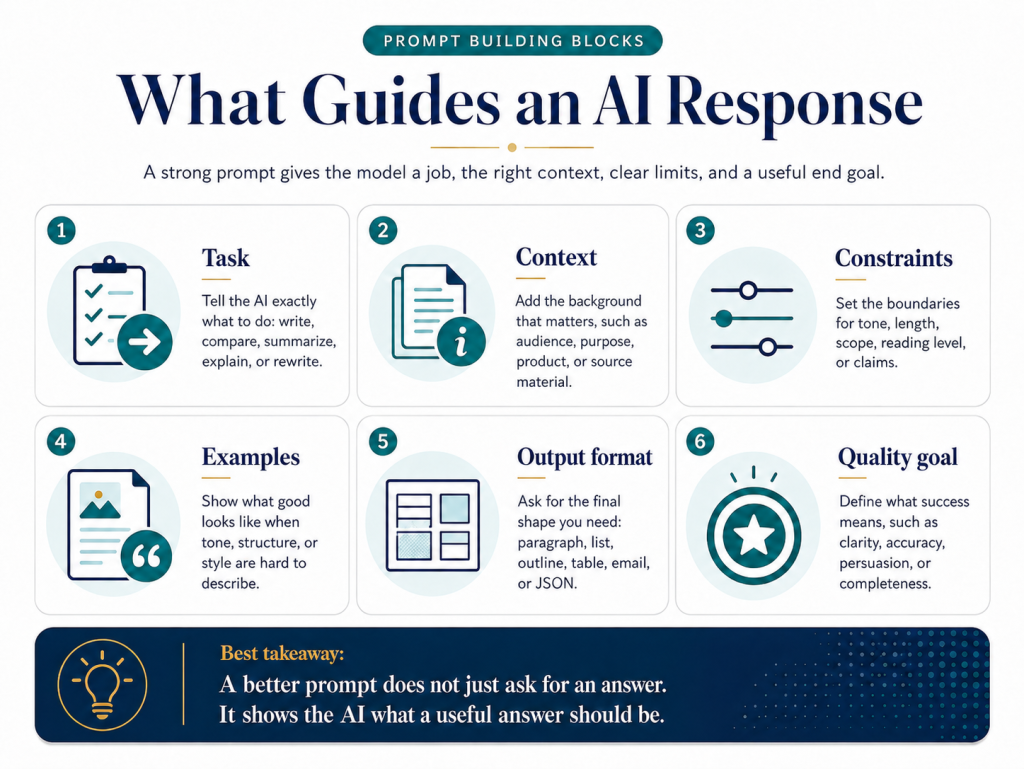
It tells the AI what job to perform, what information matters, which limits apply, and what the final result should look like.
A strong prompt may need several different parts.
Not every task requires all of them. The goal is to include only the information that helps the model understand and complete the request.
The Task
The task is the action the model needs to perform.
That might be to write, summarize, compare, classify, explain, extract, rewrite, analyze, or generate.
A clear task uses a direct verb.
“Help me with this article” is vague.
“Rewrite this introduction for a beginner audience” gives the model a defined action.
The Context
Context gives the model the background it needs.
This may include the audience, purpose, product, situation, source material, campaign goal, or previous work.
Without context, the model may make assumptions that do not match the user’s intention.
For example, asking for a product description is not enough if the model does not know who the product is for, what problem it solves, or what makes it different.
The Constraints
Constraints define the boundaries of the response.
They may control:
- Length
- Tone
- Scope
- Vocabulary
- Claims
- Structure
- Exclusions
- Reading level
Constraints help prevent the model from producing something technically relevant but practically unusable.
They should be specific and consistent.
Conflicting constraints make the task harder to follow.
The Examples
Examples show the model what success looks like.
They can demonstrate tone, structure, formatting, vocabulary, or the difference between acceptable and unacceptable output.
Examples are especially useful when the desired result is difficult to describe with abstract instructions alone.
A strong example reduces interpretation.
A weak example can teach the wrong pattern.
The Output Format
The output format tells the model how to organize the result.
The user may want:
- A paragraph
- A table
- An outline
- A numbered process
- A social post
- An email
- A JSON object
- A list of recommendations
Defining the format makes the response easier to use.
It also reduces the chance that the model delivers the right information in the wrong form.
The Quality Standard
The quality standard explains what makes the response successful.
This may include accuracy, clarity, originality, completeness, persuasion, restraint, or alignment with a specific audience.
Vague standards such as “make it better” give the model little direction.
A stronger instruction explains what “better” means.
For example: “Make the paragraph clearer by shortening long sentences, removing repetition, and keeping the main claim unchanged.”
A good prompt does not simply tell the AI to produce something.
It gives the model enough information to understand what a useful result should be.
The Anatomy Of A Strong AI Prompt
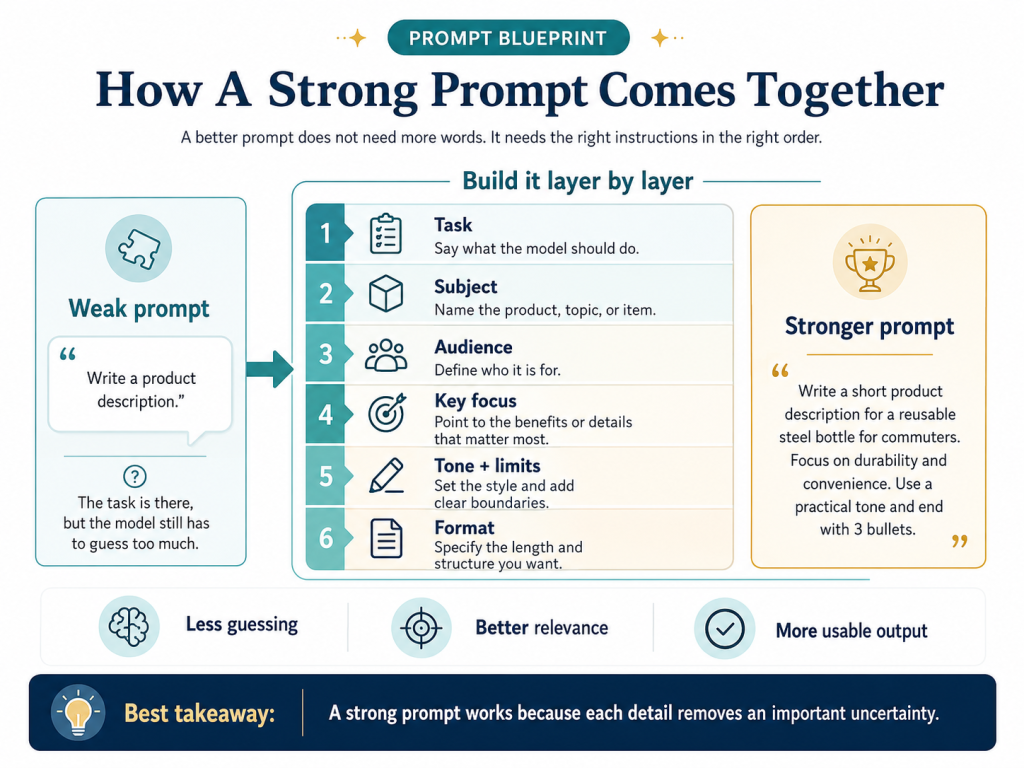
A strong prompt combines the right instructions in a clear order.
It does not need to be long.
It needs to remove the uncertainty that would otherwise force the model to guess.
Consider this weak prompt: “Write a product description.”
The task is clear, but almost everything else is missing.
The model does not know the product, audience, benefit, tone, length, or claims it should avoid.
A stronger prompt adds those details one layer at a time.
Start With The Task
“Write a product description.”
This tells the model what to produce.
Add The Product
“Write a product description for a reusable stainless steel water bottle.”
Now the model knows the subject.
Add The Audience
“Write a product description for a reusable stainless steel water bottle aimed at commuters who want to reduce single-use plastic.”
This helps the model choose more relevant benefits and language.
Add The Main Benefit
“Focus on durability, temperature retention, and everyday convenience.”
This tells the model which features matter most.
Add The Tone
“Use a practical, confident tone without exaggerated claims.”
This shapes the style and limits unnecessary hype.
Add The Constraints
“Keep the description between 120 and 150 words. Do not claim that the bottle is leakproof or environmentally harmless.”
This gives the model clear boundaries.
Add The Output Format
“Use a short opening paragraph followed by three bullet points.”
This makes the result easier to use.
The final prompt becomes:
“Write a 120- to 150-word product description for a reusable stainless steel water bottle aimed at commuters who want to reduce single-use plastic. Focus on durability, temperature retention, and everyday convenience. Use a practical, confident tone without exaggerated claims. Do not claim that the bottle is leakproof or environmentally harmless. Use a short opening paragraph followed by three bullet points.”
The improved prompt is not better because it contains more words.
It is better because every instruction reduces a meaningful uncertainty.
That is the basic anatomy of a strong prompt:
- A clear task
- Relevant context
- Useful constraints
- A defined audience
- A clear output format
- A standard for what the result should achieve

How To Build A Prompt Step By Step
A strong prompt usually begins with a clear outcome.
From there, each added instruction should help the model understand the task, reduce ambiguity, or improve the usefulness of the response.
Step 1: Define The Outcome
Start with what the response needs to accomplish.
Do not begin with tone, formatting, or role before the goal is clear.
Instead of:
“Write something engaging about this product.”
Use:
“Write a product description that explains the main benefit and encourages first-time buyers to learn more.”
The second version gives the model a purpose.
Step 2: Add The Necessary Context
Give the model the background it cannot reasonably infer.
This may include:
- The audience
- The product or subject
- The reason for the request
- The stage of the project
- The source material
- The intended use
Context should be relevant.
Do not add information simply because it is available. Include what helps the model make better decisions.
Step 3: Set The Boundaries
Define the limits that matter.
These might include:
- Word count
- Tone
- Reading level
- Claims to avoid
- Required points
- Excluded topics
- Brand vocabulary
- Geographic scope
Good constraints protect the result from becoming too broad, too long, or misaligned.
They should not conflict with one another.
Step 4: Show What Good Looks Like
Add an example when the desired result is difficult to describe.
Examples are especially useful for:
- Tone
- Structure
- Style
- Classification
- Formatting
- Brand voice
- Repeated tasks
The example should represent the quality and pattern you want the model to follow.
Do not include an example that contradicts the written instructions.
Step 5: Define The Output Format
Tell the model how the answer should be organized.
For example:
- Use a table with three columns.
- Write five bullet points.
- Return only valid JSON.
- Use an H2 followed by two short paragraphs.
- Create a numbered process.
- Draft an email with a subject line.
A clear output format makes the response easier to review and reuse.
Step 6: Review The First Response
The first answer is evidence.
Look at what the model misunderstood, ignored, exaggerated, or left out.
Ask:
- Did it complete the right task?
- Did it use the context correctly?
- Did it follow the constraints?
- Did it match the requested tone?
- Is the output usable?
- Did it make unsupported assumptions?
The response shows where the prompt needs improvement.
Step 7: Refine The Prompt
Change the instruction that caused the problem.
If the answer is too generic, add more relevant context.
If it is too long, tighten the length requirement.
If the tone is wrong, describe the desired tone more precisely or provide an example.
If the model ignores an important rule, move that instruction closer to the main task or state its priority clearly.
Do not keep adding random details.
Refinement should be based on the failure you observed.
Prompt engineering works best as a loop:
Define the task.
Test the prompt.
Review the output.
Improve the instruction.
Then test again.

The Prompting Techniques That Matter Most
Prompt engineering includes several techniques for guiding an AI system.
These techniques are not separate rules that must be used every time.
They are tools.
The right technique depends on the task, the amount of context available, and how much control the result requires.
Zero-Shot Prompting
Zero-shot prompting means giving the model a task without providing examples.
For example:
“Classify this customer review as positive, neutral, or negative.”
The model receives the instruction and completes the task based on patterns learned during training.
Zero-shot prompting works well when the request is simple, familiar, and clearly defined.
It becomes less reliable when the task depends on a specific style, unusual category system, or strict interpretation.
Few-Shot Prompting
Few-shot prompting gives the model examples before asking it to complete the task.
For example:
“Review: ‘The delivery was fast, but the item arrived damaged.’
Label: Mixed
Review: ‘Everything worked perfectly.’
Label: Positive
Now classify this review: ‘The product is useful, but the setup was frustrating.’”
The examples show the model how the categories should be applied.
Few-shot prompting is especially useful for classification, formatting, tone, style, and repeated tasks.
The examples must be accurate and consistent. Weak examples can guide the model toward the wrong pattern.
Role Prompting
Role prompting gives the model a perspective, responsibility, or working context.
For example:
“Review this paragraph as a senior copy editor focused on clarity and factual restraint.”
The role helps shape what the model prioritizes.
A copy editor may focus on structure and wording. A teacher may explain the same idea more simply. A risk reviewer may look for unsupported claims or missing safeguards.
Role prompting can improve focus.
It does not give the model real qualifications, professional judgment, or access to knowledge it does not have.
Constraint Prompting
Constraint prompting sets clear boundaries around the response.
A prompt might require:
- A specific word count
- A defined tone
- Certain points to include
- Claims to avoid
- A reading level
- A required structure
- Terms that must not appear
Constraints make the result easier to control.
They work best when they are specific and compatible.
A prompt that asks for a highly detailed answer in fewer than 50 words creates tension the model may not resolve well.
Context Prompting
Context prompting gives the model the background needed to complete the task properly.
This may include the audience, purpose, source material, project history, product details, or situation behind the request.
For example:
“Rewrite this explanation for first-time business owners who understand basic marketing but are unfamiliar with automation.”
The context changes the language, examples, and level of detail the model should use.
Useful context reduces assumptions.
Irrelevant context creates noise.
Prompt Templates
A prompt template is a reusable structure with fixed instructions and variables that change.
For example:
“Summarize the following [DOCUMENT TYPE] for [AUDIENCE]. Focus on [PRIORITY]. Keep the response under [WORD COUNT] words and use [OUTPUT FORMAT].”
Templates are useful for repeated tasks because they create consistency.
They should still be tested and adjusted when the input or goal changes.
Prompt Chaining
Prompt chaining divides a complex task into smaller, connected prompts.
Instead of asking the model to research, plan, write, edit, and format a complete article in one request, the work can be separated:
- Identify the search intent.
- Build the outline.
- Draft one section at a time.
- Review the structure.
- Edit for clarity and accuracy.
- Prepare the final metadata.
Each output becomes context for the next step.
Prompt chaining gives the user more control and makes errors easier to identify.
The most effective prompting technique is not the most advanced one.
It is the one that gives the model the right amount of guidance for the task.

Why Examples Often Work Better Than More Instructions
Instructions tell the AI what you want.
Examples show it.
That difference matters when the desired result depends on tone, structure, style, or judgment.
A direction such as “make this more professional” is open to interpretation. The model may make the writing formal, distant, technical, or overly polished.
An example gives the model a pattern to follow.
It can show:
- Sentence length
- Vocabulary
- Tone
- Structure
- Level of detail
- Formatting
- Acceptable claims
- What to avoid
This reduces the number of decisions the model has to make on its own.
Examples Make Abstract Standards Concrete
Words such as “clear,” “engaging,” “concise,” and “professional” can mean different things in different situations.
A legal notice, product description, blog introduction, and customer support reply may all need to sound professional, but they should not sound the same.
An example shows what the standard means for the specific task.
Instead of saying:
“Write in a friendly but professional tone.”
You might add:
“Use short sentences, plain language, and a calm tone. Avoid slang, hype, and overly formal wording.”
A sample response can make the distinction even clearer.
Examples Help With Repeated Patterns
Few-shot prompting is especially useful when the same type of task appears repeatedly.
For example, a model may need to classify messages, rewrite headlines, format product details, or turn notes into structured summaries.
Showing two or three correct examples can help the model recognize the pattern more consistently.
The examples become a temporary reference for how the task should be completed.
Examples Can Show What Not To Do
Negative examples can also be useful.
A prompt may include one weak response and explain why it fails.
For example:
“Do not write: ‘This revolutionary product will completely transform your life.’ This is too exaggerated and makes an unsupported promise.”
That helps the model understand the boundary more clearly than a vague instruction to “avoid hype.”
Poor Examples Can Create Poor Results
Examples are only useful when they represent the desired output accurately.
If the examples are inconsistent, too broad, or lower quality than the result you want, the model may copy the wrong pattern.
A prompt may ask for short paragraphs while showing an example with long blocks of text.
It may ask for a restrained tone while providing highly promotional copy.
The model now has conflicting signals.
Examples should support the written instructions, not compete with them.
More Examples Are Not Always Better
A few strong examples are often more useful than a large collection of mixed ones.
Too many examples can add noise, increase prompt length, or make it harder for the model to identify the main pattern.
Choose examples that represent the most important cases.
If the task includes meaningful variations, show those variations deliberately.
The goal is not to give the model everything.
It is to show the pattern clearly enough that the model can apply it to a new input.
Why Complex Tasks Often Need More Than One Prompt
Some tasks are too large to handle well in a single prompt.
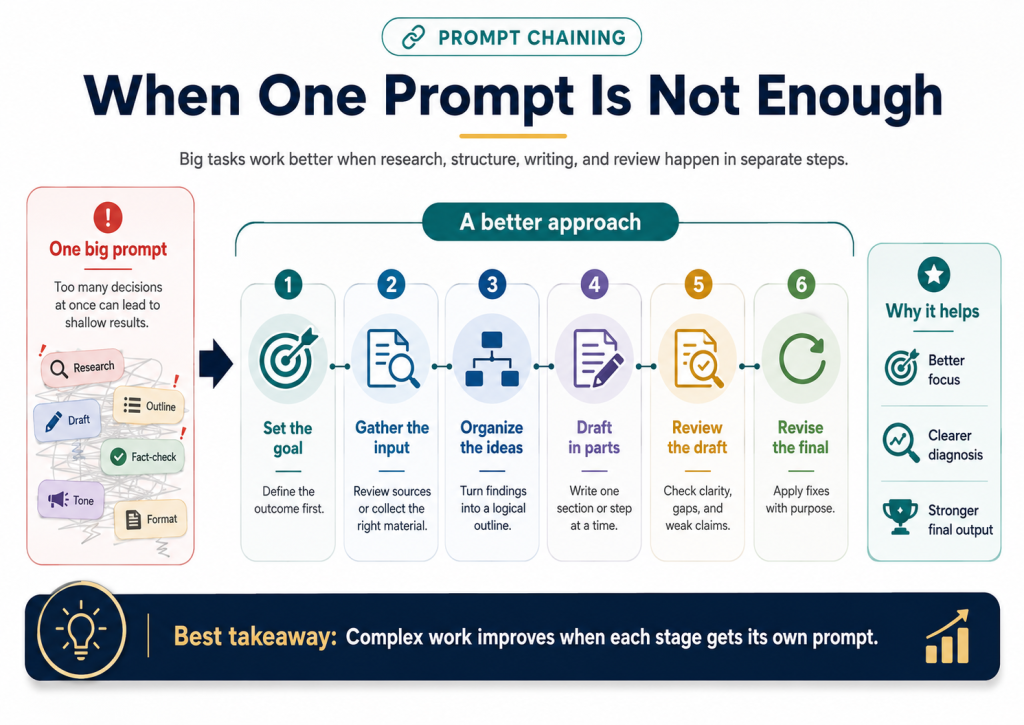
A model may be asked to research a topic, identify the strongest ideas, organize them, write a complete draft, check the facts, improve the tone, and format the final result all at once.
That creates too many decisions inside one response.
The model may complete every part at a basic level without doing any part especially well. It can also become difficult to see where the process failed.
Prompt chaining solves this by dividing the task into smaller stages.
Each prompt handles one part of the work. The output from one stage becomes the input or context for the next.
Start With Research Or Source Material
The first prompt can focus only on gathering or reviewing information.
For example:
“Review these sources and identify the five claims most relevant to the topic. Do not draft the article yet.”
This keeps the model focused on understanding the material before writing.
Organize The Information
The next prompt can turn the findings into a logical structure.
For example:
“Arrange these claims into an outline that moves from basic understanding to practical application and risk.”
This separates information architecture from drafting.
Draft One Part At A Time
The model can then write each section individually.
This makes it easier to control depth, avoid repetition, and maintain a logical flow.
It also allows the user to correct the direction before the entire piece is written.
Review Against Clear Criteria
A separate prompt can evaluate the draft.
For example:
“Review this section for clarity, unsupported claims, repetition, and alignment with the search intent. Identify problems before rewriting.”
Separating diagnosis from revision often produces stronger editing.
Revise Based On The Review
The final prompt can apply the specific corrections.
This creates a cleaner process than repeatedly asking the model to “make it better.”
Prompt Chaining Makes Failures Easier To Find
When a single large prompt produces a weak result, it can be difficult to know whether the problem came from the research, outline, writing, tone, or formatting.
A chained process makes each stage visible.
If the outline is weak, fix the outline.
If the facts are incomplete, improve the research.
If the writing is repetitive, revise the draft.
This makes improvement more deliberate.
Prompt Chaining Does Not Need To Be Complicated
A simple chain might be:
- Define the goal.
- Gather the information.
- Organize the ideas.
- Draft the response.
- Review the result.
- Revise the final version.
The purpose is not to create more prompts for the sake of complexity.
It is to give each important part of the task enough attention.
One prompt works well when the task is simple.
Prompt chaining becomes more useful when the work contains several decisions, stages, or quality checks.

Why Longer Prompts Are Not Always Better
A longer prompt is not automatically a stronger prompt.
Extra detail can help when it gives the model necessary context, clearer boundaries, or a better example.
It becomes a problem when the prompt adds noise.
The model still has to decide which instructions matter most. If the prompt is crowded, repetitive, or internally inconsistent, the response may become less focused instead of more accurate.
Irrelevant Background Creates Noise
Context should help the model complete the task.
Background information that does not affect the answer makes the prompt harder to follow.
For example, a request to rewrite a product description may need the audience, product benefits, tone, and claims to avoid.
It probably does not need the full history of the company unless that history is relevant to the message.
Useful context reduces uncertainty.
Irrelevant context creates distraction.
Repeated Instructions Can Blur Priorities
Repeating the same rule several times does not always make the model follow it more closely.
It can make the prompt longer without making the requirement clearer.
State the instruction once, place it near the task it affects, and make the wording specific.
Instead of repeating “keep it concise,” define the limit:
“Keep the response between 150 and 180 words.”
Conflicting Instructions Force A Compromise
Long prompts often collect instructions from different drafts, people, or stages of a project.
That can create contradictions.
A prompt might ask for a detailed explanation while also requiring fewer than 100 words. It might request a warm conversational tone and then demand highly formal language.
The model may satisfy one instruction while weakening another.
Before using a long prompt, check whether every requirement can realistically work together.
Too Many Goals Weaken The Main Task
A single prompt may ask the model to educate, persuade, summarize, compare, entertain, and sell at the same time.
Those goals may compete.
The response can become unfocused because the model has no clear way to decide which outcome matters most.
If several goals are necessary, identify the primary one.
If the work contains distinct stages, separate them through prompt chaining.
Important Instructions Can Become Buried
A critical rule placed deep inside a long block of text may receive less attention than the opening task or final request.
Structure helps.
Use clear sections such as:
- Task
- Context
- Requirements
- Source material
- Output format
- Final checks
This makes the prompt easier to review and reduces the chance that important instructions disappear inside the background.
More Source Material Can Reduce Focus
Adding many documents or long passages does not guarantee a better response.
The model may struggle to identify which source is authoritative, current, or most relevant.
When possible, provide only the material needed for the task.
If several sources are necessary, explain how they should be prioritized and what the model should do when they conflict.
A Good Prompt Is Complete, Not Bloated
The goal is not to write the shortest prompt possible.
Some tasks genuinely require detailed context, examples, and constraints.
The better standard is relevance.
Every part of the prompt should help the model understand the task, use the right information, follow the boundaries, or produce the required format.
If an instruction does none of those things, it may not belong.

The Most Common Prompt Engineering Mistakes
Weak AI responses often begin with weak instructions.
The problem is not always that the prompt is too short. It is often that the prompt leaves out an important decision, combines too many goals, or asks the model to do something it cannot reliably do.
Asking For Too Many Outcomes At Once
A single prompt may ask the model to explain, compare, persuade, summarize, and sell at the same time.
Those goals can conflict.
The model may produce a response that touches everything but does nothing especially well.
Choose one primary outcome.
If the task contains several stages, separate them through prompt chaining.
Leaving The Audience Or Purpose Unclear
The model needs to know who the response is for and what the response should accomplish.
“Explain email marketing” is broad.
“Explain email marketing to a local business owner who wants to understand how newsletters can support repeat sales” gives the model a clearer audience and purpose.
Without that context, the model has to guess the level of detail, vocabulary, examples, and tone.
Using Vague Quality Words
Words such as “better,” “professional,” “engaging,” and “high quality” are open to interpretation.
The model may satisfy them in a way the user did not intend.
Replace vague standards with observable requirements.
Instead of:
“Make this more engaging.”
Use:
“Open with a specific problem, shorten the paragraphs, remove generic claims, and use one concrete example.”
Adding Conflicting Instructions
A prompt may ask for a detailed explanation while requiring an extremely short response.
It may request a friendly tone while also asking for formal legal language.
When instructions conflict, the model has to decide which one to weaken.
Review the prompt before submitting it.
Make sure the constraints support the same outcome.
Assuming The AI Knows Missing Information
The model cannot use information that has not been provided or made available through a connected source.
It may not know the audience, product details, current policy, brand standards, or exact goal behind the task.
If the missing information matters, include it.
Otherwise, the model may fill the gap with assumptions.
Giving Too Much Irrelevant Context
Missing context is a problem.
So is unnecessary context.
Long background sections can bury the main request and make it harder for the model to identify what matters.
Include only the information that affects the task, decision, or output.
Providing Weak Or Inconsistent Examples
Examples can improve a prompt, but only when they reflect the desired result.
If one example is concise and another is highly detailed, the model may struggle to identify the pattern.
If the written instruction asks for restraint but the example uses exaggerated language, the signals conflict.
Examples should reinforce the prompt, not undermine it.
Failing To Define The Output Format
The model may provide the right information in the wrong form.
A user may expect a table and receive several paragraphs. They may need valid JSON and receive an explanation with code mixed into it.
Specify how the answer should be organized.
The more structured the task, the more important the format becomes.
Treating The First Response As Final
Prompt engineering is rarely finished after one attempt.
The first response shows how the model interpreted the instruction.
Review what it missed, assumed, repeated, or misunderstood.
Then refine the prompt based on that evidence.
Asking The Model To Verify Information It Cannot Access
A prompt cannot give the model live data, private records, or authoritative sources by itself.
The model may still generate an answer that sounds verified.
When current or source-specific accuracy matters, the system may need web access, RAG, documents, databases, or another connected tool.
Blaming The Prompt For Every Failure
Some problems are not prompt problems.
The model may lack the necessary knowledge, context window, reasoning ability, tool access, or output reliability.
Prompt engineering can improve how the task is communicated.
It cannot remove every limitation of the model or system.
The best prompts reduce avoidable uncertainty.
They do not turn an unsuitable tool into the right one.
How To Test And Improve A Prompt
A prompt is not strong because it works once.
It is strong when it produces useful results across the situations it was designed to handle.
That requires testing.
Define What Success Looks Like
Before testing the prompt, decide what the response should achieve.
The standard might include:
- Factual accuracy
- Relevance
- Completeness
- Tone
- Structure
- Consistency
- Correct formatting
- Use of supplied context
- Absence of unsupported claims
Without a clear standard, it is difficult to judge whether the prompt actually improved.
Test More Than One Input
A prompt may perform well on one example and fail on another.
Use several realistic inputs that represent the range of situations the prompt is expected to handle.
For example, a customer support prompt should be tested with simple questions, unclear requests, frustrated users, missing information, and cases that require escalation.
This reveals whether the prompt is reliable or only works under ideal conditions.
Review The Output Against The Goal
Do not judge the response only by whether it sounds polished.
Check whether it completed the correct task.
Ask:
- Did it use the right information?
- Did it follow the constraints?
- Did it preserve important details?
- Did it avoid unsupported claims?
- Did it use the requested format?
- Did it handle uncertainty appropriately?
- Is the result genuinely useful?
Fluent writing can still hide weak task performance.
Identify The Type Of Failure
Different problems require different fixes.
If the response is too generic, the prompt may need more context.
If the output is inconsistent, the prompt may need examples.
If the model ignores the format, the requirement may need to be clearer or placed closer to the task.
If the answer includes unsupported facts, the problem may require source material, retrieval, or tool access rather than better wording.
Diagnose the failure before changing the prompt.
Change One Important Element At A Time
If several parts of the prompt change at once, it becomes difficult to know what improved the result.
Change one meaningful element, then test again.
You might:
- Clarify the task
- Add missing context
- Remove irrelevant instructions
- Tighten a constraint
- Add an example
- Change the output format
- Define how uncertainty should be handled
This makes the improvement process more deliberate.
Test For Consistency
Run the prompt more than once.
Generative AI can produce different responses from the same instruction. A prompt that succeeds once may still be unreliable.
Look for patterns across multiple outputs.
If the model repeatedly misses the same requirement, the prompt or system design needs further work.
Keep A Record Of What Changed
For repeated or important tasks, save the prompt versions and note what each change was intended to improve.
This makes it easier to compare results and avoid repeating failed approaches.
Prompt testing does not need to become a complicated experiment.
It simply needs to be structured enough that improvements are based on evidence instead of guesswork.
The goal is not to create a perfect prompt.
It is to create one that performs well enough, often enough, for the task it was designed to handle.

Where Prompt Engineering Stops Being Enough
Prompt engineering improves how a task is communicated.
It does not give the model new knowledge, permanent expertise, live information, or the ability to act outside the conversation.
Some problems require more than better instructions.
Retrieval-Augmented Generation
Retrieval-augmented generation, or RAG, gives the model access to relevant external information before it answers.
That information may come from:
- Company documents
- Knowledge bases
- Product catalogs
- Policy manuals
- Research databases
- Current web content
RAG is useful when the answer must rely on specific, private, or frequently updated material.
A prompt can tell the model to use a policy document.
RAG is what retrieves the correct document and places the relevant information into the model’s context.
Prompt engineering still matters because the model needs clear instructions about how to use the retrieved material.
It should know whether to summarize it, compare it, cite it, or refuse to answer when the evidence is incomplete.
Fine-Tuning
Fine-tuning changes the model by training it on additional examples.
It can help when a task requires consistent behavior across many repeated inputs.
Possible uses include:
- Applying a specialized classification system
- Producing a consistent output style
- Following domain-specific patterns
- Handling recurring formats
- Improving performance on a narrow task
Fine-tuning is not the first solution to every prompt problem.
A clearer prompt, better examples, or RAG may solve the issue with less complexity.
Fine-tuning becomes more relevant when the desired pattern is stable, repeated, and difficult to reproduce reliably through instructions alone.
Tools
A model may need tools when the task requires information or actions beyond text generation.
Tools can allow an AI system to:
- Search the web
- Run calculations
- Query a database
- Read files
- Execute code
- Check inventory
- Create calendar events
- Send information to another system
A prompt can describe the goal.
The tool provides the capability needed to complete it.
For example, asking a model for the current exchange rate does not make its internal knowledge current. It needs access to a live data source.
Tool use also requires controls.
The system must define when a tool may be used, what information it can access, and which actions require human approval.
AI Agents
AI agents combine models, tools, instructions, and workflows to pursue a goal across multiple steps.
An agent may plan a task, select a tool, review the result, and decide what to do next.
This is different from a standard chatbot response.
The system is no longer only generating text. It may be taking actions or coordinating a process.
Prompt engineering remains part of the design.
The agent still needs clear goals, limits, priorities, and stopping conditions.
But instructions alone are not enough.
Reliable agents also depend on:
- Tool permissions
- Error handling
- State management
- Verification
- Security controls
- Human oversight
Prompt engineering is most effective when the main problem is unclear communication.
When the problem involves missing knowledge, repeated specialization, external capabilities, or multi-step action, the solution must extend beyond the prompt.
What Prompt Engineering Can And Cannot Control
Prompt engineering can improve the quality of an AI response.
It cannot guarantee that the response is correct, complete, or safe.
Understanding that boundary is essential.
What Prompt Engineering Can Improve
A well-designed prompt can improve:
- Relevance
- Clarity
- Structure
- Tone
- Level of detail
- Use of supplied context
- Consistency
- Output formatting
- Alignment with a specific audience
It can also reduce avoidable mistakes.
Clear constraints may prevent unnecessary claims.
Examples may improve consistency.
A defined format may make the output easier to review or reuse.
These are meaningful improvements.
They come from giving the model a clearer task and better information.
What Prompt Engineering Cannot Guarantee
A prompt cannot guarantee factual accuracy.
The model may still produce incorrect information, invent details, misunderstand a source, or present uncertainty with too much confidence.
A prompt also cannot make outdated knowledge current.
Telling the model to “use the latest information” does not provide access to live data.
Current information requires a reliable external source or tool.
Prompt engineering cannot guarantee perfect reasoning either.
The model may follow the requested structure while making a weak comparison, missing an exception, or drawing the wrong conclusion.
It also cannot guarantee that every instruction will be followed exactly.
Long prompts, conflicting requirements, difficult tasks, and model limitations can all affect compliance.
A Prompt Cannot Replace Missing Evidence
The model cannot verify a claim without access to supporting information.
It may generate a plausible answer based on patterns rather than evidence.
When accuracy matters, provide the relevant source material or connect the system to an authoritative source.
The prompt should then explain how that evidence must be used.
For example:
“Answer only from the supplied documents. If the documents do not contain enough information, state that the answer cannot be confirmed.”
This reduces unsupported guessing.
It does not eliminate the need to review the result.
A Prompt Cannot Create Real Expertise
Role prompting can change the model’s focus and language.
It cannot turn the model into a licensed lawyer, doctor, accountant, engineer, or security specialist.
The response may imitate professional communication without carrying professional accountability or judgment.
High-stakes decisions still require qualified review.
A Prompt Cannot Make Every Task Suitable For AI
Some tasks require access, authority, physical observation, human judgment, or responsibility that a text model does not have.
A better prompt does not solve that mismatch.
The user must decide whether AI is appropriate for the task before trying to optimize the instruction.
Human Review Still Matters
The level of review should match the level of risk.
A brainstorming list may need only a quick check.
A public claim, legal document, medical explanation, financial analysis, or automated action requires much closer scrutiny.
Prompt engineering can make review easier by asking the model to show assumptions, identify uncertainty, cite supplied evidence, or follow a structured format.
It cannot remove the need for judgment.
The purpose of prompt engineering is not to control every word the model produces.
It is to create better conditions for a useful response while recognizing what instructions alone cannot solve.
Conclusion
Prompt engineering is not a collection of secret phrases.
It is the practical work of giving an AI system a clearer task, better context, useful constraints, and a defined standard for success.
Strong prompts reduce unnecessary guessing.
They help the model understand the audience, purpose, boundaries, and format of the response.
The best prompts are not always the longest.
They include the information that matters and remove the information that does not.
They are also tested.
A weak response should lead to a diagnosis, not a random rewrite of the prompt. The user should identify what the model misunderstood, adjust the relevant instruction, and test again.
Examples, templates, and prompt chains can improve difficult or repeated tasks.
They do not remove the limits of the underlying model.
Prompt engineering cannot guarantee truth, provide missing evidence, create live access, or replace professional judgment.
When instructions are not enough, the system may need RAG, fine-tuning, tools, agents, or human review.
Better AI results often begin with better instructions.
But the real skill is knowing what the prompt should control, what the system must provide, and what still needs to be verified.

Frequently Asked Questions
What Is Prompt Engineering In Simple Terms?
Prompt engineering is the process of designing and improving instructions for an AI system.
The goal is to make the task clearer, reduce unnecessary assumptions, and produce a more useful response.
Do You Need Technical Skills To Learn Prompt Engineering?
No. Basic prompt engineering depends more on clear thinking, precise communication, and careful testing than on coding.
Technical skills become more important when prompts are connected to APIs, tools, databases, or automated workflows.
What Makes A Good AI Prompt?
A good prompt usually includes a clear task, relevant context, useful constraints, and a defined output format.
Examples can help when the desired tone, structure, or decision rule is difficult to explain.
Are Longer Prompts More Effective?
Not always. Long prompts can help when a task requires detailed context or strict requirements.
They can also become repetitive, contradictory, or difficult to follow.
A strong prompt includes enough information to complete the task without unnecessary detail.
What Is The Difference Between Zero-Shot And Few-Shot Prompting?
Zero-shot prompting gives the model an instruction without examples.
Few-shot prompting includes one or more examples that demonstrate how the task should be completed.
Few-shot prompting is often more useful when the task depends on a specific pattern, format, tone, or classification system.
What Is Prompt Chaining?
Prompt chaining divides a complex task into several connected prompts.
Each prompt handles one stage, such as research, outlining, drafting, reviewing, or revising.
This approach provides more control and makes problems easier to identify.
Can Prompt Engineering Stop AI Hallucinations?
No. Clear prompts and reliable source material can reduce unsupported answers, but they cannot guarantee factual accuracy.
Important claims should still be verified against trustworthy evidence.
When Should You Use RAG Instead Of A Better Prompt?
RAG is useful when the model needs access to specific, private, or current information.
A better prompt can explain how the information should be used, but it cannot provide knowledge that is missing from the model’s context.
Is Prompt Engineering The Same As Fine-Tuning?
No. Prompt engineering changes the instructions given to the model.
Fine-tuning changes the model by training it on additional examples.
Prompt engineering is usually easier to test and should often be considered before fine-tuning.
Will Prompt Engineering Become Obsolete?
AI systems may become better at interpreting short or incomplete requests.
However, users will still need to define goals, provide context, set boundaries, and evaluate results.
The techniques may change, but clear instruction and deliberate review will remain important.

Leave a Reply