AI Hallucinations: Why AI Makes Things Up With Confidence
Introduction
AI can give a clear, polished answer that is completely wrong.
It may invent a statistic, misquote a source, describe an event that never happened, or provide a citation that does not exist. The response can sound so natural and authoritative that the mistake is easy to miss.
This is known as an AI hallucination.
The term describes content generated by an AI system that is false, unsupported, or disconnected from the available evidence. The system is not deliberately lying. It is producing language that fits the prompt and learned patterns, even when those patterns do not lead to a truthful answer.
That distinction matters.
Large Language Models are designed to generate likely responses, not to verify every claim against a reliable source. When information is missing, unclear, or difficult to predict, the model may still produce an answer instead of admitting uncertainty.
This creates one of the central problems in modern AI. The same fluency that makes AI useful can also make its errors look trustworthy.
This guide explains what AI hallucinations are, why they happen, where they become dangerous, and what people can do to recognize and reduce them without assuming they can be eliminated completely.
Key Takeaways
- AI hallucinations are false, unsupported, or fabricated outputs generated by an AI system.
- Hallucinations happen because language models are trained to produce likely responses, not to verify every claim as true.
- A polished answer can still be wrong. Fluency, confidence, and detail do not guarantee accuracy.
- Hallucinations can appear as invented facts, fake citations, incorrect summaries, false quotes, or unsupported conclusions.
- The risk increases when AI is used for legal, medical, financial, academic, or other high-stakes decisions.
- Retrieval, source checking, clearer prompts, and human review can reduce hallucinations, but they cannot eliminate them completely.
Affiliate Disclosure: Some links on our site are affiliate links. This means that if you click one of these links and make a purchase, we may earn a small commission at no additional cost to you.
What AI Hallucinations Actually Are
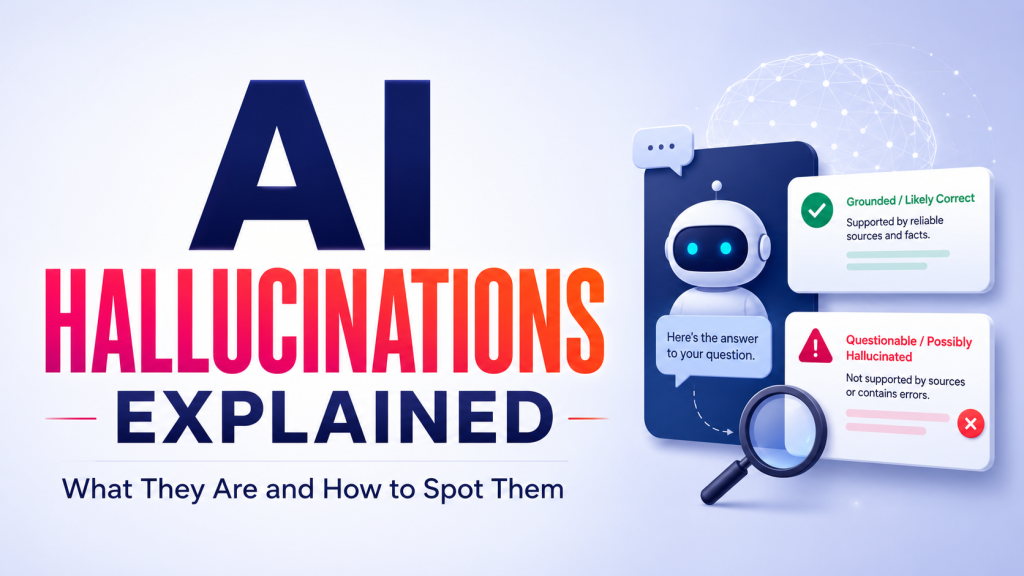
An AI hallucination is an output that sounds plausible but is false, unsupported, or disconnected from the available evidence.
The system may invent a fact, misstate a detail, create a fake citation, attribute a quote to the wrong person, or draw a conclusion the source material does not support.
The mistake can be obvious.
An AI might name a book that does not exist or provide a broken link.
But hallucinations can also be subtle.
A response may mix accurate information with one incorrect date, exaggerate a research finding, or summarize a document in a way that changes its meaning.
That is what makes hallucinations difficult to catch.
The answer often looks complete. It may use confident language, detailed explanations, and professional formatting. None of those qualities prove the information is true.
The term “hallucination” can also be misleading.
The AI is not seeing or imagining something in the human sense. It is generating language from learned patterns and context, then producing a response that appears to fit even when the underlying information is wrong.
The simplest definition is this:
An AI hallucination happens when the system produces an answer that looks credible but cannot be supported by reliable evidence.
OpenAI describes hallucinations as plausible but false statements generated by language models, which helps explain why these errors can appear convincing even when the underlying information is wrong.
Why AI Hallucinations Happen
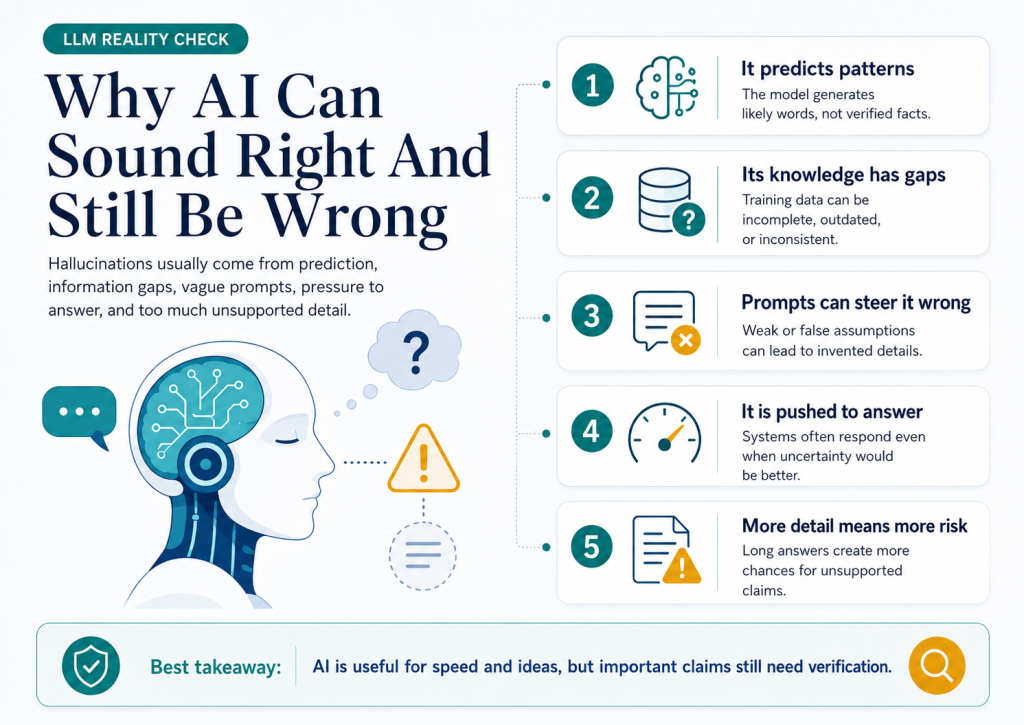
AI hallucinations happen because language models are built to generate likely language, not to confirm truth.
When a model receives a prompt, it predicts which words or tokens should come next based on patterns learned during training.
Most of the time, that process creates a useful response.
But the model does not automatically know whether the answer is supported by a reliable source. If the information is missing, unclear, outdated, or outside its training, it may still continue generating text.
That is where hallucinations begin.
The Model Predicts Instead Of Verifies
A language model does not check every claim against a database of facts.
It generates a response by estimating what language is most likely to fit the prompt and context.
A likely answer can sound correct without being true.
The Training Data Is Incomplete
No model has access to every fact, document, event, or update.
Training data can also contain errors, contradictions, outdated information, and gaps.
When the model encounters a question that falls inside those gaps, it may fill them with patterns that sound plausible.
The Prompt Leaves Room For Guessing
Vague or misleading prompts can increase the risk of hallucination.
If a question assumes something false, the model may accept the assumption and build an answer around it.
For example, asking about a study that does not exist may lead the model to invent details instead of correcting the premise.
The Model Is Encouraged To Answer
Many AI systems are designed to be helpful and responsive.
That can create pressure to provide an answer even when the model is uncertain.
If the system is rewarded for completing the task but not for admitting uncertainty, guessing may become more likely than saying, “I do not know.”
Longer Answers Create More Opportunities For Error
Every additional claim creates another chance for something to go wrong.
A short response may contain one factual statement. A detailed explanation may include dates, names, statistics, sources, examples, and conclusions.
The more unsupported detail the model generates, the greater the chance that part of the answer will be false.
Hallucinations are not one isolated defect.
They are a result of how language models generate responses, the limits of their training data, the wording of the prompt, and the pressure to keep answering.
Research published in Nature argues that next-word prediction creates statistical pressure toward hallucination, while accuracy-based evaluations can reward confident guessing instead of admitting uncertainty.
The Most Common Types Of AI Hallucinations
AI hallucinations do not all look the same.
Some are easy to spot. Others are mixed into otherwise accurate answers and can pass unnoticed.
Invented Facts
The model may create names, dates, events, statistics, or explanations that have no reliable basis.
These claims often sound reasonable because they follow familiar patterns.
Fake Citations And Sources
An AI system may generate a convincing article title, author name, court case, academic paper, or URL that does not exist.
It may also cite a real source that does not support the claim being made.
False Quotes
The model may place words inside quotation marks and attribute them to a real person, book, speech, or study.
The quote may be partly altered or completely fabricated.
Incorrect Summaries
An AI can summarize a document while missing an important qualification, reversing the author’s position, or presenting a minor detail as the main conclusion.
The summary may be fluent while changing the meaning of the original source.
Blended Information
The model may combine details from different people, events, products, or studies into one answer.
Each detail may resemble something real, but the final combination is false.
Unsupported Conclusions
An AI system may start with accurate information and then draw a conclusion the evidence does not justify.
This is especially difficult to notice because the supporting facts can make the final claim appear credible.
Outdated Information Presented As Current
A model may give information that was once correct but is no longer accurate.
It may describe an old law, product feature, officeholder, price, or policy as if nothing has changed.
Fabricated Details In Creative Or Technical Work
Hallucinations also appear in code, formulas, instructions, and generated media.
The model may invent a software function, misstate a technical requirement, produce unusable code, or add realistic-looking details that do not match the request.
The most dangerous hallucinations are not always the most dramatic.
They are often small, believable errors hidden inside an answer that is mostly correct.
Why Confident AI Answers Are So Easy To Trust
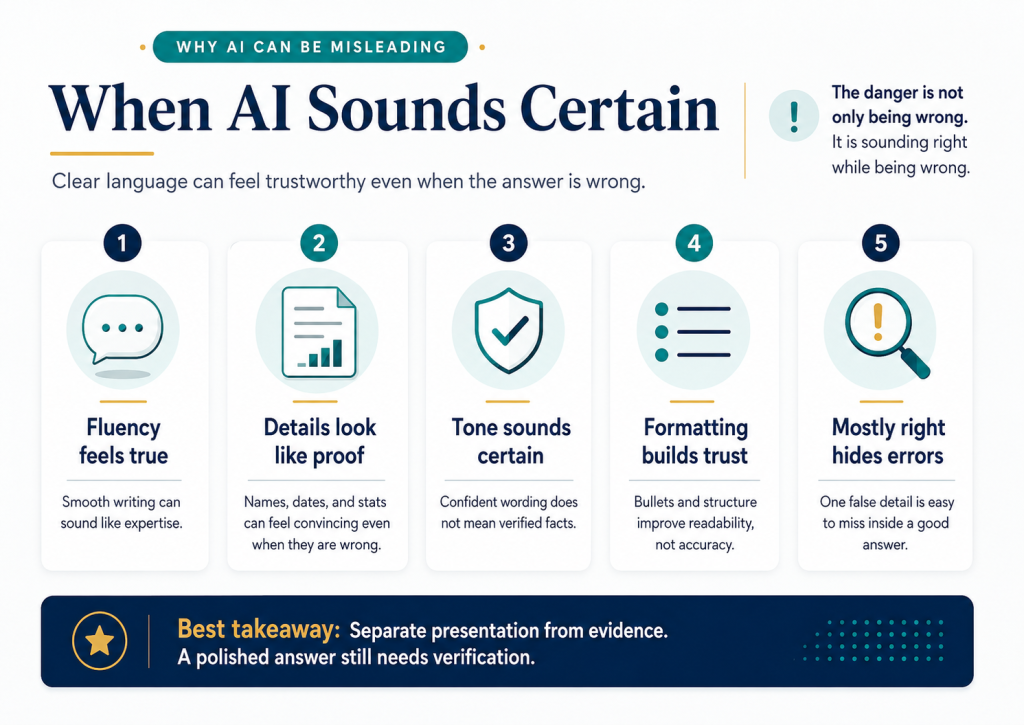
AI hallucinations are dangerous because they rarely look uncertain.
A model can present a false answer with the same polished tone it uses for an accurate one. It may organize the response clearly, explain its reasoning, and include specific details that make the information feel credible.
That presentation creates a trust problem.
Fluency Feels Like Knowledge
People often associate clear language with expertise.
When an answer is well written, grammatically correct, and easy to follow, it can feel more reliable than it actually is.
Language models are especially good at fluency. That strength can hide weak evidence.
Specific Details Create False Credibility
Names, dates, statistics, quotes, and citations make an answer appear researched.
But an AI system can generate those details even when they are unsupported or fabricated.
The presence of detail should not be confused with proof.
Confidence Is Part Of The Writing Style
An LLM does not need to feel certain before using confident language.
It may state a claim directly because that style fits the predicted response, not because the model has verified the information.
The tone reflects language generation, not internal certainty.
Helpful Formatting Can Hide Weak Evidence
Headings, bullet points, tables, and step-by-step explanations make information easier to read.
They can also make a false answer look organized and authoritative.
Professional formatting improves presentation. It does not improve factual accuracy on its own.
People Expect Computers To Be Precise
Many traditional tools behave predictably.
Calculators, databases, and search filters usually return consistent results based on defined rules. Users may carry that expectation into generative AI.
But a language model is not a calculator or a verified database.
It generates responses probabilistically, which means the same fluency can appear in both accurate and inaccurate answers.
Mostly Correct Answers Lower Suspicion
Hallucinations are often surrounded by true information.
If most of the answer is accurate, readers may be less likely to question one incorrect name, statistic, date, or conclusion.
That is why subtle hallucinations can be more dangerous than obvious ones.
The safest approach is to separate presentation from evidence.
An answer can be clear, detailed, and confident while still requiring verification.

Where AI Hallucinations Become Dangerous
Not every hallucination carries the same risk.
A wrong movie recommendation may be inconvenient. A false medical instruction, legal citation, or financial claim can cause real harm.
The danger depends on what the answer is used for, how much people trust it, and whether anyone checks the result before acting.
Healthcare
In healthcare, an AI system may misstate symptoms, invent a treatment, misunderstand clinical guidance, or summarize medical information incorrectly.
Even a polished answer can be unsafe if it causes someone to delay care, use the wrong medication, or misunderstand a diagnosis.
AI can support healthcare work, but it should not replace qualified medical judgment.
Legal Work
Legal hallucinations can appear as fake court cases, incorrect statutes, invented quotations, or misleading summaries of legal documents.
These errors are especially serious because legal decisions often depend on precise wording, jurisdiction, and current law.
Every legal citation generated by AI should be checked against an authoritative source.
Finance
An AI system may provide outdated prices, incorrect tax guidance, unsupported investment claims, or false information about financial products.
The risk increases when users mistake a general explanation for personalized financial advice.
Financial decisions require current data, context, and professional review when the stakes are high.
Academic And Professional Research
AI can invent studies, authors, statistics, journals, or findings that appear credible.
A fabricated source can weaken an article, report, thesis, or business decision even when the rest of the work is accurate.
Researchers should verify every citation and return to the original source before using a claim.
News And Current Events
Language models may rely on outdated knowledge or combine separate events into one false account.
They can also repeat rumors, misidentify people, or present incomplete reporting as settled fact.
Current events should always be checked against recent, reputable sources.
Software And Technical Systems
AI-generated code may contain insecure functions, nonexistent libraries, incorrect syntax, or logic that fails in edge cases.
A technical answer can look convincing while introducing security problems or breaking a system.
Generated code should be tested, reviewed, and understood before deployment.
AI Agents And Automated Workflows
Hallucinations become more serious when AI can take action.
A chatbot may give a wrong answer. An AI agent may act on that answer by updating a record, sending a message, approving a request, or triggering another system.
The shift from generation to execution increases the cost of error.
The higher the stakes, the less acceptable unchecked hallucination becomes.
AI should be used with stronger verification, narrower permissions, and clearer human oversight whenever its output can affect health, rights, money, safety, or real-world decisions.
The NIST Generative Artificial Intelligence Profile identifies confabulation, harmful bias, data privacy, information integrity, and intellectual property as significant generative AI risks, especially when outputs influence consequential decisions.

How RAG Can Reduce AI Hallucinations
Retrieval-Augmented Generation, or RAG, can reduce hallucinations by giving the model relevant source material before it answers.
Instead of relying only on patterns learned during training, the system retrieves information from a defined collection of documents, webpages, databases, or other approved sources.
That evidence is then added to the model’s context.
RAG Gives The Model Better Information
A language model is more likely to hallucinate when it lacks the facts needed to answer.
RAG helps by retrieving material that is current, specific, or outside the model’s original training data.
For example, a RAG system might retrieve the latest policy, research paper, product documentation, or account record before generating a response.
RAG Can Make Answers Easier To Verify
A well-designed RAG system can show which sources were used.
That gives the user a way to compare the answer with the supporting evidence.
Visible sources do not guarantee accuracy, but they make unsupported claims easier to detect.
RAG Can Limit The Answer To Approved Material
Some systems instruct the model to answer only from the retrieved context.
This can reduce the chance that it fills missing information with broad patterns or invented details.
The system may also be told to admit when the available sources do not contain enough evidence.
Retrieval Can Still Fail
RAG does not eliminate hallucinations.
The system may retrieve the wrong document, miss an important passage, use outdated information, or provide context that is only loosely related to the question.
The model can also misunderstand the retrieved material or add claims that the sources do not support.
Citations Can Still Be Misleading
An answer may include a real citation even when the source does not support every claim.
That creates a more subtle type of hallucination because the presence of a source can make the response appear verified.
Users still need to check whether the cited passage actually supports the statement.
RAG improves the model’s access to evidence.
It does not guarantee that the system will retrieve, interpret, or present that evidence correctly.
Research on retrieval-augmented language models found that providing models with retrieved evidence can substantially reduce hallucinations in conversational responses, although the results still depend on the relevance and quality of the retrieved information. Retrieval Augmentation Reduces Hallucination in Conversation

How To Verify AI-Generated Information
The safest way to use AI is to treat important answers as a starting point, not a final authority.
Verification does not mean checking every casual response. It means matching the level of review to the risk of being wrong.
Check The Original Source
If the AI cites a study, law, article, policy, or report, open the source.
Confirm that it exists and that it supports the claim being made.
A real citation can still be used incorrectly.
Verify Specific Claims
Names, dates, statistics, quotations, prices, legal requirements, and technical details deserve extra attention.
These are common places for hallucinations because they require precise information.
Use Current And Authoritative Sources
For changing information, rely on sources that are both recent and credible.
Official documentation, government websites, original research, recognized institutions, and primary sources are usually stronger than summaries or anonymous posts.
Ask The AI To Show Its Evidence
Request sources, quotations, or the exact passage behind the answer.
This does not prove the response is correct, but it makes the reasoning easier to inspect.
If the system cannot provide evidence, treat the claim with more caution.
Compare More Than One Source
A single source may be incomplete, outdated, or wrong.
When the decision matters, compare the claim across multiple reliable sources.
Agreement does not guarantee truth, but it lowers the risk of relying on one weak reference.
Check Whether The Answer Matches The Question
An AI response may be accurate in general while failing to answer the specific question.
Look for missing conditions, exceptions, dates, jurisdictions, definitions, or context that could change the conclusion.
Test Code And Technical Instructions
Generated code should be run in a safe environment.
Check whether the libraries exist, the functions behave as described, and the output works under realistic conditions.
Technical fluency is not proof that the code is secure or correct.
Use Human Review For High-Stakes Decisions
AI should not be the final reviewer when the answer affects health, legal rights, finances, safety, employment, or other serious outcomes.
A qualified person should verify the information and take responsibility for the decision.
The goal is not to distrust every AI answer.
The goal is to know when an answer needs evidence before it deserves confidence.

Can AI Hallucinations Be Eliminated?
AI hallucinations can be reduced, but they cannot currently be eliminated completely.
The reason is structural.
Large Language Models generate responses by predicting likely language. They do not verify every statement against a complete and authoritative record of truth.
Even when a model has access to strong sources, errors can still enter at different stages.
Better Training Can Reduce Errors
Higher-quality training data, stronger evaluation, and improved model design can make AI systems more reliable.
Models can also be trained to recognize uncertainty, refuse unsupported requests, and avoid inventing details when evidence is missing.
These improvements help, but they do not remove every failure.
Retrieval Can Improve Grounding
RAG can give a model access to current and source-specific information.
This lowers the risk of answering from incomplete training data.
But retrieval can still select the wrong passage, miss important context, or supply conflicting evidence.
Clearer Prompts Can Reduce Guessing
A well-structured prompt can tell the model to use only supplied evidence, separate facts from assumptions, and admit when information is unavailable.
That can improve the response.
It cannot guarantee that the model will follow every instruction perfectly.
Human Review Remains Necessary
Human review is still one of the strongest safeguards, especially when the answer affects health, law, finance, safety, or other serious decisions.
People can compare claims with original sources, notice missing context, and take responsibility for the final judgment.
Reliability Depends On The Entire System
The model is only one part of the problem.
Hallucination risk also depends on the source material, retrieval method, prompt, connected tools, evaluation process, and level of oversight.
A better model inside a weak system can still produce unreliable results.
The realistic goal is not zero hallucinations.
It is lower risk, stronger evidence, clearer uncertainty, and better controls around how AI-generated information is used.
Researchers have developed uncertainty-based methods that can identify some types of confabulation, but these techniques address only part of the broader hallucination problem. Nature
Conclusion
AI hallucinations are not random glitches.
They are a consequence of how language models generate responses. These systems are designed to produce likely language, not to verify every claim against a complete source of truth.
That is why an answer can sound polished, detailed, and confident while still being wrong.
The risk becomes more serious when AI is used in healthcare, law, finance, research, software, or automated workflows where false information can influence real decisions.
Hallucinations can be reduced.
Better training, stronger retrieval, clearer prompts, visible sources, and human review all help. But none of those safeguards turns AI into a perfect authority.
The most useful approach is neither blind trust nor automatic rejection.
It is disciplined use.
AI can accelerate research, writing, analysis, and problem-solving. Its answers become safer when people know what to verify, where errors are most likely, and why confidence should never be treated as proof.

Frequently Asked Questions
What Is An AI Hallucination?
An AI hallucination is a false, unsupported, or fabricated output generated by an AI system.
It may appear as an invented fact, fake citation, incorrect summary, false quote, or conclusion that is not supported by evidence.
Why Does AI Make Things Up?
AI makes things up because language models are designed to generate likely responses, not verify every statement as true.
When information is missing, unclear, or outside the model’s knowledge, the system may still produce a plausible answer instead of admitting uncertainty.
Do AI Models Know When They Are Hallucinating?
Not reliably. A model may generate a false answer using the same confident tone it uses for an accurate one. It does not have human self-awareness or a dependable internal sense of truth.
Are AI Hallucinations The Same As Lies?
No. Lying implies intent to deceive. AI systems do not have human intentions.
A hallucination happens when the model generates false or unsupported information because of how it predicts language.
What Are Common Examples Of AI Hallucinations?
Common examples include:
- Invented statistics
- Fake academic papers
- False legal cases
- Misattributed quotations
- Incorrect dates
- Broken or fabricated links
- Unsupported conclusions
- Outdated information presented as current
Can RAG Stop AI Hallucinations?
RAG can reduce hallucinations by giving the model access to relevant source material before it answers.
It cannot eliminate them. The system may still retrieve the wrong information, misunderstand the source, or add claims the evidence does not support.
How Can You Tell If An AI Answer Is Hallucinated?
Check whether the answer includes claims that can be verified.
Review names, dates, statistics, citations, quotations, and technical details against reliable sources. Be especially cautious when the answer sounds highly specific but provides no evidence.
Are Some AI Models Less Likely To Hallucinate?
Some models perform better than others on factuality and reliability tests.
However, every current generative AI model can hallucinate. The risk also depends on the prompt, topic, available context, retrieval system, and way the output is used.
Are AI Hallucinations Dangerous?
They can be. The risk is highest when hallucinated information affects healthcare, law, finance, safety, employment, research, or automated decisions.
A low-stakes factual error may be inconvenient. A high-stakes error can cause real harm.
Can AI Hallucinations Be Completely Eliminated?
Not with current technology. Better models, retrieval systems, clearer prompts, visible sources, and human review can reduce the risk, but no method guarantees perfect accuracy.
Should You Trust AI-Generated Information?
AI-generated information should be treated according to the risk of being wrong.
For casual or creative tasks, limited verification may be enough. For important factual claims or high-stakes decisions, the information should be checked against authoritative sources.

Leave a Reply