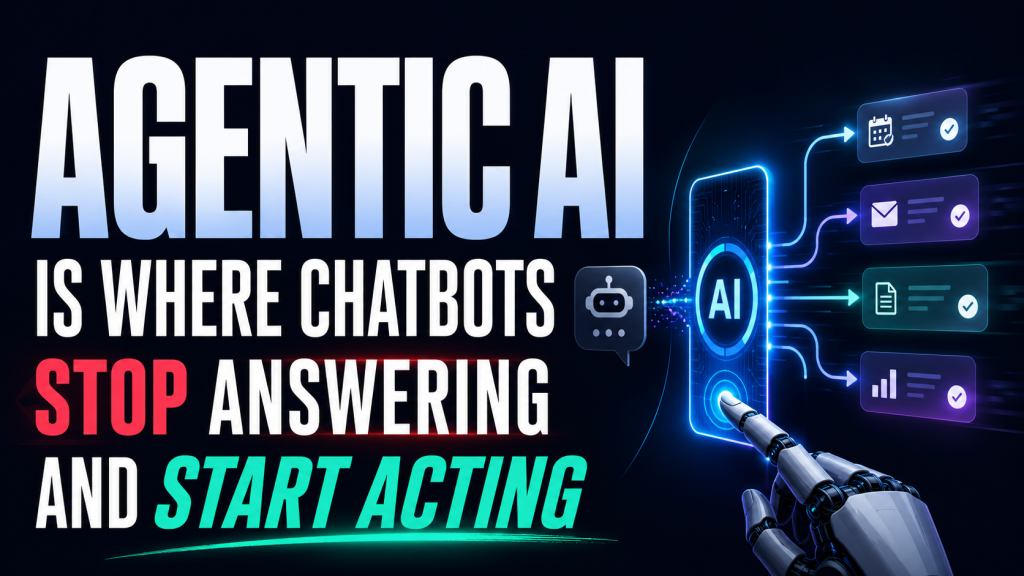
Agentic AI Is Where Chatbots Stop Answering And Start Acting
Introduction
Most AI tools still wait for instructions.
You ask a question. The system responds. You give another prompt. It answers again. That pattern has made AI useful, but it also keeps the human responsible for every next step.
Agentic AI changes that relationship.
Instead of only responding to prompts, agentic AI systems can work toward a goal. They can plan steps, use tools, make decisions inside a defined workflow, and adjust based on what happens next.
That shift is why agentic AI matters.
It moves artificial intelligence from conversation into execution. A chatbot can explain how to update a customer record. An agentic AI system may be able to check the customer history, draft the response, update the CRM, and flag the case for review.
That makes the technology powerful.
It also makes it riskier.
When AI only gives an answer, the main concern is whether the answer is right. When AI can take action, the concern becomes larger: what systems can it access, what decisions can it make, what happens if it is wrong, and who is responsible?
This guide explains what agentic AI is, how it works, where it creates value, and why autonomy only becomes useful when it is paired with control.
Key Takeaways
- Agentic AI refers to AI systems that can plan, act, and work toward goals with limited human supervision.
- The main difference between agentic AI and a chatbot is execution. A chatbot responds to prompts. Agentic AI can take steps inside a workflow.
- Agentic AI often depends on language models, tools, memory, planning, permissions, feedback loops, and guardrails.
- The strongest use cases are repeatable workflows with clear goals, reliable data, and controlled access to systems.
- The biggest risks come from wrong actions, weak permissions, poor oversight, data exposure, and overtrust.
Affiliate Disclosure: Some links on our site are affiliate links. This means that if you click one of these links and make a purchase, we may earn a small commission at no additional cost to you.
What Agentic AI Actually Means
Agentic AI is artificial intelligence designed to pursue a goal, not just respond to a prompt.
The word “agentic” comes from agency. It refers to the ability to act, make choices, and move toward an outcome. In AI, that means a system can take steps inside a workflow with some level of independence.
A regular chatbot waits for the user to guide each move.
An agentic AI system can receive a goal and decide what steps are needed to complete it. It may search information, call a tool, open a file, update a system, draft a message, compare options, or ask for approval before moving forward.
That does not mean agentic AI is fully independent.
Most useful agentic systems still need limits. They need permissions, guardrails, review points, and clear rules about what they can and cannot do.
The simplest way to understand agentic AI is this:
A chatbot helps you think through a task.
Agentic AI helps carry out the task.
IBM defines agentic AI as an AI system that can accomplish a specific goal with limited supervision, often through agents that handle subtasks and coordinate through orchestration.
Why Agentic AI Feels Like A Bigger Shift Than Chatbots
Chatbots changed how people interact with AI.
Agentic AI changes what AI can do after the interaction begins.
That difference matters.
A chatbot can answer a question, draft a message, summarize a document, or explain a process. But the user usually has to decide the next step, move between tools, check the result, and complete the workflow manually.
Agentic AI pushes beyond that pattern.
It can connect the answer to action. Instead of only telling a user what to do, it may help execute the task inside a defined system.
That is why agentic AI feels like a larger shift.
It moves AI from a support layer into the workflow itself.
In a customer support setting, a chatbot may suggest a response. An agentic system may review the ticket, check the customer’s history, draft the reply, update the CRM, and escalate the issue if it meets certain conditions.
In a software workflow, a chatbot may explain an error. An agentic system may inspect the codebase, suggest a fix, run tests, and prepare a pull request for review.
The value is not just better answers.
The value is fewer handoffs between thinking, deciding, and doing.
McKinsey describes agentic AI as systems based on generative AI foundation models that can act in the real world and execute multistep processes, which is why the shift from response to action matters for business workflows.
How Agentic AI Works
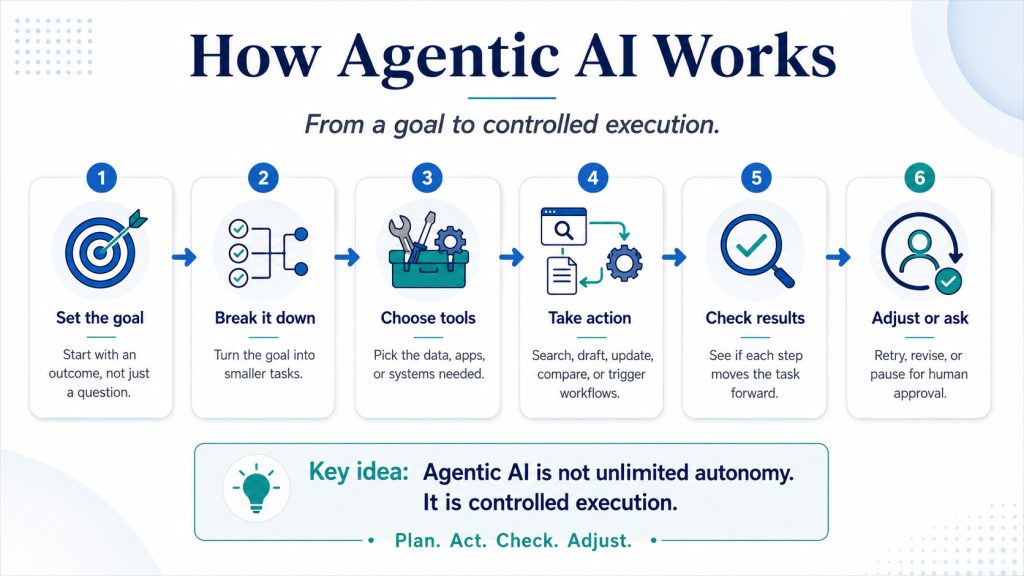
Agentic AI works by turning a goal into a sequence of actions.
The process usually starts with an instruction. The user gives the system an outcome to pursue, not just a question to answer. That outcome might be “summarize these support tickets and identify urgent cases” or “research these accounts and prepare a sales brief.”
The system then breaks the goal into smaller steps.
It may decide what information it needs, which tools to use, what order the steps should happen in, and when to ask for human approval. This planning layer is what separates agentic AI from a simple one-response chatbot.
Once the plan is formed, the system begins taking action.
It might search documents, call an API, update a database, generate a draft, compare results, or trigger another workflow. After each action, it checks whether the result moves the task closer to completion.
That feedback loop is essential.
If the first step fails, the system may adjust the plan. If the data is missing, it may ask for clarification. If the action requires approval, it may pause before continuing.
The basic flow looks like this:
- A user gives the system a goal.
- The system breaks the goal into steps.
- It chooses the tools or information it needs.
- It takes action inside the allowed workflow.
- It checks the result.
- It adjusts, continues, or asks for human input.
The goal is not unlimited autonomy.
The goal is controlled execution.
What An AI Agent Needs To Take Action
An AI agent cannot act on its own just because it uses a powerful model.
It needs a system around it.
The first requirement is a clear goal. The agent needs to know what outcome it is trying to reach. A vague instruction can lead to vague action, so the task must be specific enough to guide the workflow.
The second requirement is access to tools. An agent may need to search a database, read a document, use a browser, update a CRM, send a message, create a ticket, or call an API. Without tools, the system can only respond. With tools, it can act.
The third requirement is context. The agent needs relevant information about the task, the user, the workflow, and the rules it must follow. That context may come from documents, memory, connected systems, or retrieval tools.
The fourth requirement is permission. An agent should not have unlimited access. It needs clear boundaries around what it can view, change, send, delete, approve, or escalate.
The fifth requirement is feedback. After the agent takes a step, it needs a way to check whether that step worked. Without feedback, it cannot adjust its plan or recover from mistakes.
The final requirement is human oversight. Some actions should happen automatically. Others should pause for review before anything is changed, sent, or approved.
Agentic AI works best when these pieces are designed together.
A model alone can generate an answer. An agent needs goals, tools, context, permissions, feedback, and guardrails to complete work safely.
OpenAI’s guide to building agents explains that agents become more useful when they are connected to tools, because tool access allows them to move beyond responses and complete more complex tasks inside workflows.
Where Agentic AI Shows Up In Real Workflows
Agentic AI is most useful when work has multiple steps.
It is not needed for every task. If someone only needs a quick answer, a regular chatbot may be enough. Agentic AI becomes more useful when the task requires planning, tool use, follow-up, and movement across systems.
Customer support is one example.
An agentic system can review a ticket, check the customer’s account history, suggest a response, update the case status, and escalate the issue if it meets certain rules.
Sales teams can use agentic AI to research prospects, summarize company information, enrich lead records, draft outreach, and update CRM fields after a rep approves the next step.
Software teams can use agentic systems to inspect code, explain errors, suggest fixes, run tests, and prepare changes for review.
Operations teams can use agents to monitor reports, flag unusual activity, move information between tools, and prepare summaries for managers.
Research teams can use agentic AI to gather information, compare sources, extract key points, and organize findings into a usable brief.
The strongest use cases share the same pattern.
The workflow is repeatable. The goal is clear. The data is accessible. The actions can be limited. And a human can review the result when the stakes are high.
Agentic AI is not valuable because it acts everywhere.
It is valuable when it acts inside the right workflow.
Why Agentic AI Can Be Risky
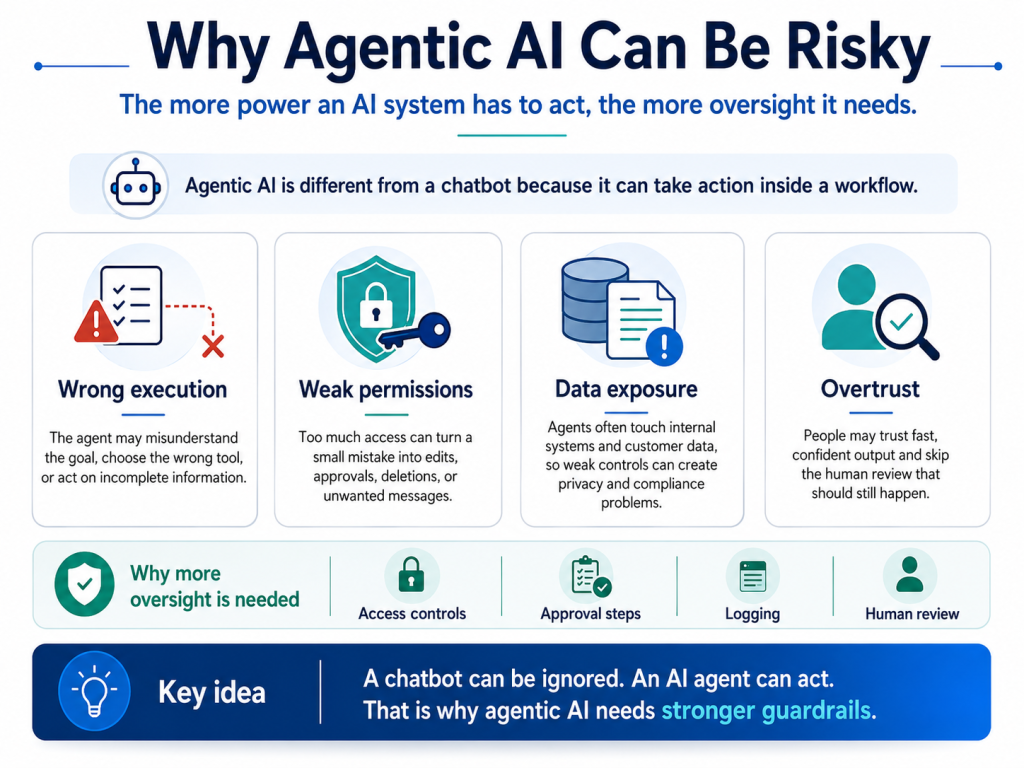
Agentic AI is risky because it does more than generate answers.
It can take action.
That changes the stakes. If a chatbot gives a bad response, the user can ignore it, revise it, or ask again. If an agentic AI system takes the wrong action inside a workflow, it may update the wrong record, send the wrong message, expose private data, trigger the wrong process, or make a decision that affects a customer, employee, or business operation.
The first risk is wrong execution.
An agent may misunderstand the goal, use the wrong tool, act on incomplete information, or follow a plan that looks reasonable but produces the wrong result.
The second risk is weak permissions.
If an AI agent has too much access, a small error can become a larger problem. A system that can read documents is less risky than one that can edit records, approve transactions, delete data, or message customers without review.
The third risk is data exposure.
Agentic systems often need access to internal documents, customer records, business systems, and connected tools. Without strong controls, they can create privacy, security, and compliance issues.
The fourth risk is overtrust.
People may assume the agent is handling the workflow correctly because it sounds confident or completes tasks quickly. That can reduce human review at the exact moment review matters most.
This is why agentic AI needs more oversight than a chatbot.
The more power a system has to act, the more carefully its access, logging, approvals, and failure points need to be designed.
How Businesses Should Approach Agentic AI
Businesses should not start with the question, “How much can we automate?”
They should start with a better question:
Where can agentic AI act safely, clearly, and usefully?
The best starting points are narrow workflows with clear rules. A support triage process, sales research task, internal report summary, or CRM update workflow is easier to control than a broad agent with open-ended authority across the company.
The workflow should also have reliable data.
An AI agent cannot act well if the documents are outdated, the CRM is messy, or the system cannot access the right information. Poor inputs lead to poor actions.
Permissions should be limited from the start.
Give the agent only the access it needs to complete the task. If it only needs to read customer history, do not give it permission to edit billing records. If it can draft an email, require human approval before sending.
Businesses also need monitoring.
Every agentic workflow should have logs that show what the agent did, which tools it used, what information it accessed, and where a human approved or changed the result.
The right approach is controlled rollout.
Start small. Test the workflow. Measure accuracy. Review failures. Add safeguards. Expand only when the system proves it can act reliably inside clear limits.
Agentic AI becomes useful when businesses design for both action and accountability.
NIST’s AI Risk Management Framework emphasizes the need to manage AI risks to individuals, organizations, and society, which supports the need for clear oversight, accountability, testing, and governance when businesses deploy agentic systems.
What Agentic AI Means For The Future Of Automation
Agentic AI is not just a better chatbot.
It is a shift in how automation works.
Traditional automation depends on fixed rules. A workflow runs because someone defines each step in advance. If this happens, do that. If a condition changes, the workflow may fail or require manual adjustment.
Agentic AI makes automation more flexible.
Instead of following only a rigid sequence, an agentic system can interpret a goal, choose steps, use tools, respond to feedback, and adjust within defined limits.
That does not mean traditional automation disappears.
Rules-based automation is still useful when the process is stable, predictable, and low-risk. Agentic AI becomes more valuable when the workflow involves judgment, changing inputs, multiple tools, or decisions that require context.
The future of automation will likely combine both.
Simple tasks will still use rules. More complex workflows may use agents. Human review will remain important where actions affect customers, money, legal obligations, private data, or business-critical systems.
The real future is not fully autonomous AI replacing every workflow.
It is controlled automation where AI can handle more steps, but people still define the goals, limits, permissions, and points of review.
Conclusion
Agentic AI matters because it changes the role of artificial intelligence.
A chatbot can answer a question. An agentic AI system can help move work forward. That shift from response to action is what makes the technology so powerful.
It is also what makes it harder to manage.
The more an AI system can do, the more important its limits become. Businesses need clear goals, reliable data, narrow permissions, human review, monitoring, and accountability before they give AI systems authority inside real workflows.
Agentic AI should not be judged by how independent it can become.
It should be judged by how safely and usefully it can act inside a well-designed system.
The future of AI automation will not be defined by autonomy alone. It will be defined by controlled action, where AI handles more of the workflow without removing human responsibility.

Frequently Asked Questions
What Is Agentic AI?
Agentic AI is AI designed to pursue a goal, plan steps, use tools, and take action inside a workflow with limited human supervision.
It is different from a basic chatbot because it can do more than respond. It can help execute tasks.
How Is Agentic AI Different From Generative AI?
Generative AI creates outputs such as text, images, code, or summaries.
Agentic AI uses AI to move toward a goal. It may rely on generative AI, but it adds planning, tool use, feedback, permissions, and workflow execution.
What Is An AI Agent?
An AI agent is a system that can perform tasks on behalf of a user or organization.
It usually has a goal, access to tools, context about the task, and rules that define what it can and cannot do.
What Are Examples Of Agentic AI?
Examples include systems that triage customer support tickets, research sales leads, update CRM records, summarize internal reports, inspect code, run tests, or gather information across multiple tools.
The key feature is that the system can take steps toward completing a task, not just explain what to do.
What Are The Risks Of Agentic AI?
The main risks include wrong actions, weak permissions, data exposure, tool misuse, poor monitoring, and overtrust.
The risk is higher when the system can edit records, send messages, approve actions, access private data, or trigger business workflows.
Can Businesses Use Agentic AI Safely?
Yes, but only with clear limits. Businesses should start with narrow workflows, reliable data, limited permissions, logging, human approval points, and regular review. Agentic AI works best when autonomy is paired with control.
Will Agentic AI Replace Traditional Automation?
Not completely. Traditional automation is still useful for stable, rule-based processes. Agentic AI is better suited for workflows that involve changing inputs, multiple tools, judgment, or step-by-step adaptation.
Leave a Reply