Deep Learning: How the Most Powerful AI Systems Work
Introduction
Deep learning can help predict the structure of more than 200 million proteins, power the chatbot you used this morning, recognize your face on your phone, and translate a sentence in seconds.
That is the brilliant part.
The baffling part is that even the people who build deep learning systems cannot always explain exactly why a model reached a specific answer.
That tension is what makes deep learning so important to understand. It is one of the core technologies behind modern artificial intelligence, but it is also one of the reasons AI can feel both powerful and unpredictable.
This guide explains what deep learning is, how it works, why it became so important, where it shows up in the real world, and why its biggest weakness is not just that it can be wrong. It is that it can be wrong in ways that are hard to trace.
Key Takeaways
- Deep learning is a form of machine learning that uses layered neural networks to find patterns in large datasets.
- Unlike traditional software, deep learning systems learn from examples instead of relying only on hand-written rules.
- Deep learning became powerful because of massive datasets, specialized hardware, and better model architectures.
- The same complexity that makes deep learning useful also makes many systems difficult to interpret.
- Deep learning can support major breakthroughs, but it can also produce false outputs, amplify bias, and fail in ways that are difficult to diagnose.
Affiliate Disclosure: Some links on our site are affiliate links. This means that if you click one of these links and make a purchase, we may earn a small commission at no additional cost to you.
What Deep Learning Actually Means
Deep learning is a specialized form of machine learning.
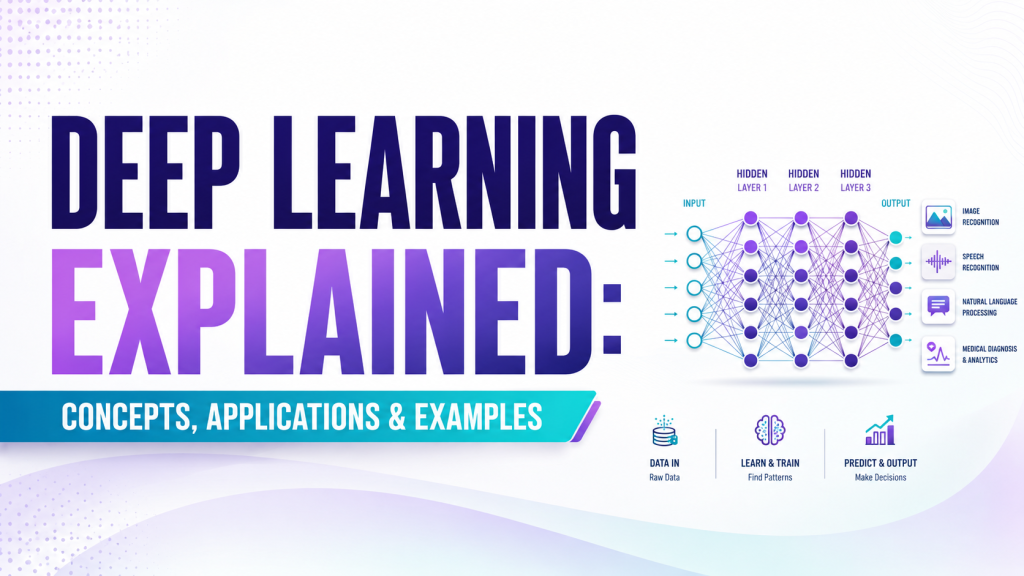
Machine learning is the broader field of AI where systems learn patterns from data. Deep learning goes further by using artificial neural networks with multiple layers. These layers allow a model to learn simple patterns first, then combine them into more complex patterns.
That is why the word “deep” matters.
It does not mean the system understands the world deeply. It means the network has multiple layers of processing between the input and the output.
A basic machine learning model might rely on features that humans define in advance. A deep learning model can learn many of those features on its own by processing large amounts of data.
For example, instead of telling a system every rule that defines a cat, engineers can train a deep learning model on many images. Early layers may learn edges and textures. Later layers may learn shapes, ears, eyes, fur patterns, and eventually the broader concept of “cat.”
This is the central shift.
Traditional software follows instructions.
Deep learning learns patterns.
IBM defines deep learning as a subset of machine learning that uses multi-layered neural networks to learn from data, which is why the term usually applies to systems that process complex inputs such as images, language, audio, and code.

How Deep Learning Moved Beyond Hand-Written Rules
Early artificial intelligence depended heavily on rules-based programming.
Humans had to define the logic. The system followed the instructions. This worked well when the problem had clear rules, limited variables, and predictable outcomes.
Chess is a good example. A program can evaluate possible moves because the board, pieces, and legal actions are clearly defined.
The real world is harder.
Recognizing speech, identifying tumors in scans, translating language, predicting protein structures, or understanding natural images all involve messy patterns. There are too many variations for humans to manually code every rule.
Deep learning changed the approach.
Instead of writing every instruction, developers train models on examples. The model adjusts itself as it finds patterns that improve performance.
That is why deep learning became so important. It made AI more useful in problems where the rules are difficult to write but patterns exist in the data.
Inside The Artificial Neural Network
A deep learning system is built from artificial neural networks.
These networks are loosely inspired by the structure of the brain, but they do not think like a human brain. They are mathematical systems made of connected nodes, often called artificial neurons.
A simple neural network has three broad areas:
- An input layer that receives the data.
- Hidden layers that process and transform the data.
- An output layer that produces the prediction or result.
Each connection between nodes has a value called a weight. During training, the model adjusts these weights to reduce errors.
If the model misclassifies an image, mistranslates a phrase, or predicts the wrong next word, the training process pushes the network to adjust. Over many examples, the model becomes better at finding patterns that lead to accurate outputs.
The power comes from the layers.
One layer may detect simple details. Another may combine those details into shapes. A deeper layer may connect those shapes to more meaningful patterns.
This layered learning is why deep learning is so effective for complex data such as images, audio, language, code, and biological structures.
Why Deep Learning Needs So Much Data And Computing Power
Deep learning works best when it has enough data to learn from and enough computing power to process that data.
That is one reason the field accelerated so quickly in recent years.
The internet created enormous stores of text, images, audio, video, and code. At the same time, specialized hardware made it possible to train large models at much greater scale.
Graphics Processing Units, or GPUs, became especially important because they can perform many calculations at the same time. Tensor Processing Units, or TPUs, were also developed for machine learning workloads.
This matters because training a large deep learning model is not like running a normal software program. The model may need to process billions or trillions of data points while adjusting huge numbers of internal parameters.
That scale is expensive.
It requires advanced chips, data centers, engineering talent, energy, and time. This is why the most advanced models are often built by large technology companies, research labs, and well-funded AI organizations.
Deep learning is not powerful because of one breakthrough alone. It is powerful because data, compute, model design, and engineering all reached a level where large-scale learning became practical.
According to the Stanford AI Index 2025, AI development increasingly depends on large-scale infrastructure, investment, and technical resources, which helps explain why the most advanced deep learning systems are often built by organizations with access to significant compute.
The Architectures That Made Modern AI Possible
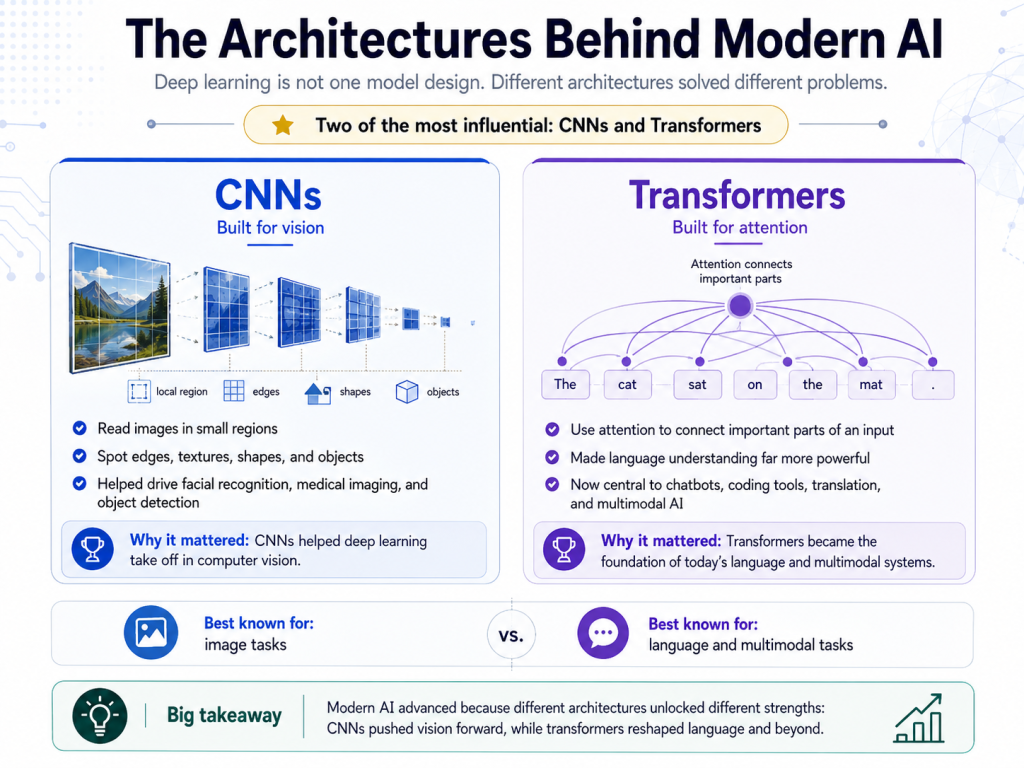
Deep learning is not one single model design.
It is a family of approaches. Different architectures are built for different kinds of data and different kinds of tasks.
Two of the most important are convolutional neural networks and transformers.
Convolutional Neural Networks
Convolutional Neural Networks, often called CNNs, became foundational in computer vision.
They are especially good at recognizing patterns in images because they can scan small parts of an image and detect features such as edges, textures, shapes, and objects.
CNNs helped drive progress in tasks like facial recognition, medical imaging, object detection, and autonomous vehicle perception.
They are no longer the only major architecture used for vision, but they remain one of the most important ideas in the history of deep learning.
Transformers
Transformers changed the direction of modern AI.
They were introduced in the 2017 paper “Attention Is All You Need.” The key idea was attention, a mechanism that helps a model focus on the most relevant parts of an input.
That made transformers especially powerful for language.
A sentence does not make sense word by word in isolation. Meaning depends on relationships between words, even when those words are far apart. Attention helps a model weigh those relationships more effectively.
Transformers are now central to many large language models and multimodal systems. They help power chatbots, coding assistants, summarization tools, translation systems, and models that work across text, images, audio, and video.
The transformer architecture was introduced in the 2017 paper “Attention Is All You Need”, which described an attention-based model architecture that became foundational to many modern language systems.
Where Deep Learning Shows Up In The Real World
Deep learning is no longer confined to research labs.
It is already embedded in everyday products and high-stakes systems.
In healthcare, deep learning can help analyze medical images, support drug discovery, and assist with biological research. AlphaFold is one of the clearest examples. Its protein structure predictions gave researchers access to a massive database that supports work across biology and medicine.
In consumer technology, deep learning powers speech recognition, facial recognition, recommendation systems, photo organization, search, translation, and generative AI tools.
In business, it helps with forecasting, fraud detection, customer support, document analysis, personalization, and workflow automation.
In science, it can help researchers find patterns in massive datasets that would be too large or complex for manual analysis.
The common thread is pattern recognition.
Deep learning excels when the data is complex, the rules are hard to write manually, and enough examples exist for the model to learn from.
Google DeepMind reports that AlphaFold has predicted more than 200 million protein structures, making it one of the clearest examples of deep learning’s impact beyond consumer software.
Why Deep Learning Can Be So Powerful
Deep learning is powerful because it can discover patterns that humans may not know how to describe.
That is its biggest advantage over traditional programming.
A person may not be able to write every rule that separates a benign image from a suspicious one, or every language pattern that makes a sentence sound natural. But a deep learning model can learn statistical relationships from huge numbers of examples.
This allows deep learning systems to perform well in specialized tasks such as image classification, speech recognition, language generation, protein structure prediction, and code completion.
It also makes these systems flexible.
A model trained on one kind of data can sometimes be adapted to related tasks through fine-tuning or transfer learning. This helps explain why the same deep learning foundations can support many different AI products.
Still, the power has a limit.
Deep learning systems do not understand meaning the way humans do. They are not reasoning from lived experience, common sense, or consciousness. They are finding and applying patterns.
That distinction matters because pattern recognition can look like understanding even when it is not.
The Black Box Problem
The greatest weakness of deep learning is not simply that it makes mistakes.
All systems make mistakes.
The deeper problem is that deep learning systems can make mistakes in ways that are difficult to explain.
Many modern models contain billions of parameters. Their behavior emerges from patterns distributed across enormous networks of mathematical relationships. Even when engineers understand the training process, they may not be able to trace a specific output back to a simple, human-readable explanation.
This is known as the black box problem.
It matters most in high-stakes settings.
If an AI system helps screen a medical scan, approve a loan, flag a person for investigation, or guide a safety-critical decision, people need more than a prediction. They need confidence, accountability, and a way to understand why the system acted as it did.
Interpretability research is trying to solve this problem, but it remains one of the central challenges in deep learning.
Computer scientist Cynthia Rudin has argued that black box models are especially problematic in high-stakes decisions because people need systems that are not only accurate, but also interpretable, reviewable, and accountable.
The Risks Behind The Breakthroughs
Deep learning creates several risks because it learns from data instead of fixed rules.
The first risk is false confidence.
A model can produce an answer that sounds accurate even when it is wrong. In generative AI, this is often called a hallucination. The system may produce a fluent response that is not grounded in fact.
The second risk is bias.
If the training data contains biased patterns, the model can learn and reproduce those patterns. This can lead to unfair or distorted outcomes, especially in areas like hiring, lending, policing, healthcare, and education.
The third risk is brittleness.
A deep learning system can perform extremely well in one setting and fail when the environment changes. A model trained on one kind of data may struggle with new patterns, edge cases, or unusual inputs.
The fourth risk is overtrust.
People may assume that a system is reliable because it is advanced, expensive, or confident. But deep learning systems still need testing, monitoring, human oversight, and clear limits.
This is why deep learning should not be treated as magic.
It is a powerful statistical technology. It can do remarkable things, but it still needs careful governance.
The International AI Safety Report 2026 notes that current AI systems can still fabricate information, produce flawed outputs, and give misleading advice, which is why reliability remains a major concern when deep learning systems are used in real-world settings.
What To Understand Before Trusting Deep Learning
The right question is not whether deep learning is good or bad.
The better question is where it can be trusted, under what conditions, and with what safeguards.
A deep learning system is more trustworthy when the task is clearly defined, the data is representative, the model has been tested against real-world conditions, and humans understand the cost of failure.
It is less trustworthy when the data is poor, the decision is high stakes, the model cannot be audited, or users have no way to challenge the result.
This is especially important because deep learning systems often improve performance without improving transparency.
A model can become more accurate on a benchmark and still remain hard to explain. That creates a practical tension. Organizations want better performance, but society also needs accountability.
The safest approach is not blind rejection or blind trust.
It is controlled use.
Deep learning should be applied where it adds real value, monitored where it can fail, and limited where its errors could cause serious harm.
Conclusion
Deep learning changed artificial intelligence by moving machines beyond rigid instructions and into pattern-based learning.
That shift made modern AI possible.
It helped unlock progress in language tools, computer vision, scientific research, healthcare, automation, and everyday software. It also created systems so complex that even experts can struggle to explain exactly how they work.
That is the central truth of deep learning.
It is powerful because it can find patterns humans could never manually program. It is risky because those same patterns can become opaque, biased, brittle, or wrong.
Deep learning is not a mystery because no one understands the math. It is a mystery because scale changes the problem. Once billions of parameters interact across massive datasets, understanding the final behavior becomes far harder than building the system itself.
The future of deep learning will depend on more than larger models. It will depend on better interpretability, better oversight, better data, and a clearer understanding of when these systems should be trusted.

Frequently Asked Questions
What Is Deep Learning?
Deep learning is a form of machine learning that uses artificial neural networks with multiple layers to find patterns in large datasets.
It is used in areas such as image recognition, speech recognition, natural language processing, recommendation systems, and generative AI.
What Is The Difference Between Machine Learning And Deep Learning?
Machine learning is the broader field of AI systems that learn from data.
Deep learning is a specific type of machine learning that uses layered neural networks. These layers allow the system to learn complex patterns with less manual feature engineering.
Why Is Deep Learning So Powerful?
Deep learning is powerful because it can learn complex patterns from huge datasets.
This makes it useful for tasks where humans cannot easily write every rule, such as recognizing images, translating language, predicting biological structures, or generating natural text.
Why Does Deep Learning Require So Much Computing Power?
Deep learning models often contain very large numbers of parameters and must process massive datasets during training.
That requires specialized hardware, especially GPUs or TPUs, along with significant energy, infrastructure, and engineering resources.
What Is The Black Box Problem In Deep Learning?
The black box problem means that a deep learning model’s decision-making process can be difficult for humans to interpret.
A model may produce an accurate answer, but it may not be clear exactly which internal patterns or relationships led to that result.
Do Deep Learning Systems Think Like Humans?
No.
Deep learning systems are loosely inspired by the brain, but they do not have consciousness, lived experience, or human understanding. They use mathematical patterns to make predictions or generate outputs.
Is Deep Learning Safe?
Deep learning can be safe in well-tested, well-monitored, low-risk uses.
It becomes riskier in high-stakes settings where errors are hard to detect, decisions affect people’s lives, or the model’s reasoning cannot be clearly explained.

Leave a Reply