AI Side Hustles: How To Build Extra Income With AI
AI side hustles make the most sense when artificial intelligence improves work that already has value.
That might mean using AI to research faster, produce content more efficiently, analyze information, create digital products, support clients, or streamline parts of a service. The opportunity is not simply having access to an AI tool. It is knowing how to apply that tool to a problem, skill, or business model people are willing to pay for.
Some AI side hustles are service-based and can generate income through client work. Others depend on building an audience, selling products, earning commissions, or completing contract-based tasks. Each model has different requirements, risks, and paths to revenue.
This guide explains how AI side hustles work, where AI creates useful leverage, which opportunities are common, how to evaluate them, and what it takes to build one responsibly.
Key Takeaways
- AI side hustles work best when AI improves a skill, service, product, or workflow that already has real value.
- Different side hustles use different income models, including client services, digital products, affiliate revenue, audience building, and contract-based work.
- AI can reduce repetitive work, improve consistency, and increase capacity, but it does not replace demand, expertise, customer acquisition, or quality control.
- A strong opportunity combines useful skills, a clear problem, a realistic path to customers or distribution, and a meaningful role for AI.
- Service-based side hustles can offer a more direct route to paid work, while audience-based and product-based models often require more time to build traction.
- The best long-term opportunities are usually the ones you can evaluate, improve, and standardize rather than those that depend entirely on raw AI output.
Affiliate Disclosure: Some links on our site are affiliate links. This means that if you click one of these links and make a purchase, we may earn a small commission at no additional cost to you.
What Are AI Side Hustles?
AI side hustles are income-generating activities where artificial intelligence supports part of the work.
The AI itself is not usually the business model. Instead, it helps someone perform an existing service, create a product, analyze information, produce content, or manage a workflow more efficiently.
For example, a freelance writer may use AI for research and outlining. A social media manager may use it to develop content ideas and adapt posts for different platforms. Someone creating digital products may use AI to organize material, draft content, or develop design concepts.
In each case, the underlying source of value still comes from solving a problem for a client, customer, or audience.
That distinction matters because access to AI tools alone does not create a viable side hustle. The work still needs a clear purpose, an income model, and a result that someone considers useful enough to pay for.
AI becomes valuable when it improves how that work is performed without removing the judgment, verification, or expertise required to deliver it well.

How AI Side Hustles Actually Work
An AI side hustle still needs the same basic elements as any other income-generating activity: useful work, someone willing to pay for it, and a practical way to deliver the result.
AI changes the workflow, not those fundamentals.
A typical model looks like this:
Skill or asset + problem + customer or audience + AI-assisted workflow = potential side hustle
The skill or asset might be writing, design, research, marketing knowledge, technical ability, or a digital product.
The problem gives that work commercial relevance. A client may need better content, faster research, stronger customer support, or a more efficient internal process.
The customer or audience creates the path to revenue. That might come through freelance clients, product buyers, subscribers, affiliate traffic, or contract work.
AI supports the workflow by reducing repetitive effort, organizing information, generating first-pass material, or helping standardize recurring tasks.
The strongest opportunities use AI where it creates genuine leverage without making the entire service dependent on unreviewed output.
That means the human role still matters. Someone needs to judge quality, verify important information, understand the customer, and decide whether the final result actually solves the problem.
AI can improve how the work gets done. It does not remove the need for demand, judgment, or a viable way to make money from the work.
Where AI Creates The Most Value
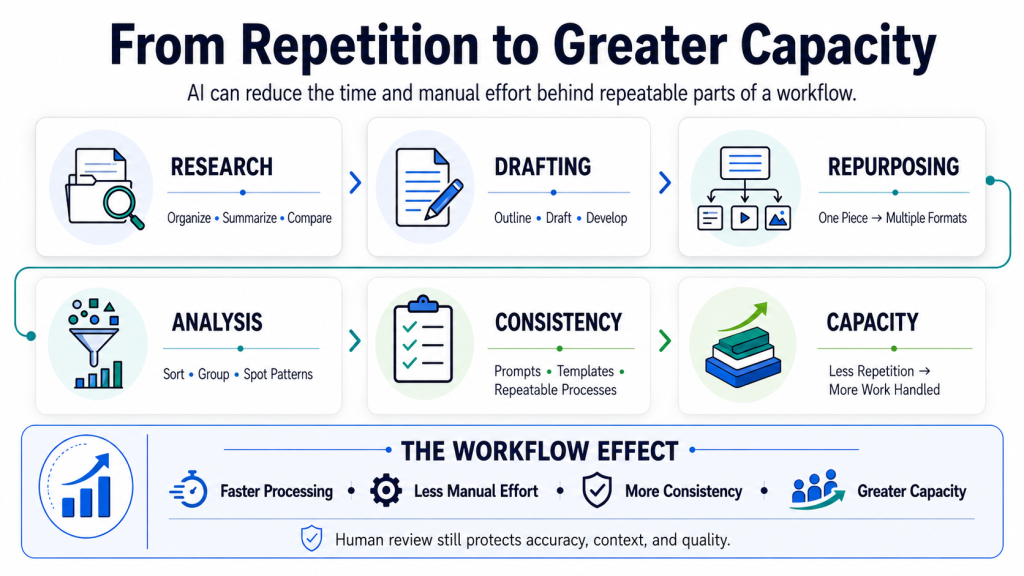
AI is most useful when it improves a part of the workflow that is repetitive, time-consuming, or easy to standardize.
That value usually appears in a few areas.
Research And Information Processing
AI can help organize source material, summarize large amounts of text, compare information, and surface patterns that would take longer to review manually.
This can support work such as market research, content planning, competitive analysis, and customer feedback review.
The information still needs verification when accuracy matters.
Drafting And Production
AI can accelerate first drafts, outlines, captions, scripts, descriptions, emails, and other repeatable content tasks.
That can reduce the time spent starting from a blank page.
The strongest results still require editing, context, and judgment before they are delivered or published.
Repurposing And Adaptation
One piece of work can often be adapted into several formats.
A long article might become social posts, an email, a short script, or a summary. A long video can be turned into shorter clips, captions, and promotional material.
AI can make that transformation faster while reducing repetitive manual work.
Analysis And Pattern Recognition
AI can help sort feedback, group recurring themes, compare options, summarize performance data, or identify patterns across large sets of information.
This can be especially useful in research, marketing, operations, and reporting.
The output should still be reviewed before important decisions are made from it.
Workflow Consistency
Repeated work becomes easier to manage when the same instructions, templates, and quality standards can be reused.
AI can support that consistency through structured prompts, custom GPTs, reusable processes, and automated steps.
This is especially useful in side hustles that involve recurring client work.
Capacity
When repetitive parts of the work take less time, one person may be able to handle more projects without increasing manual effort at the same rate.
That does not mean AI automatically makes a side hustle scalable.
Capacity only improves when the underlying process is clear and the quality remains acceptable as more work is added.
The practical value of AI comes from reducing friction in the workflow. The goal is not to automate everything, but to use AI where it saves time or improves consistency without weakening the final result.
Common AI Side Hustles And How They Work
AI side hustles can take several forms, but the most practical ones usually build on work that already has an established market.
The examples below show how AI can support that work without becoming the entire value proposition.
Freelance Writing With AI Support
Freelance writers can use AI to assist with research, outlining, first drafts, editing, and content repurposing.
The paid service is still writing. Clients are paying for clear, accurate, useful content that fits a purpose and audience.
Strong writing skills remain important because AI-generated material often needs fact-checking, restructuring, and substantial editing before it is ready to publish.
Blogging With AI Research
Bloggers can use AI to organize research, generate topic ideas, structure articles, analyze competing content, and repurpose published material.
Unlike freelance writing, blogging usually depends on building an audience or search traffic before it produces meaningful revenue.
Income may eventually come from advertising, affiliate partnerships, sponsorships, products, or services. AI can make content production more efficient, but it does not remove the need for useful content or distribution.
Affiliate Marketing With AI
Affiliate marketing generates income when someone purchases through a tracked recommendation or referral.
AI can support product research, comparison planning, content drafting, email campaigns, and the organization of customer feedback or product information.
Success still depends heavily on attracting the right audience and earning enough trust for recommendations to influence purchasing decisions.
AI-Assisted Social Media Management
Social media managers can use AI to develop content ideas, draft captions, repurpose material, organize publishing schedules, and summarize performance data.
Clients are paying for the management of their social presence rather than access to the AI tool.
Understanding brand voice, platform behavior, audience expectations, and marketing goals remains necessary because greater content volume does not automatically produce better results.
AI-Assisted Email Marketing
Email marketing services can include newsletters, promotional campaigns, welcome sequences, customer follow-ups, and other recurring communications.
AI can help generate first drafts, develop subject-line variations, organize campaign ideas, and adapt messaging for different segments.
The service becomes more valuable when the person providing it understands copywriting, customer journeys, campaign structure, and performance measurement rather than relying entirely on generated copy.
Creating Digital Products With AI
AI can support the creation of ebooks, templates, worksheets, courses, spreadsheets, guides, and other digital resources.
It may help with research, outlining, drafting, organization, design concepts, and promotional material.
The harder part is often not creating the product but identifying a problem worth solving and finding a reliable way to reach potential buyers. A large volume of AI-generated products has little value if there is no demand for them.
AI Workflow Consulting
AI workflow consultants help individuals or organizations identify where AI could improve an existing process.
The work can include reviewing repetitive tasks, developing reusable instructions, creating custom GPTs, documenting workflows, and establishing appropriate human review points.
This side hustle requires more than knowing how to write prompts. The value comes from understanding the underlying process and designing a practical way for AI to support it.
AI-Assisted Market Research
Market research services can use AI to organize competitor information, analyze customer feedback, compare products or vendors, summarize source material, and identify recurring themes.
AI can reduce the time required to process large amounts of information, but the researcher still needs to evaluate source quality and distinguish evidence from inference.
Clients are ultimately paying for useful analysis, not a generated summary.
AI Video Editing
Video editors can use AI-assisted tools for transcription, captioning, rough cuts, clip selection, script development, and content repurposing.
Those features can reduce mechanical editing work, especially when turning long-form material into shorter content.
Final quality still depends on pacing, story structure, visual judgment, audio quality, and an understanding of the platform where the video will appear.
AI Chatbot Setup
Chatbot setup involves creating conversational systems for tasks such as answering common questions, qualifying leads, supporting onboarding, or helping users find information.
AI can make these systems more flexible than rigid scripted flows, but they still need reliable information, clear boundaries, testing, and a process for situations the chatbot cannot handle.
The side hustle becomes more valuable when it solves a specific workflow problem rather than simply adding a chatbot because the technology is available.
These examples differ in how they generate revenue, how much expertise they require, and how quickly they can be put into practice. What they have in common is that AI supports an existing source of value rather than replacing the need for one.
Affiliate Disclosure: Some links on our site are affiliate links. This means that if you click one of these links and make a purchase, we may earn a small commission at no additional cost to you.
Evaluating AI Side Hustle Opportunities
Not every activity that uses AI makes a strong side hustle.
A worthwhile opportunity needs more than access to a useful tool. It needs a clear problem, a realistic way to reach customers or an audience, and enough value to justify the time required to deliver the work.
Existing skills are one of the strongest advantages.
Someone who already understands writing, design, research, marketing, video, or another discipline is better positioned to judge whether AI-assisted work is accurate, useful, and professionally finished. Without that judgment, faster production can simply create more weak output.
The income model matters as well.
Client services depend on finding and retaining customers. Blogging and affiliate marketing depend on traffic and audience development. Digital products require both creation and distribution. Contract-based work may be easier to access but can offer less control over pricing and scalability.
Demand should exist independently of the AI tool.
A useful test is whether people already pay to solve the underlying problem. Businesses already spend money on content, research, marketing, design, customer support, training, and operational improvement. AI can make those services more efficient, but it does not create demand where none exists.
The role of AI should also be meaningful.
If it reduces repetitive work, speeds up analysis, improves consistency, or increases production capacity, it may materially improve the economics of the side hustle. If AI contributes very little to the workflow, positioning the activity around AI adds little value.
Startup requirements can change how practical an opportunity is.
Some side hustles need little more than existing skills and basic software. Others require specialized tools, technical knowledge, paid advertising, or months of audience development before revenue becomes realistic.
Repeatability matters if the goal is to grow beyond occasional projects.
Work becomes easier to manage when recurring steps can be turned into templates, checklists, reusable instructions, or standardized workflows. That does not guarantee scalability, but it can reduce unnecessary effort as the workload increases.
A strong AI side hustle sits at the intersection of real demand, useful skills, a workable path to customers or distribution, and a clear role for AI. The technology can improve how the work is delivered, but it cannot compensate for a weak offer or a business model with no practical route to revenue.
How To Start An AI Side Hustle
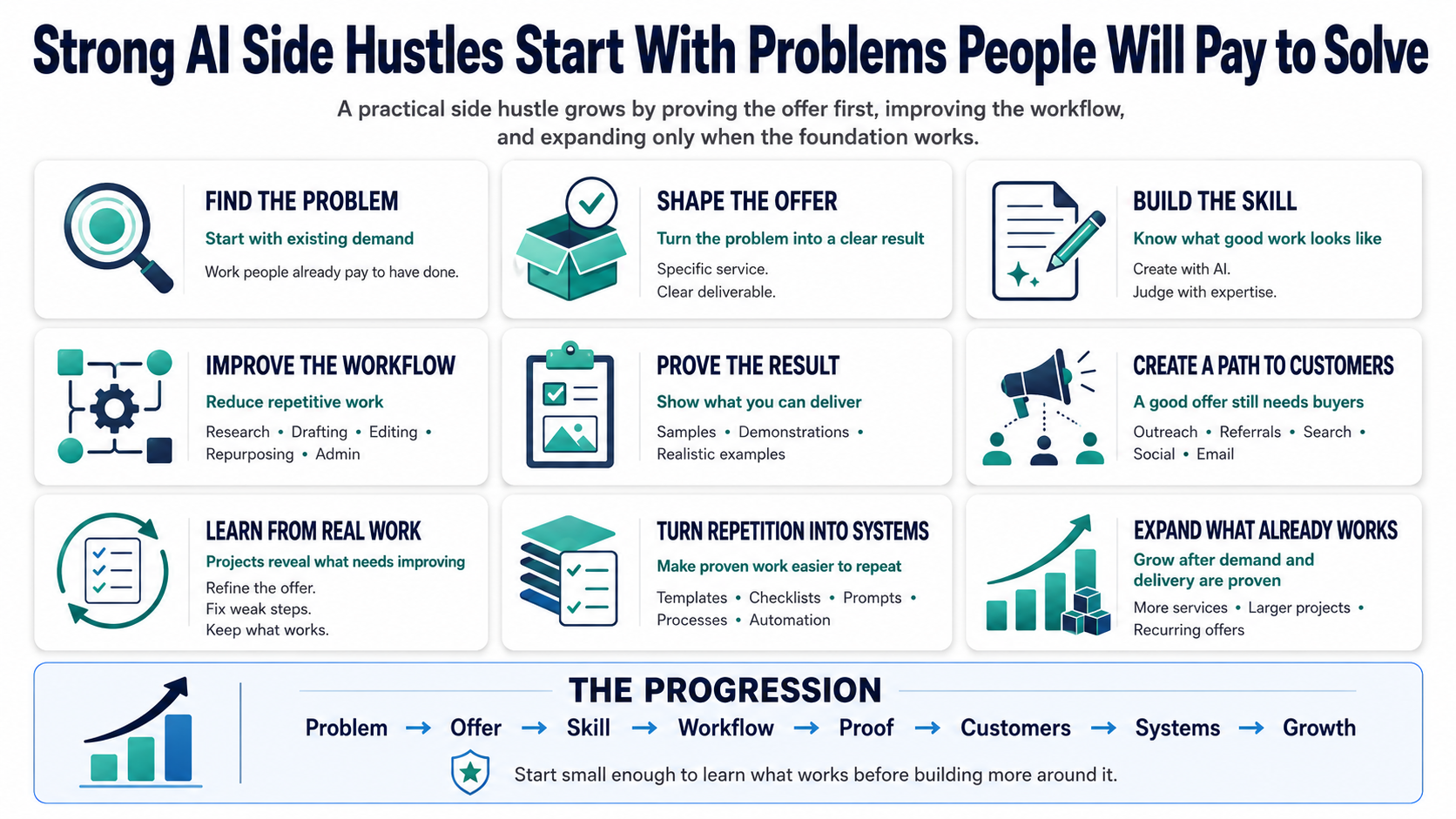
A strong AI side hustle usually starts with a simple service, product, or income model and becomes more efficient as the workflow improves.
The goal at the beginning is not to automate everything. It is to prove that the work solves a real problem and that someone is willing to pay for the result.
1. Start With A Problem Worth Solving
Begin with the problem rather than the AI tool.
Look for work people already pay to have done, such as creating content, managing marketing, conducting research, producing videos, organizing information, or improving repetitive business processes.
AI can make that work easier to deliver, but demand for the underlying result still needs to exist.
2. Define What You Will Sell
Turn the problem into a specific offer.
“AI services” is too broad. A clearer offer might be social media content management, competitor research reports, email newsletter creation, chatbot setup, or AI-assisted video editing.
A focused offer makes it easier for potential customers to understand what they are paying for.
3. Develop The Underlying Skill
Using AI does not remove the need to understand the work.
A writer still needs to recognize weak writing. A researcher needs to evaluate sources. A video editor needs to understand pacing and structure. Someone building AI workflows needs to understand the process being improved.
The better you can judge the final result, the more effectively you can use AI without becoming dependent on its first output.
4. Build An AI-Assisted Workflow
Once the service is clear, identify where AI can reduce unnecessary work.
That might include:
- Research
- Brainstorming
- Outlining
- Drafting
- Summarization
- Categorization
- Editing
- Repurposing
- Data analysis
- Routine administrative work
Keep human review around the parts that depend on accuracy, strategy, judgment, or client context.
5. Create Proof Of Your Work
You do not need a large portfolio before starting, but potential clients or customers need some way to evaluate what you can produce.
Create a few realistic examples based on the service.
A market researcher could prepare a sample competitor analysis. A writer could publish several strong articles. A chatbot specialist could build a demonstration assistant. A digital product creator could finish a small product before developing a larger catalog.
The samples should demonstrate the outcome rather than simply showing which AI tools were used.
6. Establish A Path To Revenue
The route to income depends on the type of side hustle.
Service businesses may find clients through direct outreach, referrals, professional networks, freelance platforms, or existing relationships.
Audience-based models depend on building distribution through search, social media, email, or another channel.
Digital products need a place to sell and a reliable way for potential buyers to discover them.
A useful offer without a realistic path to customers is still difficult to monetize.
7. Learn From Early Projects
Initial projects reveal how the workflow performs outside a controlled example.
Track where the work slows down, what requires the most revision, which AI-assisted steps are dependable, and where human involvement remains essential.
Client questions and feedback can also reveal whether the offer itself needs to become narrower, clearer, or more valuable.
8. Standardize Repetitive Work
Once patterns begin to emerge, turn repeated steps into systems.
Templates, checklists, reusable prompts, custom GPTs, documented processes, and carefully selected automations can reduce unnecessary setup work.
Standardization also makes it easier to maintain quality as the number of projects increases.
9. Expand Only After The First Offer Works
Adding more services does not automatically create a stronger side hustle.
Expansion makes more sense after the original offer has clear demand, a repeatable delivery process, and enough experience to understand what customers actually value.
At that point, related services, larger projects, recurring packages, or more advanced automation can extend the business without changing its foundation.
Starting small creates a useful constraint. It gives you room to develop the skill, test the offer, understand the customer, and determine where AI genuinely improves the economics of the work before trying to scale it.
How To Use AI Without Lowering The Quality Of Your Work
AI becomes useful when it removes unnecessary effort without weakening the result.
The risk appears when speed becomes more important than accuracy, originality, context, or judgment. A faster workflow only creates value if the finished work still meets the standard a client, customer, or audience expects.
Keep Human Judgment In The Workflow
AI can produce drafts, suggestions, summaries, and recommendations quickly, but it does not understand the full context of every project.
Important decisions still require someone to assess whether the output is appropriate, complete, and useful.
That matters especially in work involving strategy, research, branding, customer communication, or decisions that could affect a client directly.
Verify Important Information
Generated information should not be assumed to be correct simply because it sounds confident.
Facts, statistics, quotations, product details, legal requirements, pricing, and other source-dependent claims should be checked before they are used in finished work.
The level of verification should increase with the consequences of getting something wrong.
Give AI Enough Context
Weak output often comes from weak inputs.
Useful context may include the objective, intended audience, source material, brand requirements, constraints, examples, formatting expectations, and information the AI should not assume.
Clearer context reduces unnecessary revisions and makes the tool more useful within a repeatable workflow.
Treat The First Output As A Starting Point
AI-generated work rarely needs to be accepted exactly as produced.
Review it for structure, repetition, accuracy, tone, relevance, and missing information.
The amount of editing will vary by task, but the final deliverable should reflect your standards rather than the defaults of the tool.
Protect Client And Customer Information
Some side hustles involve business documents, customer data, internal processes, or other information that should not be entered casually into an AI system.
Before using sensitive material, understand how the tool handles data and what the client permits you to share with third-party services.
When the information is not necessary for the task, leaving it out is often the simplest safeguard.
Use Automation Selectively
Not every part of a workflow benefits from automation.
Routine steps such as formatting, categorization, summarization, or repurposing may be easier to standardize than decisions involving strategy, exceptions, or subjective judgment.
Automating the wrong step can make mistakes harder to notice because they are repeated more consistently.
Maintain A Clear Quality Standard
AI-assisted work should still be evaluated against the requirements of the task.
For writing, that may include accuracy, clarity, originality, and usefulness. For design, it may include composition and brand consistency. For research, it may include source quality and sound interpretation.
Without a defined standard, it becomes difficult to know whether AI is improving the workflow or simply increasing output.
The strongest use of AI is not maximum automation. It is selective assistance that makes good work easier to produce while keeping responsibility for the final result with the person delivering it.
Common AI Side Hustle Mistakes To Avoid
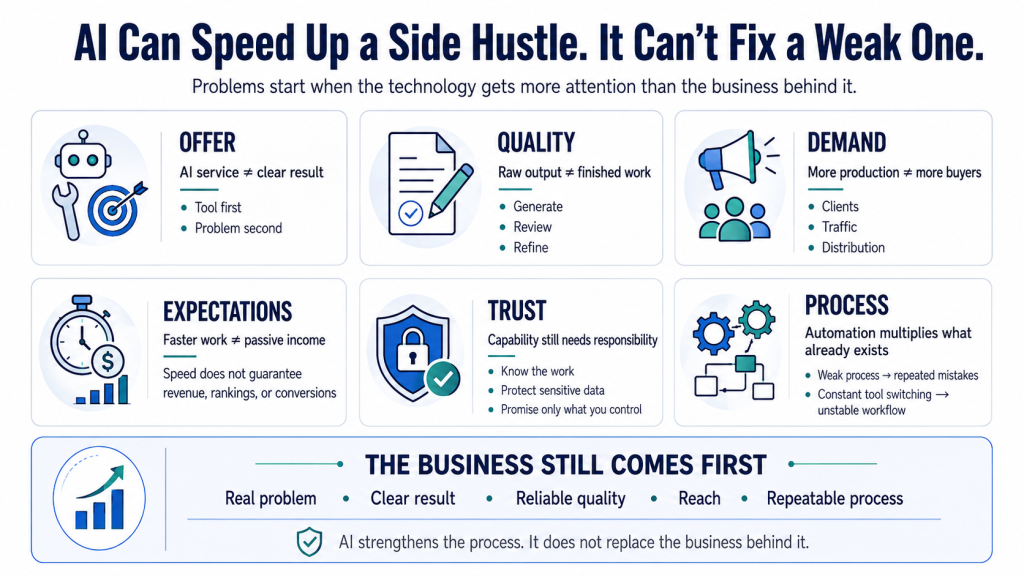
Many weak AI side hustles fail for the same reason: too much attention goes to the technology and not enough to the underlying business.
The following mistakes can make an otherwise practical idea harder to monetize, deliver, or sustain.
Selling AI Instead Of A Result
Clients and customers usually care more about the outcome than the tool used to produce it.
“AI services” is vague. A defined result such as competitor research, social media management, chatbot setup, or video editing is easier to understand and evaluate.
AI should strengthen the offer rather than become the entire offer.
Relying On Raw AI Output
The first generated response is rarely the finished product.
AI-assisted work may contain factual errors, weak reasoning, repetitive language, poor structure, or details that do not fit the customer’s needs.
Review and refinement are part of the service.
Starting With A Tool Instead Of A Problem
New AI tools can make certain tasks easier, but a tool does not create demand by itself.
Starting with a real problem makes it easier to determine whether the technology actually improves the work and whether someone has a reason to pay for the result.
Offering Work You Cannot Evaluate
AI can make unfamiliar work appear easier than it is.
Someone may be able to generate marketing copy, code, research, or design without understanding the underlying discipline well enough to recognize mistakes.
If you cannot judge the quality of the output, it becomes difficult to deliver dependable work.
Ignoring Customer Acquisition
A good service or product still needs a way to reach buyers.
Freelancers need clients. Blogs need readers. Affiliate sites need traffic. Digital products need distribution.
AI can improve production, but it does not remove the need to build demand and reach the people who might pay.
Expecting Passive Income Too Early
Some AI-assisted business models can become less dependent on direct hourly work, but that does not make them passive from the beginning.
Blogs require content and distribution. Digital products need marketing and updates. Affiliate income depends on traffic and trusted recommendations.
The workload may change over time, but the income still depends on a functioning business model.
Overpromising Results
AI can improve speed and capacity, but it does not guarantee revenue, rankings, engagement, conversions, or other business outcomes.
Promises should reflect what you can actually control.
A freelancer can commit to a defined process and deliverable. Broader performance outcomes usually depend on factors outside the service itself.
Mishandling Sensitive Information
Client work may involve internal documents, customer information, business plans, or other material that should not be shared carelessly with AI tools.
Understand what information is necessary for the task, how the software handles submitted data, and what the client permits before using sensitive material.
Automating A Weak Process
Automation makes a process repeat more efficiently.
If the underlying process is poorly designed, automation can simply reproduce the same mistakes faster and at a larger scale.
Standardize work only after you understand which steps are reliable and where human review is still needed.
Chasing New Tools Constantly
The AI market changes quickly, but switching platforms whenever a new feature appears can prevent you from developing a dependable workflow.
Tool knowledge matters less than understanding the problem, the process, and the quality standard.
A stable workflow built around a few useful tools is often more practical than constantly rebuilding the side hustle around the latest release.
Avoiding these mistakes keeps the focus where it belongs: on solving a real problem, delivering work you can stand behind, and using AI only where it improves the process.

Can An AI Side Hustle Become A Business?
Some AI side hustles can grow into larger businesses, but that usually happens because the underlying service or product becomes repeatable.
AI can support that transition by reducing repetitive work, improving consistency, and making parts of delivery easier to standardize.
A Clear Offer Comes First
Growth is difficult when every project is different.
A side hustle becomes easier to expand when the offer is specific enough that similar customers receive a similar type of result.
That makes pricing, delivery, quality control, and marketing easier to manage.
Repeatable Work Creates Leverage
Once the same steps appear across projects, they can be turned into templates, checklists, reusable instructions, custom GPTs, or automated workflows.
That reduces unnecessary setup work and can increase capacity without lowering the quality standard.
The important point is to standardize what already works rather than automate an unproven process.
Recurring Demand Matters More Than One-Off Wins
A side hustle is easier to develop into a business when customers need the service repeatedly or when the product can continue generating sales.
Social media management, email marketing, content services, chatbot maintenance, and research support can create recurring client relationships.
Digital products, affiliate content, and audience-based models can scale differently because growth depends more heavily on distribution and continued demand.
Higher Capacity Does Not Always Mean More Automation
Growth may eventually require better systems, clearer processes, contractors, specialized tools, or a narrower service.
AI can reduce some manual work, but it does not eliminate the need for project management, customer communication, quality control, or business decisions.
As volume increases, those responsibilities often become more important.
Expansion Should Follow Evidence
A successful side hustle does not need to become a large company.
Some people may prefer a small number of profitable projects alongside their main work. Others may decide to add related services, recurring packages, products, or additional capacity.
The useful signal is evidence that the original offer has demand and can be delivered consistently.
The path from side hustle to business is usually gradual: prove the offer, repeat the process, improve the system, and expand only when the economics and demand support it.
Risks And Realistic Expectations
AI can make some types of side work easier to start or more efficient to deliver, but it does not remove the uncertainty that comes with building an income stream.
The practical risks depend on the model, the tools involved, and how much of the work relies on external platforms.
Income Can Be Uneven
Side-hustle income is rarely predictable at the beginning.
Client work depends on finding and retaining customers. Affiliate and audience-based models depend on traffic and conversion. Digital products depend on demand and distribution.
AI may reduce production time, but it does not guarantee that buyers, clients, or readers will appear.
Competition Can Increase Quickly
When AI makes a task easier to produce, more people can offer similar services or products.
That can make generic work easier to replace.
A stronger position usually comes from subject knowledge, better execution, clearer specialization, stronger customer understanding, or a more reliable workflow.
AI Tools And Platforms Change
Features, pricing, access, usage limits, and policies can change over time.
A side hustle built too tightly around one tool may become harder to operate if that tool changes substantially.
The more durable asset is usually the underlying skill and process rather than familiarity with one platform.
Accuracy Still Requires Oversight
AI-generated content and analysis can contain mistakes, unsupported conclusions, or missing context.
The consequences become more serious when the work affects financial decisions, legal matters, health information, business strategy, or public-facing communications.
AI can assist with the work, but responsibility for the final result does not disappear.
Privacy And Confidentiality Matter
Some projects involve customer information, internal documents, business data, or other sensitive material.
Using that information with an AI system may create privacy, contractual, or security concerns depending on the tool and the nature of the data.
Client information should be handled deliberately rather than treated as ordinary prompt material.
Copyright And Ownership Can Be Complicated
AI-assisted writing, images, audio, video, and other creative work can raise questions about source material, licensing, ownership, and acceptable commercial use.
The relevant rules can depend on the tool, platform, jurisdiction, and type of content involved.
Anyone selling AI-assisted creative work should understand the terms that apply to the tools and marketplaces they use.
Audience And Platform Dependence Creates Risk
Blogging, affiliate marketing, social media, marketplaces, and other platform-based models depend partly on systems you do not control.
Search algorithms change. Social platforms adjust distribution. Marketplaces update policies. Affiliate programs can change terms or commission structures.
Building more than one source of traffic or customer acquisition can reduce some of that dependence over time.
Faster Production Does Not Guarantee Better Economics
Producing more work in less time can improve margins, but only if the output remains valuable and demand exists.
More articles, graphics, videos, or products do not automatically create more revenue.
The economics still depend on what the work is worth, what it costs to produce, and how effectively it reaches the right customer.
AI side hustles should therefore be approached like any other small business activity. Start with realistic expectations, understand what you can control, and use AI to improve a sound process rather than to justify an unproven one.
Conclusion
AI side hustles are most useful when artificial intelligence improves work that already has a clear source of value.
That may mean helping someone deliver a service faster, produce better content, analyze information more efficiently, create digital products, or manage a repeatable workflow. In each case, the opportunity depends on more than the tool itself.
Skills, demand, distribution, judgment, and execution still determine whether the side hustle is viable.
The strongest starting point is usually a problem you understand and a type of work you can evaluate confidently. From there, AI can support the parts of the process that are repetitive, time-consuming, or easier to standardize.
As the work develops, the same approach continues to matter. Improve the offer, refine the workflow, protect quality, and expand only when there is evidence that the model works.
AI can create leverage, but the side hustle still succeeds because it solves a real problem for a real customer or audience.
Frequently Asked Questions
What Is An AI Side Hustle?
An AI side hustle is an income-generating activity where artificial intelligence supports part of the work. AI may assist with research, drafting, analysis, design, automation, or other tasks, while the underlying value still comes from the service, product, or problem being solved.
What Are Some Common AI Side Hustles?
Common examples include freelance writing, social media management, email marketing, blogging, affiliate marketing, digital product creation, AI workflow consulting, market research, video editing, chatbot setup, and data-related contract work.
Do I Need Technical Skills To Start An AI Side Hustle?
Not necessarily. Many AI side hustles rely more on writing, marketing, research, design, communication, or business skills than coding. More technical opportunities, such as advanced automation or chatbot development, may require additional knowledge.
Can I Start An AI Side Hustle With No Experience?
You can learn how to use AI tools from the beginning, but it helps to have or develop an underlying skill you can use to evaluate the work. AI can make production faster, but it does not remove the need to understand what a good result looks like.
Which AI Side Hustles Are Easiest To Start?
Service-based opportunities that build on skills you already have are often the most practical starting point. A writer may find AI-assisted content services easier to enter, while someone with marketing experience may be better suited to social media or email services.
How Do AI Side Hustles Make Money?
The income model depends on the activity. Some generate revenue from client fees, while others rely on product sales, affiliate commissions, advertising, subscriptions, audience monetization, or contract-based work.
How Much Can You Make From An AI Side Hustle?
There is no standard income level. Earnings depend on demand, skill, pricing, customer acquisition, the business model, and how consistently the work can be delivered. Using AI does not guarantee a particular level of income.
Can AI Make A Side Hustle Passive?
AI can reduce repetitive work, but most side hustles still require some combination of creation, marketing, customer acquisition, maintenance, quality control, or updates. Some models may become less dependent on direct hourly work over time, but that does not make them automatically passive.
Do I Need To Pay For AI Tools To Get Started?
Not always. Some opportunities can be tested with free or limited versions of AI tools. Paid software may become useful when you need additional features, higher usage limits, specialized capabilities, or a more efficient workflow.
Should I Build My Side Hustle Around One AI Tool?
Usually not. Tools can change in price, features, access, and availability. Building around a useful skill and repeatable process is generally more durable than depending entirely on one platform.
Can AI Side Hustles Become Full-Time Businesses?
Some can. Growth becomes more practical when there is recurring demand, a clear offer, reliable delivery, and a process that can be standardized. Not every side hustle needs to become a larger business, however.
What Is The Biggest Mistake To Avoid With An AI Side Hustle?
One of the biggest mistakes is selling access to AI rather than solving a meaningful problem. Customers are more likely to value a useful result than the fact that a particular AI tool was involved in producing it.
Leave a Reply
One Response to AI Side Hustles: How To Build Extra Income With AI