AI Negative Prompts: How to Reduce Unwanted Outputs
When working with generative artificial intelligence, specifying what you want often solves only half the problem.
Generative models do not understand human creative intent; they predict probability distributions based on vast, uncurated training corpora. Left without explicit boundaries, they default to the center of those distributions. For image models, this central tendency surfaces as plastic skin tones, hyper-saturated lighting, extra limbs, and generic stock-photo aesthetics. For large language models (LLMs), it manifests as conversational throat-clearing, unsolicited summaries, sycophantic praise, and repetitive structural patterns.
Trying to correct these defaults by adding more positive tokens stacking terms like “photorealistic,” “natural,” or “concise” frequently backfires. It compounds prompt noise, dilutes attention heads, and leads to unpredictable generations.
A negative prompt provides the counterweight. At its core, a negative prompt is an explicit exclusionary boundary either a mathematical negative vector in a diffusion latent space or a negative constraint in an autoregressive language model that instructs the system what to actively suppress during output generation.
Understanding how to construct, calibrate, and limit these negative parameters is the difference between wrestling with model artifacts and producing predictable, production-ready outputs.
Key Takeaways
- Exclusion beats positive over-specification. Stacking positive descriptors like “realistic” or “concise” often backfires by adding noise. Explicitly repelling default dataset biases produces cleaner outputs faster than piling on positive modifiers.
- Image models and language models require opposite approaches. Diffusion tools steer away from unwanted concepts through mathematical vector subtraction. Language models process negations sequentially, meaning unanchored exclusions actively prime the model to produce the banned tokens.
- Every text exclusion requires a structural substitute. Telling an LLM what not to do creates a probabilistic vacuum. Reliable constraints must pair an explicit exclusion with a defined boundary and an immediate positive replacement.
- Token lists work best when kept lean. Monolithic 50-word negative dumps dilute guidance weights, wash out image contrast, and trigger prompt drift. A curated list of 5 to 10 specific defect tokens consistently yields superior results.
- Modern model architectures reject legacy negative prompting. Next-generation image generators (like Flux) rely on native single-pass guidance and descriptive text encoders rather than negative CFG baselines. Pasting legacy Stable Diffusion token dumps into them causes severe clipping and visual degradation.
How Negative Prompting Actually Works
To use negative prompting effectively, it helps to understand what a generative model is doing under the hood when it converts a text string into an image or a sequence of words.
Latent Space as a High-Dimensional Map
Generative diffusion architectures do not stitch together pixels from a database. Instead, they operate inside an abstract mathematical environment known as a latent space, a compressed mathematical coordinate system containing billions of learned visual features, patterns, and concepts.
Every concept the model has seen during training occupies a relative coordinate or cluster within this space:
- Related concepts sit close together (for example, the coordinate clusters for “oil painting,” “canvas texture,” and “brush strokes” share close mathematical proximity).
- Divergent concepts sit far apart (such as “hyper-detailed digital illustration” versus “charcoal sketch”).
When you supply a positive prompt, the text encoder translates your words into an embedding vector. That vector acts as a directional pull, nudging the diffusion denoising process toward the cluster of coordinates that corresponds to your description.
A negative prompt acts as a repulsive vector. Rather than telling the model where to travel, it establishes coordinates to actively avoid. When calculating the trajectory of each denoising step, the sampling algorithm calculates the vector pointing toward the positive embedding while subtracting the influence of the vector pointing toward the negative embedding. The generation moves along the resulting trajectory: toward what you requested, but directly away from the concepts you marked as toxic or undesirable.
Steering Latent Trajectories via Classifier-Free Guidance
During the diffusion process, an image is synthesized by progressively removing Gaussian noise from a random latent canvas across a sequence of denoising steps.
At each individual step t, the generator calculates two competing predictions to determine where to move next:
- An unconditioned baseline (ε∅): What the network would synthesize purely by unguided statistical probability (an empty prompt ∅).
- A conditioned trajectory (pos): What the network synthesizes when directed by your positive prompt tokens (cpos).
The fundamental mechanism driving this steering is Classifier-Free Guidance (CFG), formulated by Jonathan Ho and Tim Salimans in their foundational 2022 research. CFG applies a guidance weight (w) to magnify the directional difference between the unguided distribution and the conditioned prompt:
Negative conditioning alters this equation by replacing the passive, empty baseline (ε∅) with an active negative embedding vector (neg):
By scaling the distance between pos and neg by the guidance weight w, the diffusion process computes a step trajectory that is mathematically repelled by the negative tokens. If cneg contains the token “plastic,” the system calculates the mathematical gradient of “plastic” in latent space and steers the denoising trajectory 180 degrees in the opposite direction.
Why “Defaults” Require Active Repulsion
Without negative steering, generative models naturally gravitate toward the statistical center of their training distribution, a phenomenon known as model bias or mode collapse.
Because training datasets scrape millions of scraped web images and forum threads, the “average” depiction of human skin in consumer datasets often features smooth, airbrushed stock-photo textures. The “average” dramatic landscape features oversaturated HDR sunset lighting. Similarly, the “average” business email generated by an LLM opens with “I hope this email finds you well” or “In today’s fast-paced digital world.”
When you attempt to correct these defaults solely through positive additions such as adding “natural lighting, realistic pores, candid shot” you force the model to balance conflicting clusters within the prompt. The model still retains its underlying probability priors toward high-contrast digital sheen.
Negative prompts disrupt this tendency by depressing the activation weights of those default clusters. By explicitly zeroing out or repelling the central tendencies of the training data, you clear the latent path for the model to honor subtle, nuanced positive instructions.
Diffusion Models vs. LLMs: Two Fundamentally Different Mechanisms
While practitioners use the term “negative prompt” interchangeably across image generators and text assistants, the internal mechanics differ fundamentally by model architecture. Treating an autoregressive language model like a diffusion network leads directly to prompt failure.
Token Subtraction in Diffusion Latent Spaces
In visual diffusion models (such as Stable Diffusion, Midjourney, and Flux), negative prompting operates at the conditioning level before or during the denoising pass.
Because images are spatial matrices synthesized across latent dimensions rather than sequential streams of characters, negative tokens do not need to form coherent sentences. A diffusion model treats a negative prompt as a decoupled set of semantic targets to suppress:
- Independent Conditioning Channels: The text encoder processes the positive string and the negative string into two separate embedding tensors.
- Vector Subtraction: The negative embedding serves as the baseline from which the guidance trajectory pushes away. The words never “speak” to each other in a grammatical sense; their coordinate weights are simply subtracted from the sampling path.
Because early diffusion text encoders (like CLIP ViT-L/14 in Stable Diffusion 1.5) struggled with natural language syntax, phrasing an exclusion as a conversational sentence such as “a street with no cars” routinely failed. The CLIP encoder extracts the semantic token “cars” and associates it with visual features of automobiles. Without a dedicated negative vector channel, the model denoises the concept it recognized: resulting in a street filled with cars.
Linguistic Constraints in Autoregressive Language Models
Large language models (such as Claude, ChatGPT, and Gemini) do not feature an isolated negative conditioning vector or a CFG baseline channel during standard inference. They operate autoregressively, predicting one token at a time based on the statistical probabilities established by all preceding tokens in the context window.
This architecture introduces two primary constraints when attempting to exclude concepts:
1. The “Pink Elephant” Attention Priming Problem
When you tell a human “Do not think of a pink elephant,” the brain must first represent the concept of a pink elephant before attempting to suppress it. Transformer attention heads operate similarly.
When an LLM processes the instruction “Do not use passive voice and avoid words like ‘delve’ or ‘tapestry,’”, the self-attention mechanism assigns positive attention weights to the tokens “passive voice”, “delve”, and “tapestry”. By injecting those concepts directly into the context window, you inadvertently increase their activation levels in the transformer’s latent representations.
If the prompt lacks explicit positive instructions to fill the semantic gap, the model’s next-token generation frequently drifts toward the very concepts you prohibited.
2. Syntactic Negation vs. Latent Repulsion
Unlike diffusion engines that push generation away from an entire latent coordinate cluster, LLMs must evaluate negative instructions syntactically. The model has to maintain a high-level representation of a negative constraint while simultaneously balancing grammar, factual accuracy, and coherence.
This explains why simple user-level negative commands (“Don’t write a long response”, “No filler words”) degrade under complex reasoning tasks. As context length increases, the model’s attention heads disperse, and adherence to negative boundaries weakens unless reinforced structurally.
System Prompts vs. Conversational Negatives
To enforce negative boundaries effectively in language models, exclusions should be placed at the system instruction level rather than mixed haphazardly into user prompts:
- System-Level Directives: Instructions placed in system messages establish high-priority global priors that condition the model’s behavioral posture before conversational turns begin.
- Contextual Grounding: A system-level negative instruction operates as an operational guardrail (e.g., “Omit conversational preamble, concluding summaries, and meta-commentary”), allowing the user prompt to remain strictly focused on task data.
- Separation of Concerns: Mixing exclusions into the user prompt creates noise and increases the risk of attention dilution. Isolating constraints into system rules ensures the model parses negative boundaries as operational filters rather than conversational topics.
Syntax and Implementation Across Major AI Tools
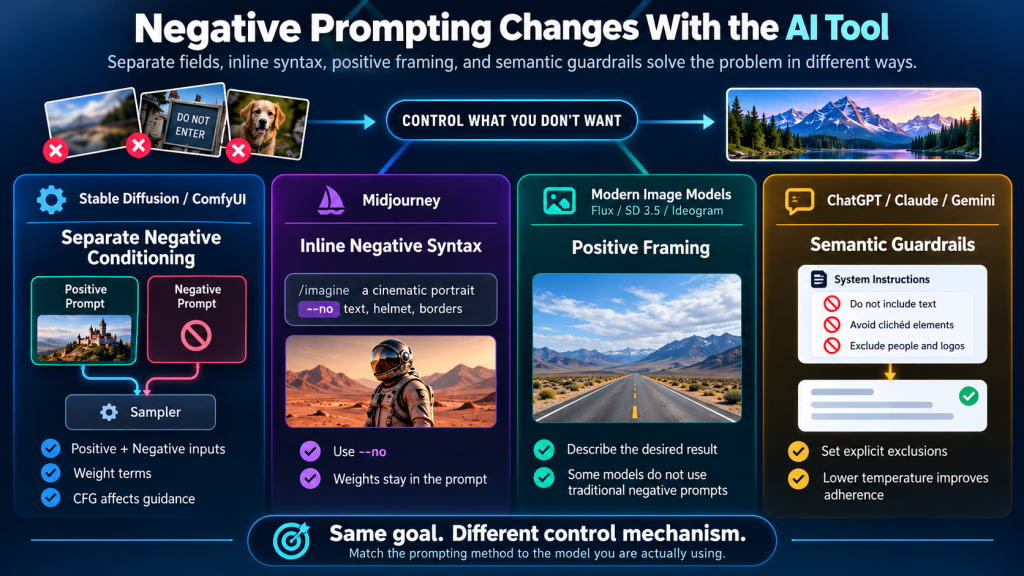
Because architectures handle conditioning differently, negative prompt syntax varies significantly between tools. Applying the syntax of one environment to another guarantees suboptimal results.
Stable Diffusion and ComfyUI
In Stable Diffusion ecosystems (SD 1.5, SDXL, and custom checkpoints), interfaces like Automatic1111, Forge, and ComfyUI provide dedicated text inputs for negative conditioning.
Token Weighting Syntax
Tokens in the negative field can be individually amplified or attenuated to calibrate how aggressively the model repels specific features:
- Emphasis syntax: (unwanted_feature:1.2) increases the negative weight by 20%, repelling the concept more aggressively.
- De-emphasis syntax: (unwanted_feature:0.8) lowers the repulsive vector weight, applying gentle suppression without distorting surrounding features.
- Nested brackets (legacy Automatic1111): ((token)) multiplies weight by 1.1 × 1.1 = 1.21, while [token] scales it down to approximately 0.9.
ComfyUI Node Conditioning
In node-based workflows like ComfyUI, the positive and negative text strings are processed through distinct CLIP Text Encode nodes. Both feed into the KSampler node via separate positive and negative conditioning inputs:
- The sampler computes the difference between both conditioning tensors at each step according to the CFG scale.
- Setting CFG to 1.0 disables guidance entirely, rendering the negative conditioning node inactive regardless of the tokens it contains. Optimal CFG ranges for traditional Stable Diffusion checkpoints typically sit between 5.0 and 8.0.
Midjourney
Midjourney does not feature a separate negative prompt field. Instead, it processes negative parameters inline using CLI-style flags or multi-prompt weights.
The –no Parameter
The primary method for negative conditioning in Midjourney is the –no parameter appended to the end of a prompt:
/imagine prompt: cinematic portrait of an astronaut on Mars –no helmet, visor, suit reflections
- Execution mechanics: Under the hood, –no item automatically assigns a multi-prompt weight equivalent to ::-0.5.
- Comma separation: Multiple items can be passed in a single parameter separated by commas (e.g., –no blur, oversaturation, text, borders).
Granular Multi-Prompt Weighting
When the standard –no parameter repels a concept too aggressively or distorts the positive prompt composition, Midjourney’s multi-prompt syntax allows manual negative calibration:
/imagine prompt: vibrant street market scene::2 crowd::-0.3 neon signs::-0.5
Negative weights must stay within the range of -0.5 to -0.01 (weights cannot be lower than -0.5). The sum of all weights across the entire prompt must remain greater than zero, otherwise the generation fails.
Flow Matching and Modern Image Models
Modern text-to-image models present a fundamental departure from legacy diffusion workflows.
- Flux (Black Forest Labs): Flux utilizes a flow-matching architecture and modern transformer text encoders (T5-XXL and CLIP-L). Black Forest Labs explicitly built Flux to run natively at a guidance scale of 1.0 (distilled versions) or using dynamic guidance without a negative conditioning baseline. As a result, Flux does not natively support negative prompts. Attempting to feed negative token dumps into Flux workflows either fails or requires third-party sampling hacks that often introduce contrast clipping.
- T5-XXL Integration (SD 3.5, Ideogram): Newer models integrate large language model encoders capable of parsing full grammatical sentences. In these architectures, prompt engineering relies on descriptive positive framing (e.g., “an empty desert highway under overcast daylight”) rather than retrofitting 50-word negative keyword dumps.
Autoregressive LLMs (Claude, ChatGPT, Gemini)
In text generation, negative boundaries cannot be specified via mathematical sliders or negative text boxes. They require explicit semantic guardrails.
Formatting Boundaries in System Prompts
Rather than peppering user prompts with ad-hoc exclusions, establish negative parameters within system messages or custom instructions using structured Markdown blocks:
## Negative Constraints (Strict Exclusions)
- Do not include conversational greetings, throat-clearing, or sign-offs.
- Do not summarize the response in a concluding paragraph.
- Omit editorial clichés such as “in today’s fast-paced world”, “delve”, “testament”, and “tapestry”.
- Never output explanatory boilerplate before code blocks.
Temperature Calibration
Adherence to negative constraints degrades when sampling temperature is set too high.
- High Temperature (0.8-1.2): Encourages token exploration and probability variance, causing attention heads to occasionally drift past negative boundaries.
- Low Temperature (0.1-0.4): Constrains next-token sampling to the highest probability peaks, ensuring the model strictly respects operational instructions and formatting bans.
The 3-Part Negative Constraint Formula for Text and Code
Telling a language model simply “don’t do X” creates an unstable generation state. Because the transformer’s attention mechanism has now registered the prohibited concept, removing it leaves a statistical void in the next-token probability distribution. If the prompt does not specify how to fill that void, the model either falls back on default clichés or slips into generating the very tokens you attempted to ban.
To reliably eliminate unwanted text patterns, hallucinations, or deprecated code patterns, every negative constraint should follow a three-part structure: Exclusion, Boundary, and Alternative.
Component 1: The Explicit Exclusion
The exclusion defines the exact pattern, phrase, syntax, or library that must not appear in the response.
Vague exclusions (such as “write naturally” or “make this sound human”) fail because they lack precise semantic targets. An exclusion must be discrete and unambiguous:
- Weak Exclusion: “Don’t write like an AI.” (The model cannot operationalize “like an AI” without clear token anchors).
- Strong Exclusion: “Do not use promotional adverbs, rhetorical questions, or the words ‘delve’, ‘testament’, ‘beacon’, or ‘intertwined’.”
- Code Exclusion: “Do not use legacy callback patterns, third-party date libraries like moment.js, or the var keyword.”
By pinpointing the exact tokens to suppress, you give the model an unambiguous pattern-matching rule.
Component 2: The Structural Boundary
The structural boundary sets an enforceable technical or stylistic parameter around the response. It defines the operational envelope that prevents the model from substituting one unwanted behavior for another.
For example, when told not to write corporate jargon, models frequently compensate by generating meandering, conversational fluff. The boundary establishes rigid mechanical guardrails:
- Length Constraints: “Limit the total response to exactly 3 bullet points, each under 25 words.”
- Syntactic Restrictions: “Write exclusively in the active voice using declarative sentences.”
- Architecture Rules (Code): “Ensure all functions remain pure and return immutable objects; enforce strict TypeScript types with no use of any.”
Boundaries narrow the search space, drastically reducing the probability of token drift.
Component 3: The Preferred Alternative
The alternative is the positive anchor that resolves the “Pink Elephant” problem. It explicitly instructs the model on what path to take in place of the prohibited pattern.
Without a defined alternative, the model must guess how to satisfy both the context and your exclusion. Supplying a preferred substitute channels token selection toward a specific high-quality output:
- Writing Alternative: “Instead of introductory pleasantries, open the first sentence with the primary action item or decision required.”
- Editorial Alternative: “Replace high-level conceptual summaries with concrete quantitative metrics from the source document.”
- Code Alternative: “Implement date operations using native JavaScript Intl.DateTimeFormat and modern temporal methods.”
When an LLM evaluates the next token, the positive alternative provides an immediate, high-probability target that suppresses the prohibited path naturally.
Before and After: The Formula in Practice
Applying the three components together transforms fragile, error-prone prompts into robust production instructions.
Example 1: Executive Communication and Reporting
“Summarize this incident report. Don’t make it too long, don’t use corporate jargon, and don’t include fluff.”
Result: The model produces a three-paragraph memo opening with “In today’s fast-paced operational environment, ensuring platform reliability is paramount…” followed by vague generalities.
Generate an executive incident summary from the logs below. [Exclusion] Omit introductory greetings, editorial commentary, and generic conclusions (e.g., “moving forward”, “lessons learned”). [Boundary] The summary must consist of exactly three sections: Impact, Root Cause, and Resolution. Total word count must not exceed 150 words. [Alternative] State facts directly using chronological bullet points. Quantify duration in minutes and user impact in exact percentages.
Result: A concise, data-driven brief that cuts straight to operational facts without throat-clearing.
Example 2: Modern Web Development (TypeScript / Node.js)
“Write a function to fetch user data and calculate session durations. Don’t use outdated code and don’t introduce bugs.”
Result: The model writes an untyped function using var, mixes Promises with callback chaining, or installs an unneeded heavy npm dependency.
Write a Node.js utility to fetch user session telemetry and calculate session duration. [Exclusion] Do not import third-party date or HTTP libraries (such as moment, dayjs, or axios). Do not use callback patterns or mutable `let`/`var` declarations. [Boundary] All code must be strictly typed in TypeScript (no `any` types). Wrap asynchronous operations in explicit try/catch blocks with custom error classes. [Alternative] Use native `fetch` and standard JavaScript `Date.now()` arithmetic. Return results in a frozen, readonly interface.
Result: Modern, zero-dependency, type-safe production code that conforms exactly to modern standards without boilerplate.
Practical Negative Prompt Swipe Banks (Categorized)
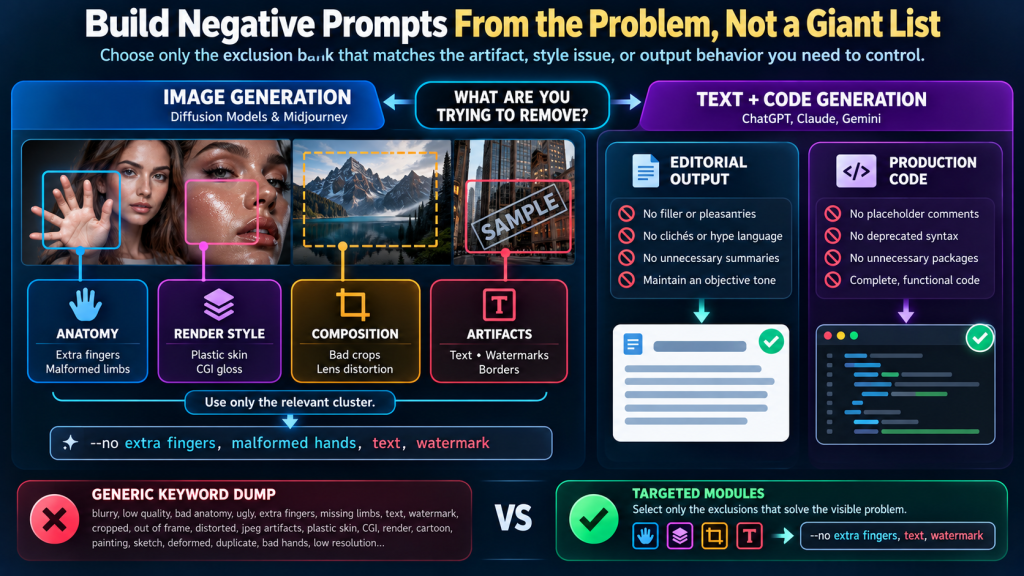
The most effective negative prompts are modular and targeted. Pasting indiscriminate 80-word generic keyword dumps dilutes the text encoder’s attention channels, flattens image contrast, and often produces dull, washed-out outputs.
Instead of monolithic templates, select only the specific clusters corresponding to the artifacts you need to eliminate.
Image Generation Swipe Banks (Diffusion & Midjourney)
These token clusters target recurring failure modes in visual diffusion models (such as Stable Diffusion 1.5, SDXL, and Midjourney via –no).
1. Anatomy and Character Integrity
Use this bank when generating realistic figures, hands, and facial portraits to suppress malformed limb synthesis and symmetry degradation:
–no deformed hands, extra fingers, fused digits, extra limbs, asymmetrical eyes
Focuses strictly on geometric and limb-count defects. It omits vague subjective qualifiers like “ugly” or “bad anatomy” which muddy latent coordinates without providing precise geometric anchors.
2. Render Gloss and Uncanny Digital Aesthetics
Use this bank to strip out the artificial, airbrushed sheen that dominates unguided base models:
–no plastic skin, 3D render, CGI, wax texture, smooth skin
Repels the 3D-engine and stock-photo clusters common in scraped art platform datasets, allowing natural film grain, skin pores, and authentic specular highlights to emerge.
3. Composition, Framing, and Optics
Use this bank when generating portraits, landscapes, or architectural stills where the model consistently misplaces framing or introduces optical distortions:
–no cropped, out of frame, off-center, lens flare, wide angle distortion
Establishes spatial and optical boundaries that prevent accidental close-up cutoffs, extreme perspective warps, and busy compositional noise.
4. Signage, Typography, and Post-Processing Artifacts
Use this bank to eliminate garbled synthetic text, compression artifacts, and artificial framing borders:
–no text, watermark, signature, border, frame, blur, jpeg artifacts
The central distribution of web-scraped visual training sets contains stock watermarks and signature stamps in corner coordinates. Repelling these coordinates suppresses synthetic overlays.
Text and Code Generation Swipe Banks (LLMs)
Because large language models process instructions linguistically, use structured Markdown rules in your system prompts or developer instructions rather than comma-separated token lists.
1. Editorial and Professional Tone Constraints
Use this directive block to strip out conversational filler, sycophancy, and AI editorial clichés from articles, documentation, and executive memos:
### Editorial Constraints & Exclusions
- Omit conversational preamble, self-referential pleasantries (“Sure, I can help with that!”), and closing remarks.
- Never summarize or re-explain the response in a concluding paragraph unless explicitly instructed.
- Do not use hyperbolic adjectives or overused generative clichés, including: “delve”, “tapestry”, “testament”, “beacon”, “pivotal”, “bustling”, “vibrant”, or “in today’s fast-paced world”.
- Avoid rhetorical questions and false enthusiasm; maintain an objective, authoritative editorial tone.
2. Clean Production Code Constraints
Use this directive block when prompting for software engineering tasks to prevent hallucinated libraries, legacy syntax, and non-actionable placeholder comments:
### Code Quality & Implementation Boundaries
- Do not generate placeholder comments (e.g., “// TODO: implement logic here”, “// rest of code remains the same”). Write complete, functional implementations.
- Do not import third-party packages or utilities when native language APIs can accomplish the task.
- Strictly avoid deprecated language features, untyped variables (`any`), and mutable global state.
- Omit narrative introductions and conversational summaries around code blocks; output only the requested code and inline type definitions.
Common Negative Prompting Mistakes to Avoid
Even experienced practitioners run into output degradation by treating negative prompting as an all-purpose clean-up tool. Misunderstanding how negative parameters interact with guidance vectors and attention mechanisms leads directly to washed-out imagery, model hallucinations, and erratic behavior.
Here are the four most common failure modes and how to prevent them:
Negative prompt bloat
Blindly copying massive 100-word negative prompt templates (a common habit inherited from early 2023 Stable Diffusion forums) routinely degrades image quality. In diffusion models, every negative token exerts a repulsive force along its specific latent vector. When you stack dozens of unvetted terms such as “low quality, bad art, ugly, worst quality, amateur, blurry, normal quality” the sampling algorithm must repel so many disparate coordinate regions simultaneously that the trajectory loses coherence.
The result is washed-out contrast, flattened color saturation, plasticized textures, and loss of fine textural detail. A lean negative prompt containing 5 to 10 specific terms targeting exact defects will consistently outperform an indiscriminate keyword dump.
Contradictory semantic weighting
A negative prompt fails when it suppresses visual features or concepts that the positive prompt fundamentally requires to construct the scene.
For example, prompting for “an atmospheric medieval cobblestone alleyway in heavy rain” while adding “puddles, water reflections, dark shadows, gloom” to the negative prompt forces the diffusion model into mathematical gridlock. The positive tokens demand moisture and low-key illumination, while the negative baseline repels the very physical markers that define those conditions.
This contradiction leads to severe image artifacts, bizarre unnatural lighting transitions, or outright prompt collapse where the model ignores one side entirely.
Open-ended negation in language models (The “Don’t Think of a Bear” trap)
In LLMs, instructing a model what not to do without specifying a concrete replacement leaves the model in an ambiguous probabilistic state. Commands like “Don’t write a boring summary” or “Don’t be repetitive” provide zero actionable constraints; they simply prime the model’s attention mechanism on the subjective concept of boredom or repetition.
Because the model must still generate tokens to fill the context, it often defaults back into the statistical patterns it was asked to avoid. Effective LLM negation must always be closed-ended, defining explicit textual replacements and mechanical boundaries rather than subjective bans.
Architectural mismatch
Applying legacy diffusion prompting practices to modern generative architectures guarantees poor results.
Feeding an Automatic1111-style negative token dump into modern flow-matching models like Flux produces severe contrast clipping or completely unguided generations, because Flux relies on dynamic guidance and modern T5 language encoders rather than a decoupled negative CFG baseline.
Similarly, attempting to use image-style comma-separated token strings (such as bad writing, repetitive, passive voice) in an LLM user prompt treats an autoregressive transformer like a spatial vector subtractor. Always match the constraint method to the model’s actual mathematical mechanics.
Conclusion
Negative prompting is fundamentally an instrument of calibration, not a blunt aesthetic filter.
Generative models reflect the statistical averages of their training datasets. When left entirely to positive instructions, they drift toward clichés, saturated lighting, distorted anatomy, and repetitive prose. Stacking dozens of vague positive terms rarely solves this problem; it merely clutters the prompt and forces the model to reconcile competing instructions.
By understanding the underlying mechanics repelling latent coordinates via Classifier-Free Guidance in diffusion models, and anchoring attention heads with the Exclusion-Boundary-Alternative formula in language models you replace random trial-and-error with predictable control.
Effective prompting does not require an exhaustive catalog of every flaw an AI could conceivably produce. Start with a clean positive prompt, observe where the model defaults drift off target, and apply lean, targeted negative constraints only where precision demands them.
Frequently Asked Questions
Does using negative prompts increase generation time or inference compute costs?
In standard visual diffusion workflows (such as Stable Diffusion and ComfyUI), adding words to an existing negative prompt does not increase generation time. Because Classifier-Free Guidance requires evaluating an unconditioned forward pass at every denoising step regardless of whether a negative prompt is present, the model computes that negative pass anyway. In language models, negative constraints consume context window tokens, which slightly increases initial prompt processing (prefill) latency and input token costs, but does not increase generation time for the subsequent output tokens.
Why does an image generator occasionally produce an object listed in the negative prompt?
This failure typically stems from either insufficient Classifier-Free Guidance (CFG) or positive token contamination. If the CFG scale is set too low (e.g., below 4.0), the repulsive vector lacks the mathematical weight needed to steer the denoising path away from that coordinate cluster. Alternatively, if your positive prompt contains terms that are inextricably linked to the unwanted item in the training data (such as requesting a “crowded subway car” while putting “people” in the negative prompt), the positive conditioning overpowers the negative repulsion.
Can negative prompts eliminate hallucinations in large language models?
Negative constraints alone cannot eliminate hallucinations. Instructing an LLM “Do not make up facts” or “Do not hallucinate” is ineffective because the model cannot verify factual ground truth during token sampling; it merely predicts probable continuations. To mitigate factual drift, negative constraints must be structural rather than conceptual (e.g., “Do not extrapolate beyond the provided text; if an answer is not explicitly stated in the source document, output ‘DATA NOT FOUND’”).
Is negative prompting becoming obsolete with newer generative architectures?
In image generation, the traditional practice of pasting massive negative keyword dumps is fading. Modern architectures (such as Flux and SD 3.5) rely on advanced text encoders like T5-XXL and flow matching, making models far more capable of following positive natural language descriptions without needing constant negative CFG steering. However, in large language models, structured negative constraints remain essential for stripping out conversational preamble, enforcing deterministic code formats, and eliminating editorial clichés.

Leave a Reply