5 Custom GPT Examples To Automate Repetitive Task
Custom GPTs make more sense when you want to automate or streamline a task you do repeatedly.
Instead of giving ChatGPT the same instructions and context every time, you can configure a GPT around a specific job and give it the information it needs to handle that work more consistently.
These five custom GPT examples show what that looks like in practice and can help you identify where a custom GPT could fit into your own workflow.
Key Takeaways
- The most useful custom GPTs are built around a clear job, not a broad request to help with everything.
- Customer questions, content, sales follow-up, research, and operations are five practical areas where a custom GPT can provide repeatable support.
- Instructions should define how the GPT behaves, while relevant files can give it the information needed to perform its role.
- Custom GPTs can streamline or automate parts of recurring work, but important decisions and exceptions may still need human review.
- Testing realistic situations is essential because a well-written configuration does not guarantee that every answer will be correct.
Affiliate Disclosure: Some links on our site are affiliate links. This means that if you click one of these links and make a purchase, we may earn a small commission at no additional cost to you.
What Custom GPTs Are
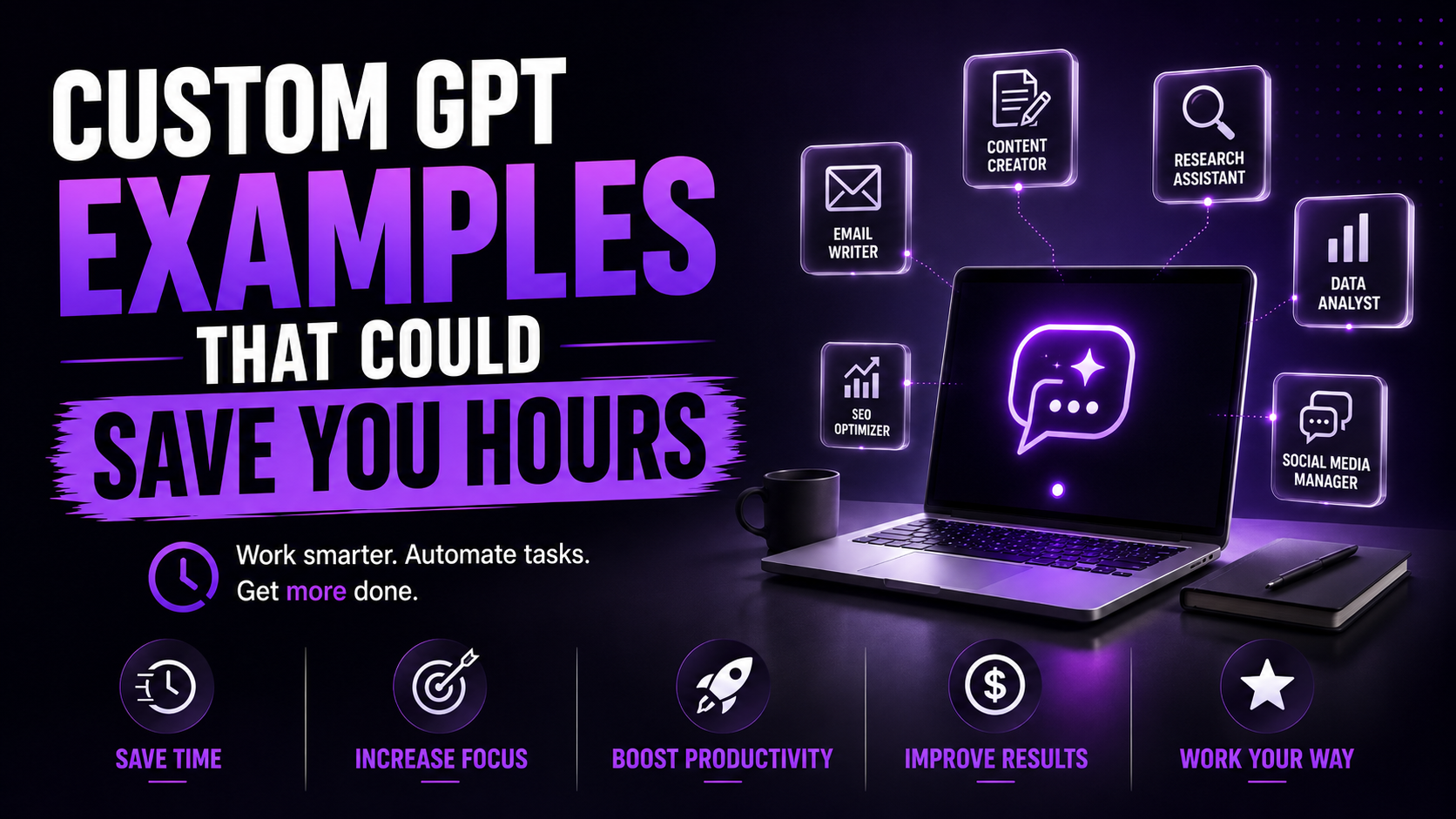
A custom GPT is a version of ChatGPT configured for a particular purpose.
Instead of explaining the same role and requirements at the beginning of every conversation, you can define instructions that apply whenever the GPT is used. Those instructions can cover its purpose, workflow, tone, priorities, output format, and boundaries.
Relevant files can provide additional context.
For example, a customer question GPT could use return policies and FAQs as reference material. A content GPT might work from brand guidelines and approved examples. An operations GPT could draw from SOPs and internal process guides.
Instructions and knowledge do different jobs. Instructions tell the GPT how to behave. Knowledge files provide material it can reference while completing the task.
Depending on the configuration, a GPT can also use additional capabilities. The right combination depends on what the GPT is supposed to accomplish rather than how many features can be enabled.
OpenAI’s current documentation on creating and editing GPTs explains that instructions guide behavior, uploaded knowledge provides reference material, and additional capabilities can extend what a GPT is able to do.
5 Custom GPT Examples At A Glance
These five examples cover different jobs, but each follows the same principle: the GPT has a defined responsibility and receives the context needed to handle it.
| Custom GPT Example | Main Purpose | Typical Input | Typical Output |
|---|---|---|---|
| Customer Question GPT | Help answer recurring customer questions | Customer message or situation | Suggested response |
| Content And Brand Voice GPT | Apply consistent writing standards | Topic, draft, or content brief | New or revised content |
| Sales Follow-Up GPT | Turn sales context into a useful next message | Meeting notes or conversation details | Follow-up email |
| Research And Decision-Support GPT | Organize information for evaluation | Documents, findings, or options | Comparison or research brief |
| Operations And SOP GPT | Make documented procedures easier to use | Operational question or situation | Process guidance |
A useful custom GPT does not need to perform every part of a workflow. It needs to perform its own part clearly and consistently.

1. Customer Question GPT
Customer questions often repeat even when the wording changes.
Someone may ask about a refund, shipping time, cancellation rule, product feature, service area, or what happens after placing an order. Answering the question can require finding the correct information before a response can even be written.
A Customer Question GPT can make that process more direct.
The GPT could reference approved FAQs, policies, product information, and support procedures. Its instructions would define how answers should be written and what should happen when a request falls outside the available information.
Consider a customer asking whether a particular situation qualifies for a refund.
Instead of searching through the policy manually and drafting a response from scratch, you could provide the customer’s question to the GPT. It could identify the relevant information and prepare a response based on the material it has been given.
This can streamline routine support without requiring every interaction to be automated.
The limits matter as much as the normal cases. A refund exception, unusual complaint, contractual issue, or request not covered by the existing policies may need someone with authority to review it.
A well-configured Customer Question GPT should recognize that boundary rather than filling gaps with an invented answer.
2. Content And Brand Voice GPT
AI can produce a draft quickly. Getting that draft to match established writing standards is a different problem.
Without a custom setup, the same context may need to be explained again and again. The prompt might include the audience, tone, positioning, terminology, formatting rules, phrases to avoid, product information, and other editorial requirements before the actual assignment begins.
A Content And Brand Voice GPT can hold much of that context in one place.
Its instructions might define the writing principles, voice, preferred terminology, structural rules, and editorial boundaries that should apply across different assignments. Uploaded material could provide brand information, successful examples, product details, or other useful references.
That changes what the individual prompt needs to accomplish.
Instead of rebuilding the editorial system every time, you can focus on the specific task. The GPT might draft an email, rewrite a product description, prepare a social post, turn notes into an article section, or evaluate existing copy against established guidelines.
It can also support editorial review.
For instance, the GPT could be instructed to identify repetitive sentence openings, weak transitions, unnecessary wording, inconsistent terminology, or claims that require verification. That makes it useful beyond first-draft generation.
Consistency still needs judgment.
A draft can technically follow the stated rules and still miss the purpose of the piece. Facts may also need verification before publication. The GPT should support the editorial process rather than become an automatic approval system.
3. Sales Follow-Up GPT
Good sales follow-up depends on what happened before the follow-up.
A prospect may have raised a concern, asked about a feature, discussed timing, or agreed to a particular next step. A generic email template cannot reflect those details without additional work.
A Sales Follow-Up GPT can give that work a repeatable structure.
You could configure it with information about the offer, current product details, common objections, preferred positioning, qualification criteria, and rules around what should never be promised.
After a conversation, the main input could be a short set of meeting notes.
The GPT could identify the key concern, pull out the agreed next step, and prepare a concise follow-up that reflects the actual discussion.
For example, suppose a prospect likes the offer but is unsure whether implementation will fit the current workflow. The follow-up should address that concern rather than sending a generic thank-you message.
This is where the GPT can remove some of the administrative work surrounding sales without trying to replace the conversation itself.
Boundaries remain important. Discounts, guarantees, contractual language, custom features, or expected financial results should not be invented simply to make the message more persuasive.
The configuration should make those restrictions explicit.
4. Research And Decision-Support GPT
Research problems are not always caused by a lack of information.
Sometimes the difficulty is organizing what has already been collected.
Different options may be evaluated using different criteria. Important facts can become mixed with assumptions. Missing information may disappear inside a polished summary instead of remaining visible.
A Research And Decision-Support GPT can create more structure around that process.
Rather than configuring it around one permanent research topic, you can define how research should be analyzed and presented.
The GPT might be instructed to compare every option using the same criteria, distinguish direct evidence from inference, identify gaps, explain trade-offs, and organize the findings in a consistent format.
That becomes useful in many situations.
You could use the same GPT to review vendor proposals, compare software options, analyze survey responses, extract themes from meeting transcripts, or organize material before a larger decision.
Suppose three vendors provide proposals in completely different formats. Instead of comparing each document informally, the GPT could extract the same set of criteria from all three and place the findings side by side.
The goal is not to make the GPT the final decision-maker.
Research quality still depends on the material being reviewed, and some information may need independent verification. The GPT is most valuable when it makes the evidence, assumptions, and missing pieces easier to see.
5. Operations And SOP GPT
Documenting a process does not automatically make the process easy to use.
An organization may have SOPs, checklists, onboarding guides, policies, and internal instructions spread across several files. Someone facing a specific situation still has to work out which document applies and where the relevant steps are located.
An Operations And SOP GPT can make that information easier to access.
The GPT could use current procedures and process guides as its reference material. Its instructions would define how to answer operational questions, how to present steps, and what to do when the documentation does not cover a particular situation.
Imagine an onboarding process that changes depending on the type of customer.
Instead of searching through a long SOP, someone could describe the situation and ask which procedure applies. The GPT could identify the relevant process and present the documented steps in a clearer sequence.
The process itself has not changed. Access to it has.
That makes an SOP GPT useful for recurring operational questions, onboarding, internal guidance, and other situations where the answer already exists but is not always easy to retrieve.
Poor documentation remains a limitation.
If two SOPs contradict each other or an important step was never documented, the GPT should not invent a process to create the appearance of completeness. The underlying material must be reliable before the GPT can use it reliably.
Why Custom GPTs Are Useful For Automation
Automation is one reason to build a custom GPT, but it does not need to mean handing over an entire workflow.
Often, the useful part is smaller.
A custom GPT can remove repeated setup because its role, instructions, and relevant context have already been defined. The input may change from one conversation to the next while the underlying job stays largely the same.
A customer question changes, but the response still needs to follow established policies. Sales notes differ after every call, yet the follow-up follows a recognizable process. Research topics vary, while the framework used to compare evidence can remain consistent.
That repeatable layer is where a custom GPT can reduce manual effort.
Some uses are closer to assistance than full automation. You provide the input, the GPT prepares an output, and someone reviews what happens next.
Other workflows may combine a GPT with additional systems or processes.
The distinction matters because not every useful GPT needs to operate autonomously. Automating one well-defined part of a task can still remove repeated work and create a more consistent process.
The better question is not whether the whole workflow can be automated.
It is whether a specific part of the work happens often enough, follows clear enough rules, and produces a predictable enough output to benefit from a custom setup.
Pros And Cons Of Using Custom GPTs
Custom GPTs can create a more consistent way to use ChatGPT for a particular job, but they still depend on the quality of the configuration and the information available to them.
| Pros | Cons |
|---|---|
| Instructions can be reused across conversations | Weak instructions can create repeated problems |
| Relevant reference material can be available in one place | Knowledge files can become outdated |
| Outputs can follow more consistent rules and formats | Consistency does not guarantee accuracy |
| A GPT can be tailored to a defined role | Broad or conflicting roles can make behavior less predictable |
| Some recurring work can require fewer manual steps | Important outputs may still require review |
| The GPT can be refined as the use case becomes clearer | Testing and maintenance still require attention |
The strongest use cases tend to have enough structure that you can describe what a good result should look like.
If the task changes completely every time, there may be little value in creating a permanent configuration around it.
Scope matters too.
Adding more responsibilities can make a GPT sound more capable, but a narrower role is often easier to instruct and evaluate. When several tasks require different knowledge, rules, or standards of review, separate GPTs may provide a cleaner solution.
How To Build A Custom GPT
Start with the job, not the configuration screen.
A custom GPT becomes easier to design once you can explain what it is responsible for, what information it needs, and what a useful result looks like.
- Choose One Clear Purpose. Define the job narrowly enough that you can tell whether the GPT is performing it well. “Help with sales” is broad. “Turn meeting notes into a follow-up email using our approved sales guidelines” is specific.
- Identify The Inputs And Outputs. Determine what the GPT will usually receive and what it should produce. A customer message might become a suggested response. Meeting notes might become a follow-up email. A group of vendor documents might become a comparison table.
- Write The Core Instructions. Explain the role, workflow, priorities, output requirements, and boundaries. If the task follows several steps, define the sequence rather than assuming the GPT will infer it correctly.
- Add Relevant Knowledge. Upload material the GPT genuinely needs as reference, such as FAQs, product information, brand guidelines, SOPs, or research documents. Keep the collection focused on the purpose of the GPT.
- Define What It Should Do When Information Is Missing. A useful GPT needs rules for uncertainty. It may need to ask a follow-up question, flag missing information, or route the situation for human review rather than guessing.
- Add Realistic Conversation Starters. Good starters show what the GPT is designed to handle and give users a clear way to begin. They should reflect actual tasks rather than generic prompts.
- Test Normal Cases And Edge Cases. Try the situations you expect to see regularly, then test incomplete inputs, unusual requests, conflicting information, and cases that should fall outside the GPT’s authority.
- Refine Before Expanding The Role. If the GPT performs poorly, improve the instructions, examples, or supporting material before adding more responsibilities. Extra features do not compensate for an unclear job.
OpenAI’s current guidance recommends using explicit steps for multi-stage workflows, keeping behavioral rules in instructions rather than knowledge files, testing GPTs in Preview, and improving instructions and examples before adding more tools. OpenAI also currently limits new GPT creation and publishing to eligible Business, Enterprise, and Edu workspaces when permissions allow, while previously created GPTs may remain available under applicable plan and permission requirements.

Common Custom GPT Mistakes To Avoid
A custom GPT can have a useful idea behind it and still perform poorly because of the way it was configured.
Common problems include:
- Giving The GPT Too Many Jobs. A GPT expected to handle customer support, marketing, research, sales, and operations may end up with conflicting instructions and unclear priorities.
- Using Vague Instructions. Directions such as “be helpful” or “write professionally” do not explain the workflow, boundaries, or qualities that actually matter.
- Relying On Uploaded Files To Explain Behavior. Reference material can provide useful information, but the core operating rules should be stated clearly in the GPT’s instructions.
- Uploading Outdated Or Contradictory Material. A GPT cannot reliably apply information that is already wrong, incomplete, or inconsistent.
- Skipping Edge-Case Testing. A configuration may work well for the obvious examples and fail as soon as information is missing or the request falls outside the normal process.
- Assuming A Confident Answer Is A Correct Answer. Clear writing can hide incorrect assumptions. Outputs still need the level of verification appropriate to the task.
- Failing To Define Boundaries. The GPT should know when it can complete the task and when it needs to ask a question, flag uncertainty, or defer the decision.
- Treating The First Configuration As Finished. Real use will expose weaknesses that were not obvious during setup. Instructions and reference material should be refined as those problems appear.
The goal is not to eliminate every possible error before using the GPT.
It is to make the role clear enough that failures can be recognized, tested, and corrected instead of becoming part of the normal workflow.
Conclusion
The best way to understand custom GPTs is to look at the jobs they can be built to perform.
A Customer Question GPT can work from established support information. A Content And Brand Voice GPT can apply the same editorial standards across different assignments. Sales follow-up can use conversation context, research can follow a consistent analysis framework, and an Operations And SOP GPT can make documented procedures easier to use.
Each example has different inputs, instructions, and boundaries.
That is the larger lesson.
A useful custom GPT starts with a defined responsibility. Once the job is clear, you can decide what information it needs, what its instructions should cover, which parts of the work can be streamlined, and where human judgment still belongs.
You do not need a GPT that can do everything.
You need one that knows what it is supposed to do.
Frequently Asked Questions
What Is An Example Of A Custom GPT?
A Customer Question GPT is one example. It can be configured with FAQs, policies, product information, and response guidelines so it can help prepare answers to recurring customer questions.
What Are Custom GPTs Good For?
Custom GPTs are useful when you want ChatGPT to work from a consistent role, set of instructions, reference material, or process. Writing, research, customer questions, sales follow-up, and internal procedures are common examples.
Can A Custom GPT Automate Tasks?
A custom GPT can automate or streamline parts of some tasks, especially when the work follows a recognizable process. It might organize information, apply predefined instructions, prepare a draft, or guide someone through documented steps. Whether the full workflow can be automated depends on what happens before and after the GPT’s part.
What Files Should I Upload To A Custom GPT?
Upload files that directly help the GPT perform its defined job. Examples include FAQs, brand guidelines, product documentation, research material, policies, and SOPs. Avoid adding unrelated files simply because they are available.
Should One Custom GPT Handle Several Tasks?
It can handle related tasks that use similar instructions and knowledge. When the jobs require substantially different rules, reference material, or review standards, separate GPTs may be easier to manage.
How Do I Know If A Custom GPT Is Working Well?
Test it against realistic inputs and compare the output with the result you would consider acceptable without the GPT. Pay attention to accuracy, consistency, missing information, unnecessary assumptions, and how it handles requests outside its normal scope.
Leave a Reply