The ERA Prompt Framework: A Clear System for Writing Better AI Prompts
Introduction
Writing good AI prompts often feels unpredictable. You change a few words and the output shifts completely. Most advice tells you to “be clearer” or “add more detail,” but that guidance rarely explains how a strong prompt is actually built.
The ERA Prompt Framework gives structure to that problem. It breaks prompt writing into clear parts so you can think before you type. Instead of guessing, you follow a simple logic that improves consistency and control.
This guide explains what the ERA Prompt Framework is, why it exists, and how it shapes better prompts without overcomplicating the process.
Key Takeaways
- The ERA Prompt Framework is a structured way to think about prompt design, not a template.
- It helps reduce randomness by clarifying intent before adding detail.
- Each part of ERA plays a distinct role in guiding AI behavior.
- The framework works best when you want predictable, repeatable results.
- ERA is a thinking tool first, and a writing tool second.
What the ERA Prompt Framework Actually Is
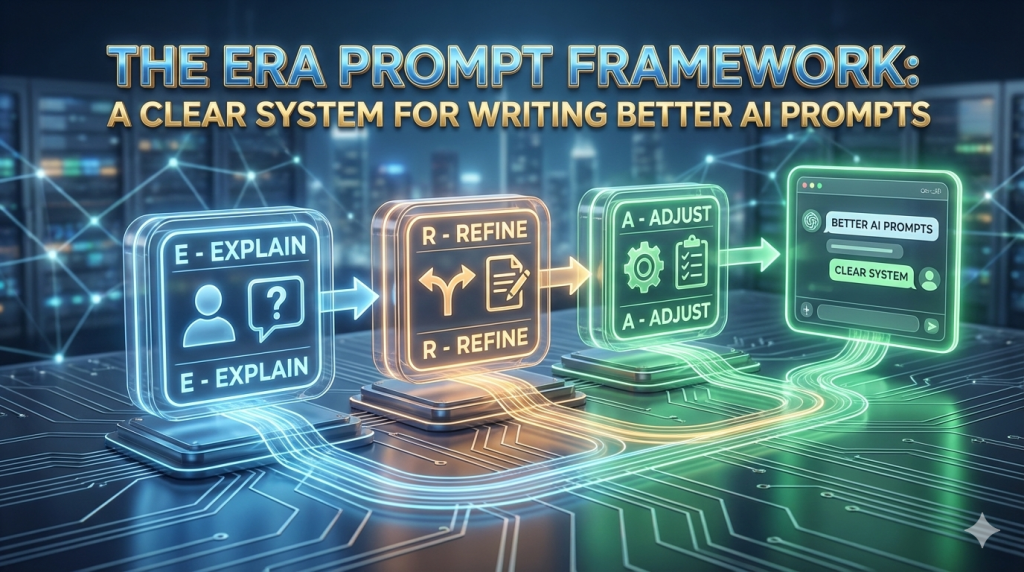
The ERA Prompt Framework is a thinking system for writing prompts with intention. It helps you decide what to say and in what order before you worry about wording.
At its core, ERA is not a prompt template. It does not tell you which words to copy or how long your prompt should be. Instead, it gives you a structure for organizing your instructions so the AI understands your goal, your expectations, and the boundaries of the task.
Most weak prompts fail for one reason. They mix ideas together. They ask for an outcome, provide context, and imply constraints all at once. The model responds, but the output feels unfocused because the input was unfocused.
ERA fixes that by separating concerns.
Each letter represents a distinct role in the prompt. You define the intent first. You then shape the response. You finally anchor the output so it stays on track. When these elements are clear and ordered, the AI has fewer decisions to guess at.
Think of ERA as a mental checklist. Before you hit enter, you know whether your prompt explains what you want, how you want it delivered, and what limits apply. That clarity is what turns prompting from trial and error into a repeatable process.
Why the ERA Prompt Framework Exists
Most prompting advice focuses on surface-level fixes. Add more detail. Be more specific. Try again if it fails. That approach treats symptoms, not the cause.
The real problem is cognitive overload. When you write a prompt, you are often thinking about the task, the format, the tone, and the constraints at the same time. Those ideas bleed together. The AI receives a dense block of instructions with no clear hierarchy.
The ERA Prompt Framework exists to solve that exact issue.
It forces separation before expansion. You clarify intent before adding guidance. You shape the response before adding limits. This sequence matters because large language models respond better when instructions follow a clear internal logic.
Without a framework, prompting becomes reactive. You adjust prompts after seeing bad output. With ERA, prompting becomes deliberate. You decide what matters first, then build outward.
Another reason ERA exists is consistency. Good prompts should be repeatable. If a prompt only works once, it is not reliable. ERA gives you a stable structure you can reuse across tasks, tools, and contexts without starting from scratch every time.
In short, ERA was created to turn prompting into a system, not a guessing game.
How the ERA Prompt Framework Works at a High Level
At a high level, the ERA Prompt Framework works by separating intent, guidance, and limits into distinct layers. Each layer solves a different problem in prompt writing, and the order matters.
Instead of giving the AI everything at once, ERA guides the model through a controlled progression.
Start by Declaring the Intent
The first step is to state the core task clearly. This answers one question only. What do you want the AI to do?
At this stage, you avoid detail. You do not explain how the response should look or what rules apply. You focus only on the outcome. This reduces ambiguity and prevents the model from guessing your goal.
Clear intent gives the AI a stable target before anything else is introduced.
Shape the Response Before Adding Limits
Once intent is clear, the next layer shapes the response. This is where you define format, tone, depth, or point of view.
This step does not change the task. It changes how the task is expressed. By separating response shape from intent, you avoid confusing the model with mixed priorities.
The AI now understands both what to do and how to deliver it.
Anchor the Output to Prevent Drift
The final layer adds anchors. Anchors set boundaries and guardrails. They clarify what to include, what to exclude, and what success looks like.
Anchors are especially important for longer or more complex prompts. They reduce drift, repetition, and unwanted assumptions. Without anchors, even well-shaped prompts can wander.
When anchors come last, they refine the output instead of overpowering the task.

Breaking Down the ERA Components One by One
To use the ERA Prompt Framework well, you need to understand what each letter is responsible for. Each component has a single job. When those jobs stay separate, prompts become clearer and more reliable.
E Is for Explicit Intent
The E stands for explicit intent. This is where you state the task in direct, simple language.
Explicit intent answers one question. What outcome do you want?
Good intent statements are short and unambiguous. They avoid background, justification, or formatting instructions. Their purpose is to give the AI a clear target before anything else is layered on.
When intent is vague, the model fills in gaps on its own. That is where unpredictable results start.
R Is for Response Guidance
The R stands for response guidance. This is where you shape how the answer should be delivered.
Response guidance can include format, tone, depth, audience level, or perspective. It does not redefine the task. It refines the presentation.
This separation matters. When response guidance is mixed into intent, the model struggles to prioritize. When it comes second, the model already knows what it is solving for.
Clear response guidance turns correct answers into usable ones.
A Is for Anchors and Constraints
The A stands for anchors. Anchors define boundaries.
They clarify what to include, what to avoid, and what success looks like. Anchors reduce drift, repetition, and unwanted assumptions, especially in longer prompts.
Anchors work best when they come last. They should constrain the output, not overpower it. When used correctly, they act like guardrails rather than brakes.
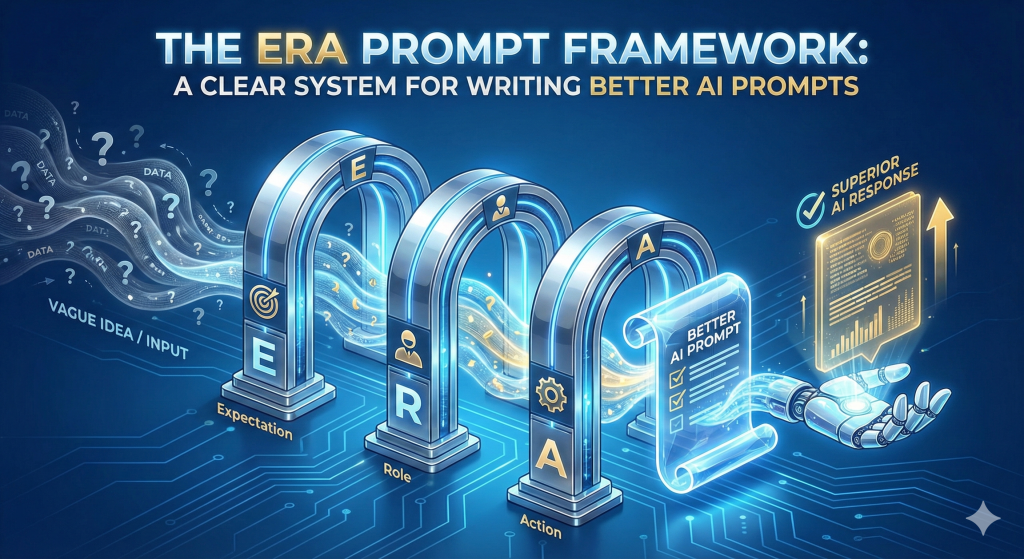
Together, these three components form a simple but powerful structure. Intent sets direction. Response guidance shapes delivery. Anchors keep the output on track.
Common Mistakes to Avoid When Using the ERA Prompt Framework
The ERA Prompt Framework is simple, but it is easy to misuse if you rush through it. Most problems come from collapsing the structure or skipping steps.
Mixing All Three Elements at Once
The most common mistake is writing intent, response guidance, and anchors in a single sentence or paragraph.
When everything appears at once, the framework loses its purpose. The AI receives competing instructions with no clear hierarchy. Even if the prompt is detailed, the output often feels scattered.
ERA only works when each element has its own role and sequence.
Adding Anchors Too Early
Anchors are powerful, but they cause problems when introduced too soon.
If you add constraints before intent is clear, the model focuses on rules instead of outcomes. This often leads to rigid or incomplete responses.
Always define what you want first. Use anchors only after the task and response shape are established.
Overloading the Response Guidance
Response guidance should shape delivery, not overwhelm it.
A common error is listing too many formatting rules, tone instructions, or stylistic preferences. When guidance becomes excessive, the model struggles to prioritize what matters.
Good response guidance is selective. It highlights what is important and leaves the rest alone.
Treating ERA as a Fixed Template
ERA is a framework, not a script.
Some users try to force every prompt into the same length or wording. This removes flexibility and slows down the process. Short prompts still benefit from ERA, but they may only need one or two clear lines.
Use the framework to think clearly, not to overengineer.
Skipping Anchors Altogether
The opposite mistake is avoiding anchors completely.
Without anchors, prompts often drift. The output may start strong and then wander. This is especially common in long-form or multi-step tasks.
Anchors do not restrict creativity. They protect alignment.

When the ERA Prompt Framework Makes Sense (And When It Doesn’t)
The ERA Prompt Framework is powerful, but it is not universal. It works best in situations where clarity, consistency, and control matter more than speed.
When ERA Is a Strong Fit
ERA shines when the task benefits from structure.
It works especially well for analytical work, long-form writing, strategic thinking, and repeatable workflows. If you want similar quality output across multiple prompts, ERA helps you get there.
It is also useful when prompts feel fragile. If small wording changes cause big output swings, ERA adds stability by clarifying intent before refinement.
Teams benefit from ERA as well. A shared framework makes prompts easier to review, reuse, and improve without guesswork.
When ERA May Be Overkill
ERA is not always necessary.
For quick experiments, casual brainstorming, or one-off questions, the framework may feel heavy. If the cost of structuring the prompt is higher than the value of the output, simplicity wins.
Short prompts that ask for general information often do not need full anchoring or response guidance. In those cases, a clear intent alone is enough.
How to Decide Quickly
Ask yourself one question. Do I care about consistency and repeatability here?
If the answer is yes, ERA is a good choice.
If the answer is no, write the prompt and move on.
ERA is a tool for control, not a rule you must follow every time.

Real-World Prompt Examples Using ERA
The best way to see the ERA Prompt Framework in action is to compare how a prompt improves as structure is added. These examples focus on clarity, not clever wording.
Example 1: Content Creation Task
Unstructured prompt: “Write a blog post about remote work productivity tips.”
The output will likely be generic and inconsistent.
Using ERA thinking:
- Explicit intent: Write an informative blog post about improving productivity while working remotely.
- Response guidance: Use a clear, practical tone. Keep it beginner-friendly. Organize the content with short sections.
- Anchors: Focus on actionable tips. Avoid statistics. Limit the length to about 800 words.
The task stays the same. The output becomes more controlled and useful.
Example 2: Analytical Task
Unstructured prompt: “Analyze this data and tell me what it means.”
This leaves too many decisions to the model.
Using ERA thinking:
- Explicit intent: Analyze the provided data to identify key trends and anomalies.
- Response guidance: Present findings in plain language with brief explanations.
- Anchors: Do not speculate beyond the data. Highlight no more than five insights.
The result is clearer, tighter, and easier to act on.
Example 3: Creative but Constrained Task
Unstructured prompt: “Come up with ideas for a landing page headline.”
Results often vary wildly.
Using ERA thinking:
- Explicit intent: Generate headline ideas for a SaaS landing page focused on time savings.
- Response guidance: Use concise, benefit-driven language. Keep headlines under 12 words.
- Anchors: Avoid buzzwords. Provide exactly 10 options.
Creativity stays intact, but the output fits the need.

Conclusion
The ERA Prompt Framework turns prompt writing into a deliberate process instead of trial and error. It works because it respects how large language models interpret instructions. Clear intent comes first. Response guidance shapes delivery. Anchors protect alignment.
You do not need longer prompts to get better results. You need clearer thinking before you write. ERA provides that structure without forcing rigid templates or complex rules.
When used well, the framework improves consistency, reduces frustration, and makes successful prompts easier to repeat. It is not about controlling the model. It is about controlling your inputs so the model has less to guess.
If prompting has ever felt unpredictable, ERA gives you a way to regain control.

Frequently Asked Questions
Is the ERA Prompt Framework a prompt template?
No. ERA is a thinking framework, not a copy-and-paste template. It helps you decide what to include and in what order, but the wording is always flexible.
Do I need to use all three parts every time?
Not always. Simple tasks may only need clear intent. More complex or repeatable tasks benefit most from using all three elements.
Can ERA be used with any AI tool?
Yes. ERA is tool-agnostic. It works with any large language model because it focuses on instruction clarity, not platform-specific features.
Does ERA limit creativity?
No. ERA limits confusion, not creativity. By clarifying boundaries, it often gives creative tasks more room to succeed.
Is ERA only useful for long prompts?
No. Even short prompts improve when intent is explicit. ERA scales up or down depending on the task.
Leave a Reply